







Question: Reading: Read the following article first and answer the next questions: The questions: Note: Metacognition (Reading Strategies)are: predicting Visualizing Noticing a problem or issue Questioning
Reading:
Read the following article first and answer the next questions:

The questions:

Note: Metacognition (Reading Strategies)are:
predicting
Visualizing
Noticing a problem or issue
Questioning
Making Connections
Using fix-ups
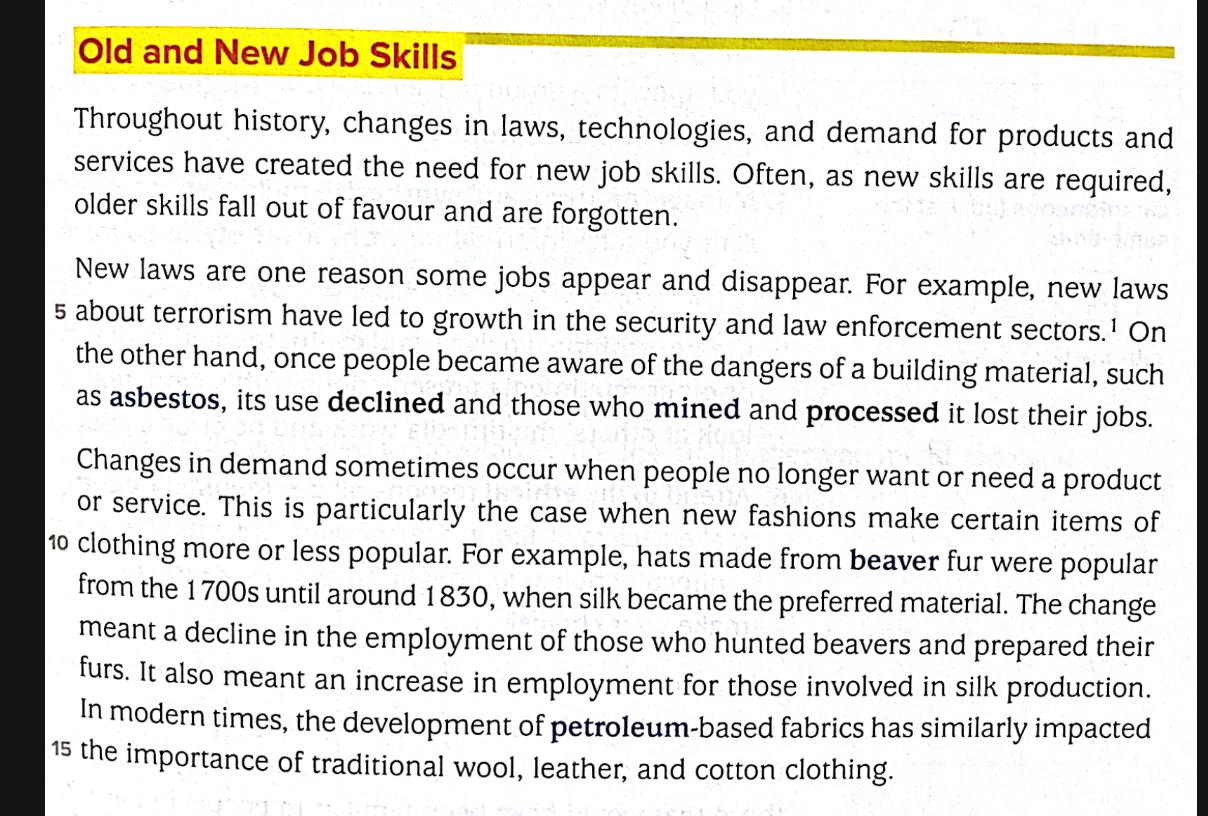
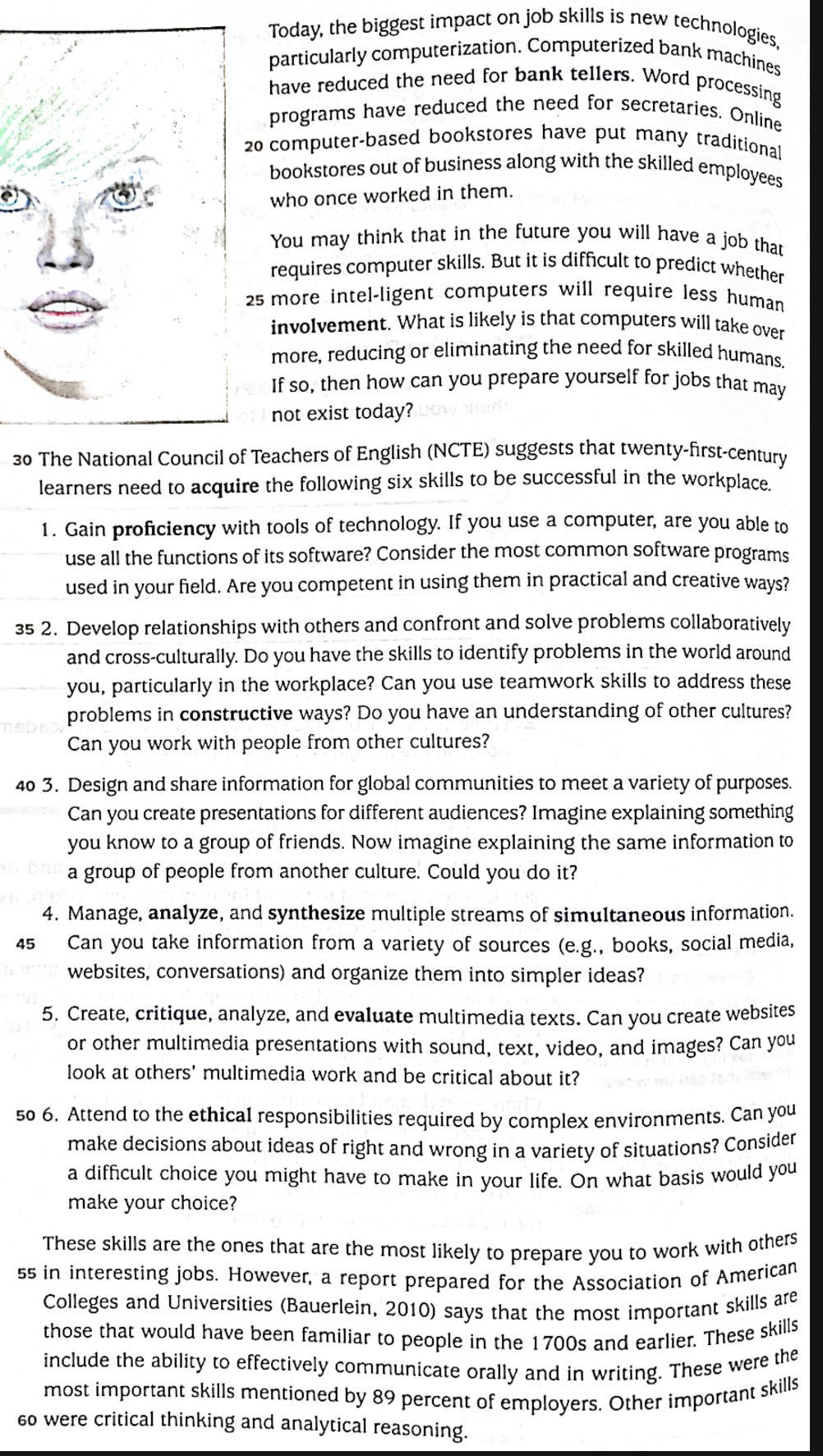
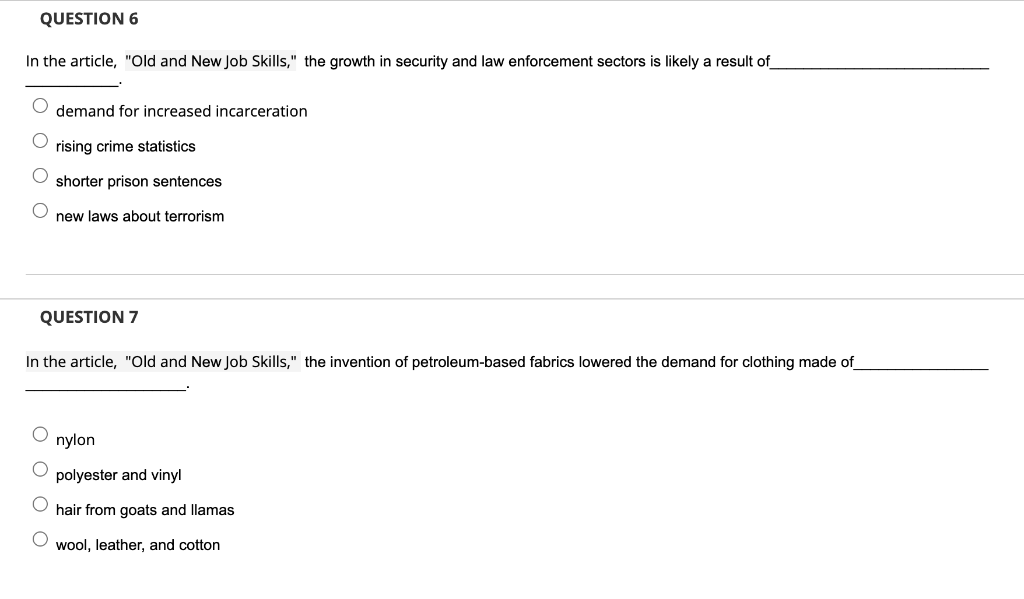
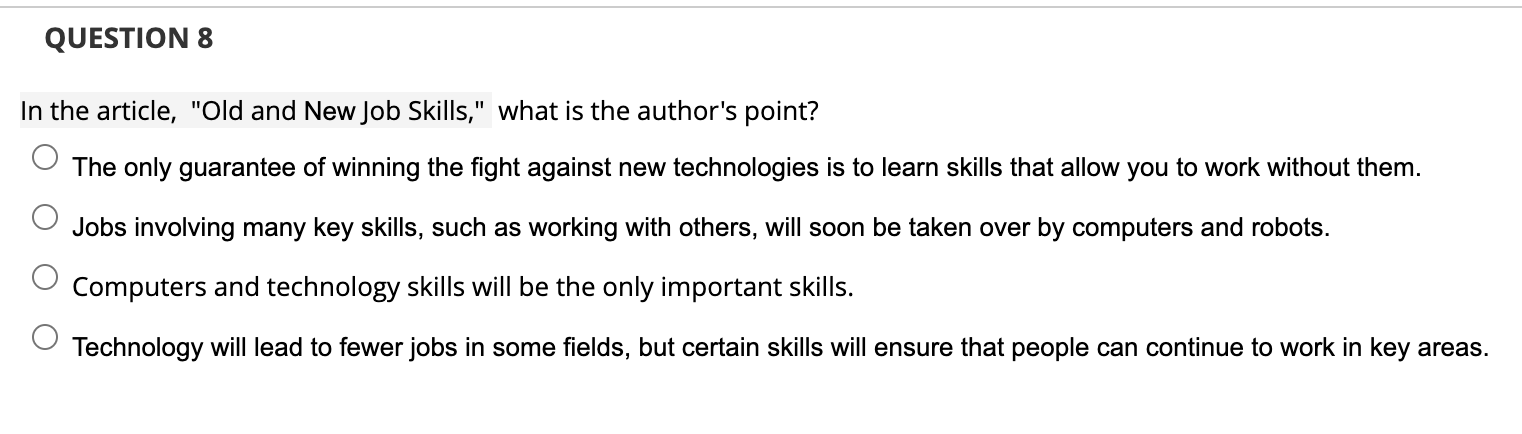
Old and New Job Skills Throughout history, changes in laws, technologies, and demand for products and services have created the need for new job skills. Often, as new skills are required, older skills fall out of favour and are forgotten. New laws are one reason some jobs appear and disappear. For example, new laws 5 about terrorism have led to growth in the security and law enforcement sectors.' On the other hand, once people became aware of the dangers of a building material, such as asbestos, its use declined and those who mined and processed it lost their jobs. Changes in demand sometimes occur when people no longer want or need a product or service. This is particularly the case when new fashions make certain items of 10 clothing more or less popular. For example, hats made from beaver fur were popular from the 1700s until around 1830, when silk became the preferred material. The change meant a decline in the employment of those who hunted beavers and prepared their furs. It also meant an increase in employment for those involved in silk production. In modern times, the development of petroleum-based fabrics has similarly impacted 15 the importance of traditional wool, leather, and cotton clothing. technologies, Today, the biggest impact on job skills is new particularly computerization. Computerized bank machines have reduced the need for bank tellers. Word processing programs have reduced the need for secretaries. Online 20 computer-based bookstores have put many traditional bookstores out of business along with the skilled employees who once worked in them. You may think that in the future you will have a job that requires computer skills. But it is difficult to predict whether 25 more intelligent computers will require less human involvement. What is likely is that computers will take over more, reducing or eliminating the need for skilled humans. If so, then how can you prepare yourself for jobs that may not exist today? 30 The National Council of Teachers of English (NCTE) suggests that twenty-first-century learners need to acquire the following six skills to be successful in the workplace. 1. Gain proficiency with tools of technology. If you use a computer, are you able to use all the functions of its software? Consider the most common software programs used in your field. Are you competent in using them in practical and creative ways? 35 2. Develop relationships with others and confront and solve problems collaboratively and cross-culturally. Do you have the skills to identify problems in the world around you, particularly in the workplace? Can you use teamwork skills to address these problems in constructive ways? Do you have an understanding of other cultures? Can you work with people from other cultures? 40 3. Design and share information for global communities to meet a variety of purposes. Can you create presentations for different audiences? Imagine explaining something you know to a group of friends. Now imagine explaining the same information to a group of people from another culture. Could you do it? 4. Manage, analyze, and synthesize multiple streams of simultaneous information. Can you take information from a variety of sources (e.g., books, social media, websites, conversations) and organize them into simpler ideas? 5. Create, critique, analyze, and evaluate multimedia texts. Can you create websites or other multimedia presentations with sound, text, video, and images? Can you look at others' multimedia work and be critical about it? 50 6. Attend to the ethical responsibilities required by complex environments. Can you make decisions about ideas of right and wrong in a variety of situations? Consider a difficult choice you might have to make in your life. On what basis would you make your choice? These skills are the ones that are the most likely to prepare you to work with others 55 in interesting jobs. However, a report prepared for the Association of American Colleges and Universities (Bauerlein, 2010) says that the most important skills are those that would have been familiar to people in the 1700s and earlier. These skills include the ability to effectively communicate orally and in writing. These were the most important skills mentioned by 89 percent of employers. Other important skills 60 were critical thinking and analytical reasoning. 45 Computers and other technologies will continue to be important in the future, but the abilities to think critically and to communicate effectively might be the most important skills that future employees can learn. (718 words) QUESTION 5 2 2 pc List and explain one before reading strategy that you used when reading "Old and New Job Skills." Support your answer with information from the article. List and explain one during reading strategy that you used when reading "Old and New Job Skills." Support your answer with information from the article. QUESTION 6 In the article, "Old and New Job Skills," the growth in security and law enforcement sectors is likely a result of demand for increased incarceration rising crime statistics shorter prison sentences new laws about terrorism QUESTION 7 In the article, "Old and New Job Skills," the invention of petroleum-based fabrics lowered the demand for clothing made of nylon polyester and vinyl hair from goats and llamas O wool, leather, and cotton QUESTION 8 In the article, "Old and New Job Skills," what is the author's point? The only guarantee of winning the fight against new technologies is to learn skills that allow you to work without them. Jobs involving many key skills, such as working with others, will soon be taken over by computers and robots. Computers and technology skills will be the only important skills. Technology will lead to fewer jobs in some fields, but certain skills will ensure that people can continue to work in key areas
Step by Step Solution
There are 3 Steps involved in it
1 Expert Approved Answer
Step: 1 Unlock

Question Has Been Solved by an Expert!
Get step-by-step solutions from verified subject matter experts
Step: 2 Unlock
Step: 3 Unlock
 Study Help