







Question: Readings: AMPL: A Modeling Language for Mathematical Programming, chap- ters 3-4. 1 Consider how you would formulate a linear programming model for a distribution
![declaring the operating data indexed over these sets: param supply (FACT] >=](https://s3.amazonaws.com/si.experts.images/answers/2024/05/6659bdc34abeb_3146659bdc2da74f.jpg)
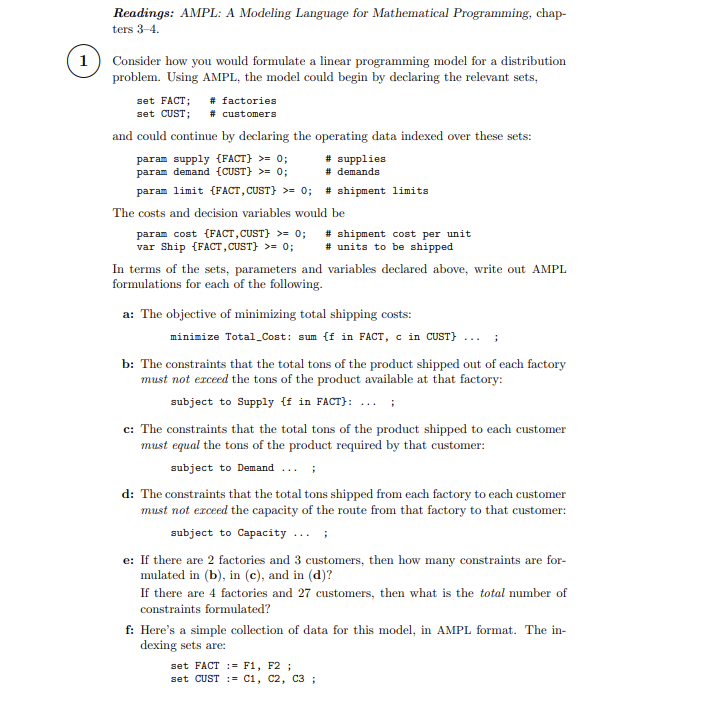
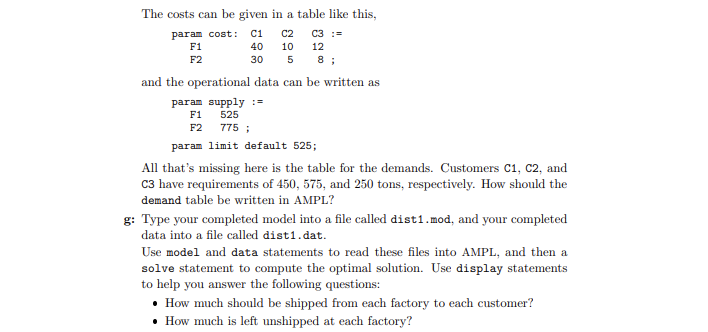
Readings: AMPL: A Modeling Language for Mathematical Programming, chap- ters 3-4. 1 Consider how you would formulate a linear programming model for a distribution problem. Using AMPL, the model could begin by declaring the relevant sets, set FACT; # factories set CUST; # customers and could continue by declaring the operating data indexed over these sets: param supply (FACT] >= 0; param demand {CUST} >= 0; # supplies # demands param limit {FACT, CUST} >= 0; # shipment limits The costs and decision variables would be param cost {FACT, CUST} >= 0; var Ship (FACT, CUST} >= 0; # shipment cost per unit # units to be shipped In terms of the sets, parameters and variables declared above, write out AMPL formulations for each of the following. a: The objective of minimizing total shipping costs: minimize Total Cost: sum (f in FACT, c in CUST} b: The constraints that the total tons of the product shipped out of each factory must not exceed the tons of the product available at that factory: subject to Supply (f in FACT): ...; c: The constraints that the total tons of the product shipped to each customer must equal the tons of the product required by that customer: subject to Demand...; d: The constraints that the total tons shipped from each factory to each customer must not exceed the capacity of the route from that factory to that customer: subject to Capacity ...; e: If there are 2 factories and 3 customers, then how many constraints are for- mulated in (b), in (c), and in (d)? If there are 4 factories and 27 customers, then what is the total number of constraints formulated? f: Here's a simple collection of data for this model, in AMPL format. The in- dexing sets are: F1, F2 ; set FACT set CUST: C1, C2, C3;
Step by Step Solution
There are 3 Steps involved in it

Get step-by-step solutions from verified subject matter experts
 Study Help