







Question: Recent advances in microelectromechanical systems ( MEMS ) have allowed for the manufacture of extremely small sensors that can be placed within the human body.
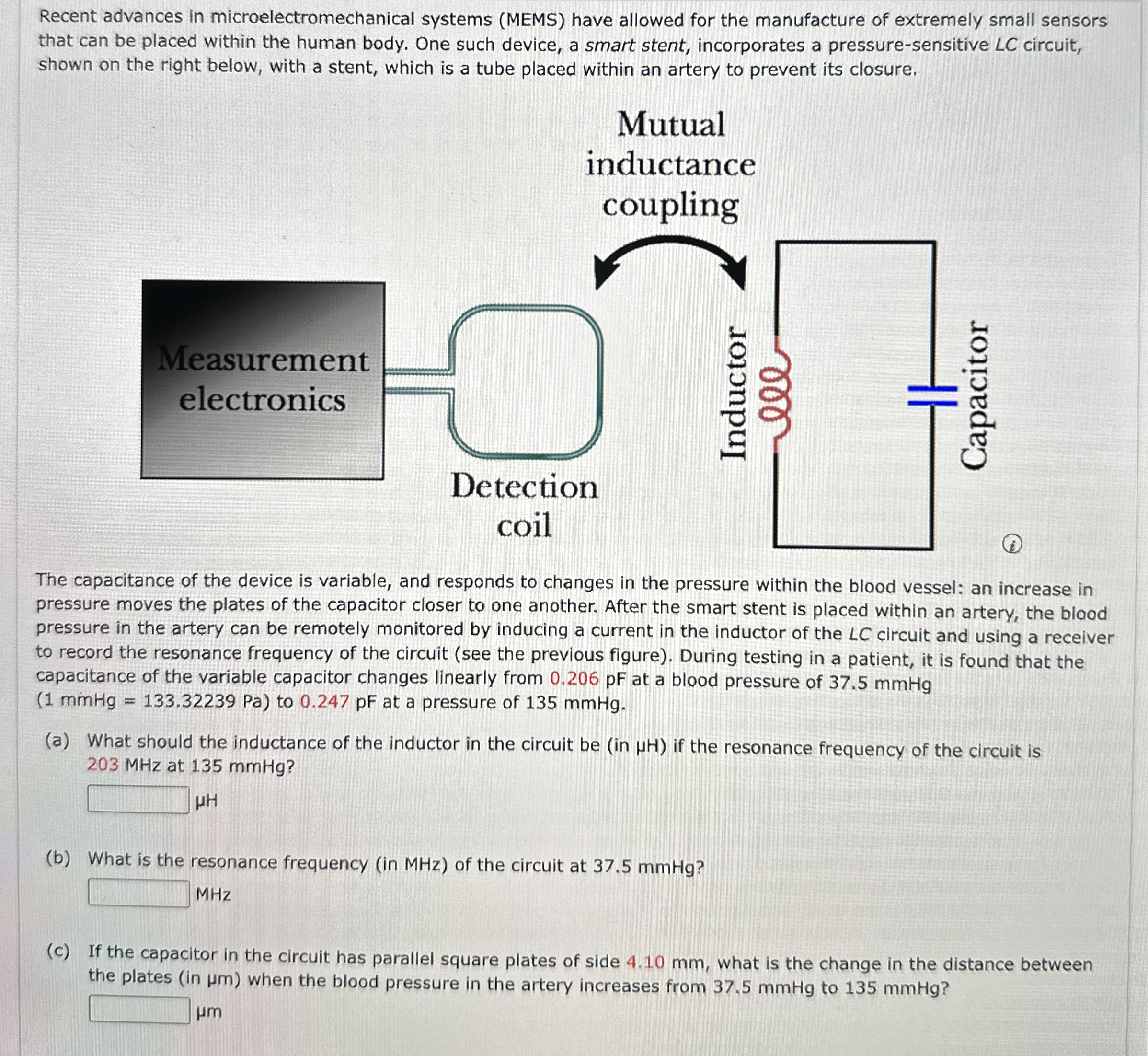
Recent advances in microelectromechanical systems MEMS have allowed for the manufacture of extremely small sensors that can be placed within the human body. One such device, a smart stent, incorporates a pressuresensitive circuit, shown on the right below, with a stent, which is a tube placed within an artery to prevent its closure.
Mutual inductance coupling
The capacitance of the device is variable, and responds to changes in the pressure within the blood vessel: an increase in pressure moves the plates of the capacitor closer to one another. After the smart stent is placed within an artery, the blood pressure in the artery can be remotely monitored by inducing a current in the inductor of the circuit and using a receiver to record the resonance frequency of the circuit see the previous figure During testing in a patient, it is found that the capacitance of the variable capacitor changes linearly from pF at a blood pressure of mmHg
to pF at a pressure of mmHg
a What should the inductance of the inductor in the circuit be in if the resonance frequency of the circuit is MHz at mmHg
b What is the resonance frequency in MHz of the circuit at mmHg
MHz
c If the capacitor in the circuit has parallel square plates of side mm what is the change in the distance between the plates when the blood pressure in the artery increases from mmHg to mmHg
Step by Step Solution
There are 3 Steps involved in it
1 Expert Approved Answer
Step: 1 Unlock

Question Has Been Solved by an Expert!
Get step-by-step solutions from verified subject matter experts
Step: 2 Unlock
Step: 3 Unlock
 Study Help