







Question: Reconsider the textbook pricing issue in Application 9.1. Show why the publisher wants a higher price using MR and MC. ATextbook-Pricing Example Setting the right
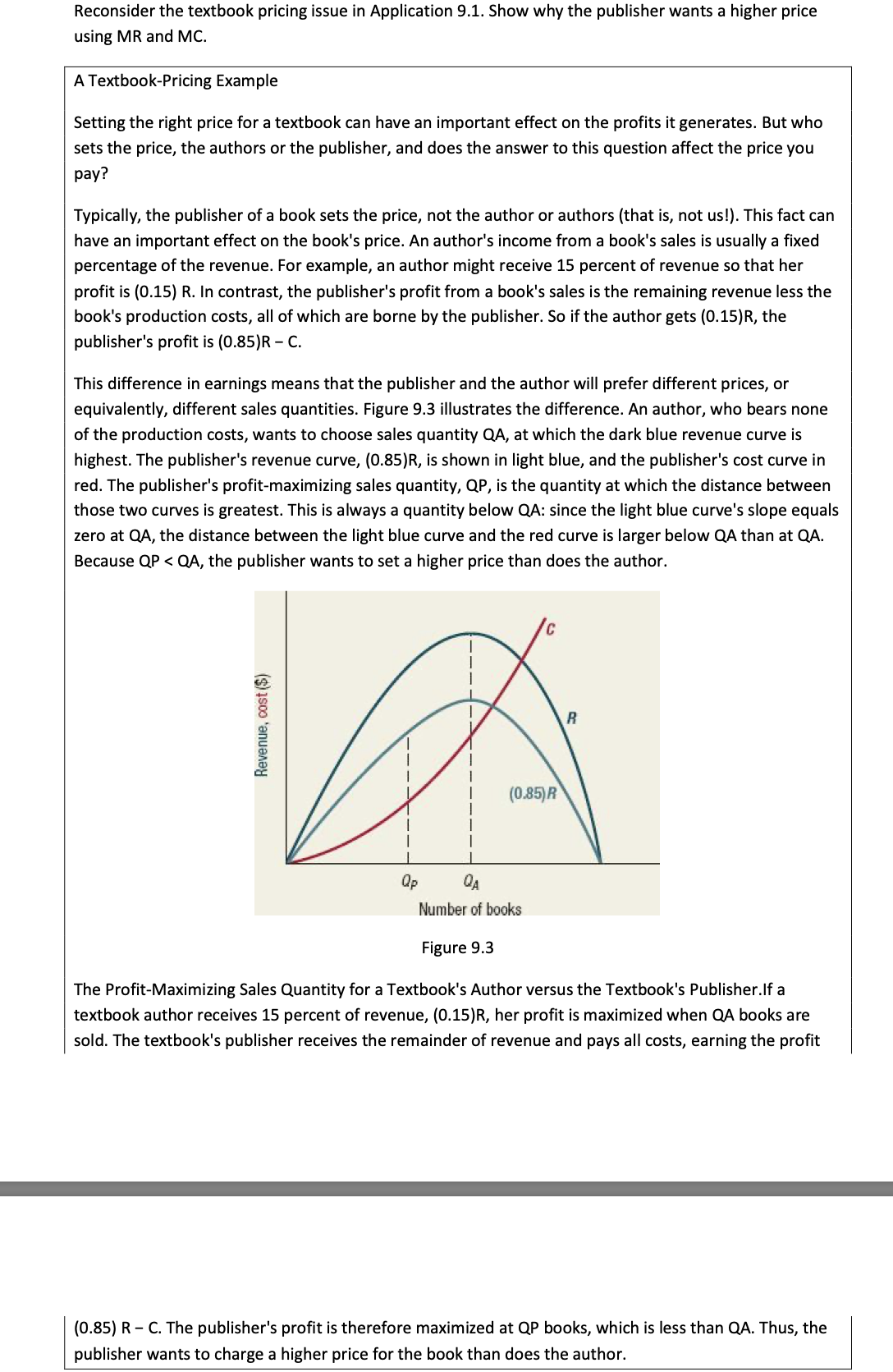
Reconsider the textbook pricing issue in Application 9.1. Show why the publisher wants a higher price using MR and MC. ATextbook-Pricing Example Setting the right price for a textbook can have an important effect on the profits it generates. But who sets the price, the authors or the publisher, and does the answer to this question affect the price you pay? Typically, the publisher of a book sets the price, not the author or authors (that is, not usl]. This fact can have an important effect on the book's price. An author's income from a book's sales is usually a fixed percentage of the revenue. For example, an author might receive 15 percent of revenue so that her profit is (0.15) R. In contrast, the publisher's profit from a book's sales is the remaining revenue less the book's production costs, all of which are borne by the publisher. So if the author gets (0.15)R, the publisher's profit is (0.85)R C. This difference in earnings means that the publisher and the author will prefer different prices, or equivalently, different sales quantities. Figure 9.3 illustrates the difference. An author, who bears none of the production costs, wants to choose sales quantity 0A, at which the dark blue revenue curve is highest. The publisher's revenue curve, (0.85)R, is shown in light blue, and the publisher's cost curve in red. The publisher's profit-maximizing sales quantity, OP, is the quantity at which the distance between those two curves is greatest. This is always a quantity below QA: since the light blue curve's slope equals zero at QA, the distance between the light blue curve and the red curve is larger below QAthan at QA. Because QP
Step by Step Solution
There are 3 Steps involved in it

Get step-by-step solutions from verified subject matter experts
 Study Help