







Question: Amylase is used by humans to facilitate digestion. Specifically, it is an enzyme that breaks down starch molecules into sugar molecules. This is why
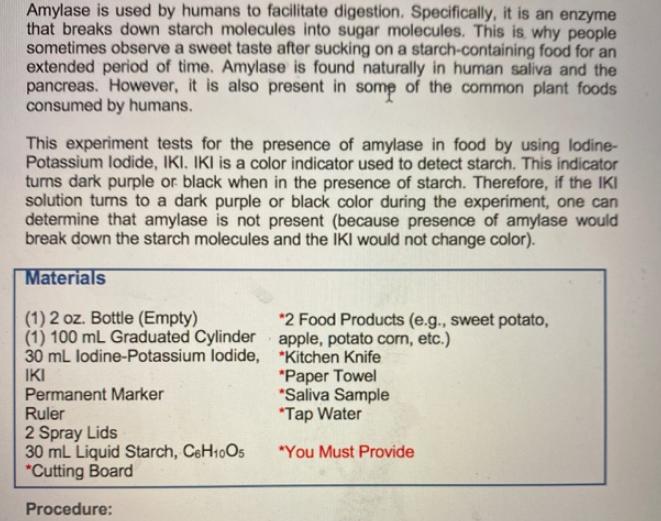
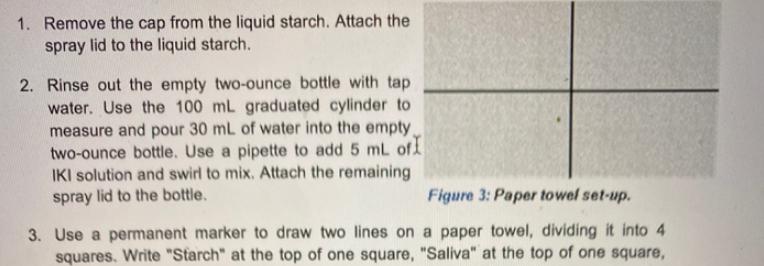

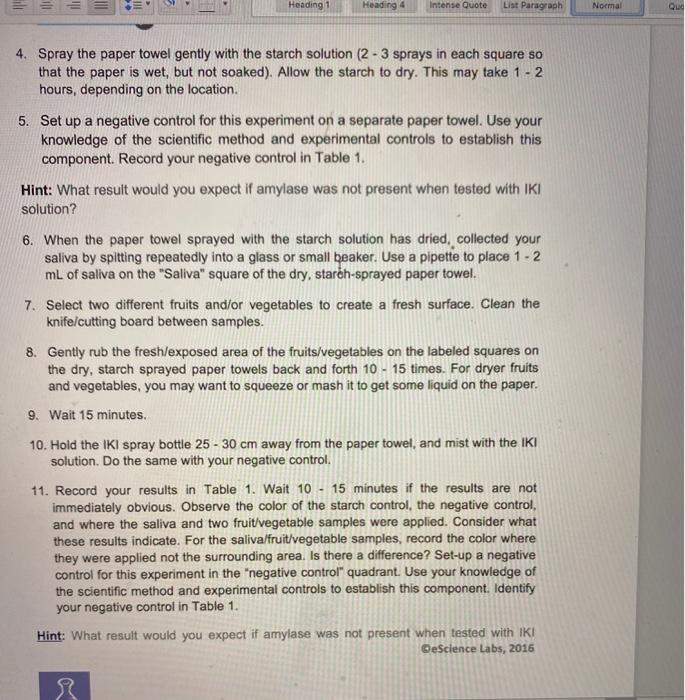
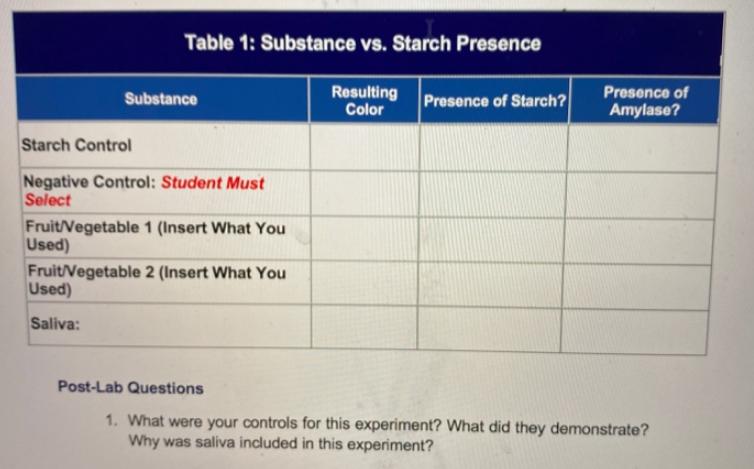
Amylase is used by humans to facilitate digestion. Specifically, it is an enzyme that breaks down starch molecules into sugar molecules. This is why people sometimes observe a sweet taste after sucking on a starch-containing food for an extended period of time. Amylase is found naturally in human saliva and the pancreas. However, it is also present in some of the common plant foods consumed by humans. This experiment tests for the presence of amylase in food by using lodine- Potassium lodide, IKI. IKI is a color indicator used to detect starch. This indicator turns dark purple or black when in the presence of starch. Therefore, if the IKI solution tuns to a dark purple or black color during the experiment, one can determine that amylase is not present (because presence of amylase would break down the starch molecules and the IKI would not change color). Materials (1) 2 oz. Bottle (Empty) (1) 100 mL Graduated Cylinder apple, potato corn, etc.) 30 mL lodine-Potassium lodide, "Kitchen Knife IKI Permanent Marker Ruler *2 Food Products (e.g., sweet potato, *Paper Towel *Saliva Sample *Tap Water 2 Spray Lids 30 mL Liquid Starch, CeH10Os *Cutting Board "You Must Provide Procedure: 1. Remove the cap from the liquid starch. Attach the spray lid to the liquid starch. 2. Rinse out the empty two-ounce bottle with tap water. Use the 100 mL graduated cylinder to measure and pour 30 mL of water into the empty two-ounce bottle. Use a pipette to add 5 mL of IKI solution and swirl to mix. Attach the remaining spray lid to the bottle. Figure 3: Paper towel set-up. 3. Use a permanent marker to draw two lines on a paper towel, dividing it into 4 squares. Write "Starch" at the top of one square, "Saliva" at the top of one square, and the name of the two food items you are testing at the top of the remaining two squares. Place the paper towel on top of the bench coat. Spray the sectioned paper towel and another blank paper towel with the starch solution. Allow the starch to dry for approximately one hour (this time interval may vary by location). Heading 1 Heading 4 Intense Quote List Paragraph Normal Que 4. Spray the paper towel gently with the starch solution (2 - 3 sprays in each square so that the paper is wet, but not soaked). Allow the starch to dry. This may take 1 - 2 hours, depending on the location. 5. Set up a negative control for this experiment on a separate paper towel. Use your knowledge of the scientific method and experimental controls to establish this component. Record your negative control in Table 1. Hint: What result would you expect if amylase was not present when tested with IKI solution? 6. When the paper towel sprayed with the starch solution has dried, collected your saliva by spitting repeatedly into a glass or small beaker. Use a pipette to place 1 - 2 mL of saliva on the "Saliva" square of the dry, staroh-sprayed paper towel. 7. Select two different fruits and/or vegetables to create a fresh surface. Clean the knife/cutting board between samples. 8. Gently rub the fresh/exposed area of the fruits/vegetables on the labeled squares on the dry, starch sprayed paper towels back and forth 10 - 15 times. For dryer fruits and vegetables, you may want to squeeze or mash it to get some liquid on the paper. 9. Wait 15 minutes. 10. Hold the IKI spray bottle 25 - 30 cm away from the paper towel, and mist with the IKI solution. Do the same with your negative control. 11. Record your results in Table 1. Wait 10 - 15 minutes if the results are not immediately obvious. Observe the color of the starch control, the negative control, and where the saliva and two fruit/vegetable samples were applied. Consider what these results indicate. For the saliva/fruit/vegetable samples, record the color where they were applied not the surrounding area. Is there a difference? Set-up a negative control for this experiment in the "negative control" quadrant. Use your knowledge of the scientific method and experimental controls to establish this component. Identify your negative control in Table 1. Hint: What result would you expect if amylase was not present when tested with IKI Oescience Labs, 2016 Table 1: Substance vs. Starch Presence Resulting Color Presence of Substance Presence of Starch? Amylase? Starch Control Negative Control: Student Must Select Fruit/Vegetable 1 (Insert What You Used) Fruit/Vegetable 2 (Insert What You Used) Saliva: Post-Lab Questions 1. What were your controls for this experiment? What did they demonstrate? Why was saliva included in this experiment?
Step by Step Solution
3.52 Rating (142 Votes )
There are 3 Steps involved in it
Required solution able 1 Substance vs Starch Presence Table 1 Substance vs Starch Presence Substance Resulting Color Presence of Starch Positive Contr... View full answer

Get step-by-step solutions from verified subject matter experts
Document Format (2 attachments)

635e2f6f7a67c_182181.pdf
180 KBs PDF File

635e2f6f7a67c_182181.docx
120 KBs Word File
 Study Help