







Question: Recursive Maze Algorithm Implementation The maze given in the source code has 64 total playable cells with 43 open cells. Let's call this an Openness
 Recursive Maze Algorithm Implementation
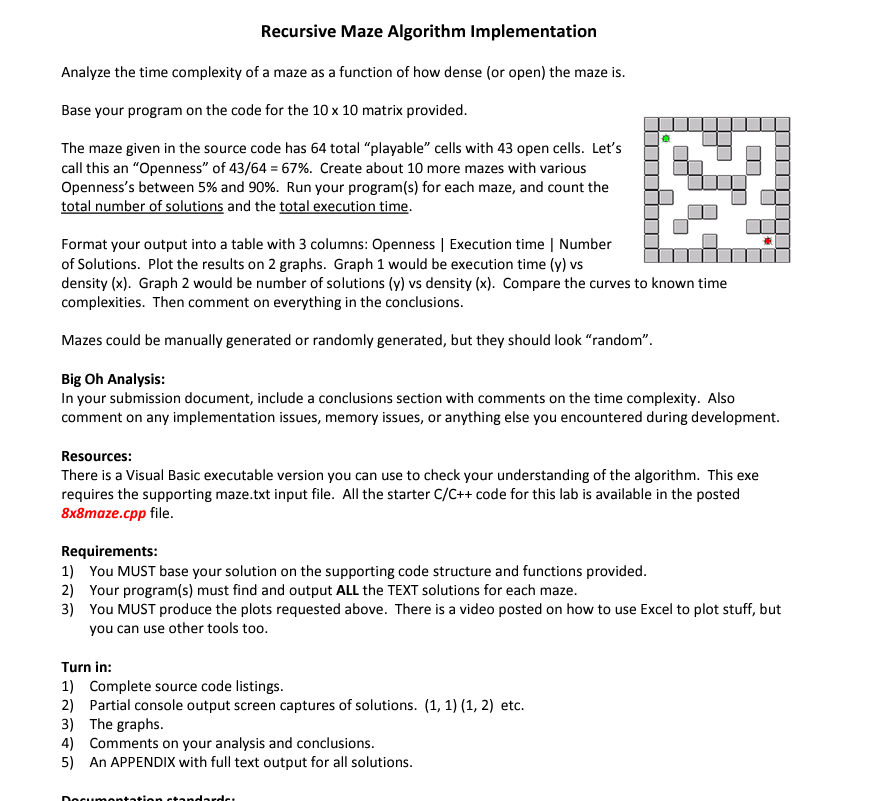
The maze given in the source code has 64 total "playable" cells with 43 open cells. Let's call this an "Openness" of 43/64=67%. Create about 10 more mazes with various Openness's between 5% and 90%. Run your program(s) for each maze, and count the total number of solutions and the total execution time. Format your output into a table with 3 columns: Openness | Execution time | Number of Solutions. Plot the results on 2 graphs. Graph 1 would be execution time (y) vs density (x). Graph 2 would be number of solutions ( y ) vs density (x). Compare the curves to known time complexities. Then comment on everything in the conclusions. Mazes could be manually generated or randomly generated, but they should look "random". Big Oh Analysis: In your submission document, include a conclusions section with comments on the time complexity. Also comment on any implementation issues, memory issues, or anything else you encountered during development. Resources: There is a Visual Basic executable version you can use to check your understanding of the algorithm. This exe requires the supporting maze.txt input file. All the starter C/C++ code for this lab is available in the posted 88 maze.cpp file. Requirements: 1) You MUST base your solution on the supporting code structure and functions provided. 2) Your program(s) must find and output ALL the TEXT solutions for each maze. 3) You MUST produce the plots requested above. There is a video posted on how to use Excel to plot stuff, but you can use other tools too. Turn in: 1) Complete source code listings. 2) Partial console output screen captures of solutions. (1,1)(1,2) etc. 3) The graphs. 4) Comments on your analysis and conclusions. 5) An APPENDIX with full text output for all solutions
Step by Step Solution
There are 3 Steps involved in it

Get step-by-step solutions from verified subject matter experts
 Study Help