







Question: Redo this LP model after ADDING AT LEAST 3 DECISION VARIABLES, and changing all the numbers and values (for objective function, constraints, optimal solution numbers,
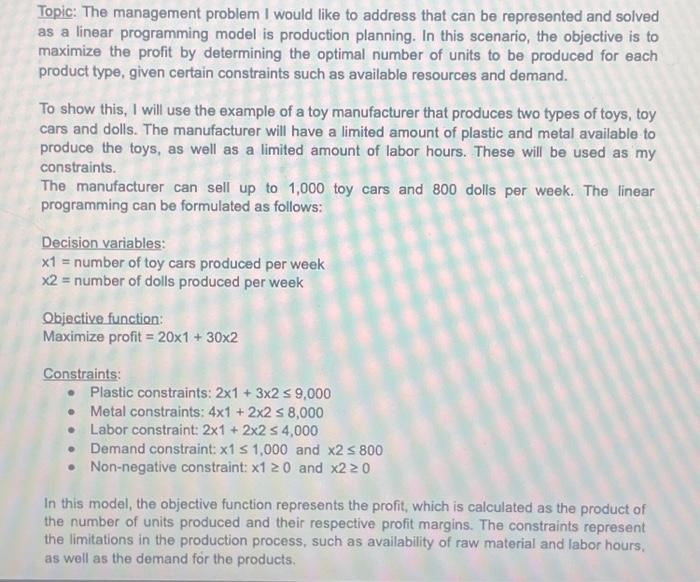

Topic: The management problem I would like to address that can be represented and solved as a linear programming model is production planning. In this scenario, the objective is to maximize the profit by determining the optimal number of units to be produced for each product type, given certain constraints such as available resources and demand. To show this, I will use the example of a toy manufacturer that produces two types of toys, toy cars and dolls. The manufacturer will have a limited amount of plastic and metal available to produce the toys, as well as a limited amount of labor hours. These will be used as my constraints. The manufacturer can sell up to 1,000 toy cars and 800 dolls per week. The linear programming can be formulated as follows: Decision variables: x1= number of toy cars produced per week x2 = number of dolls produced per week Objective function: Maximize profit =201+302 Constraints: - Plastic constraints: 21+329,000 - Metal constraints: 41+228,000 - Labor constraint: 21+224,000 - Demand constraint: x11,000 and x2800 - Non-negative constraint: x10 and x20 In this model, the objective function represents the profit, which is calculated as the product of the number of units produced and their respective profit margins. The constraints represent the limitations in the production process, such as availability of raw material and labor hours, as well as the demand for the products. By solving this linear programming model, we can find the optimal solution, which represents the optimal number of toy cars and dolls to be produced in order to maximize the profit. The optimal solution in this case is x1=600 and 2=800, which means that the manufacturer should produce 600 toy cars and 800 dolls per week to maximize the profit. The maximum profit that can be achieved is $36,000 per week
Step by Step Solution
There are 3 Steps involved in it

Get step-by-step solutions from verified subject matter experts
 Study Help