







Question: REDUCE FRACTIONS: Client Program: #include #include Fraction.h #include #include #include using namespace std; using namespace cs_Fraction; void BasicTest(); void RelationTest(); void BinaryMathTest(); void MathAssignTest(); bool
REDUCE FRACTIONS:
Client Program:
#include #include "Fraction.h" #include #include #include using namespace std; using namespace cs_Fraction; void BasicTest(); void RelationTest(); void BinaryMathTest(); void MathAssignTest(); bool eof(ifstream& in); string boolString(bool convertMe); int main() { BasicTest(); RelationTest(); BinaryMathTest(); MathAssignTest(); } void BasicTest() { cout > f; cout > ch; in.putback(ch); return !in; } string boolString(bool convertMe) { if (convertMe) { return "true"; } else { return "false"; } } void RelationTest() { cout right? " fr[i+1]) = right? " = fr[i+1]) right? " num) = right? " = num) right? " g) = right? " = g) Frac data:
# This file shows the patterns your Fraction class needs to be able to # read. A Fraction may be just a single integer, two integers separated by # a slash, or a mixed number which consists of an integer, followed by a + # and then two integers with a slash. A minus sign may appear in the # very first character to indicate the whole Fraction is negative. # No white space is allowed in between the component parts of a Fraction. # 1/3 3/6 3072/4096 -4/5 12/2 5 -8 21/15 -50/3 1+1/4 1+5/5 -4+3/12 -10+10/12
Output:
----- Testing basic Fraction creation & printing (Fractions should be in reduced form, and as mixed numbers.) Fraction [0] = 1/2 Fraction [1] = -5/7 Fraction [2] = 10 Fraction [3] = -4 Fraction [4] = 0 Fraction [5] = 4+2/3 Fraction [6] = 0 ----- Now reading Fractions from file Read Fraction = 1/3 Read Fraction = 1/2 Read Fraction = 3/4 Read Fraction = -4/5 Read Fraction = 6 Read Fraction = 5 Read Fraction = -8 Read Fraction = 1+2/5 Read Fraction = -16+2/3 Read Fraction = 1+1/4 Read Fraction = 2 Read Fraction = -4+1/4 Read Fraction = -10+5/6 ----- Testing relational operators between Fractions Comparing 1/2 to 1/2 Is left right? false Is left >= right? true Does left == right? true Does left != right ? false Comparing 1/2 to -1/2 Is left right? true Is left >= right? true Does left == right? false Does left != right ? true Comparing -1/2 to 1/10 Is left right? false Is left >= right? false Does left == right? false Does left != right ? true Comparing 1/10 to 0 Is left right? true Is left >= right? true Does left == right? false Does left != right ? true Comparing 0 to 0 Is left right? false Is left >= right? true Does left == right? true Does left != right ? false ----- Testing relations between Fractions and integers Comparing -1/2 to 2 Is left right? false Is left >= right? false Does left == right? false Does left != right ? true Comparing -3 to 1/4 Is left right? false Is left >= right? false Does left == right? false Does left != right ? true ----- Testing binary arithmetic between Fractions 1/6 + 1/3 = 1/2 1/6 - 1/3 = -1/6 1/6 * 1/3 = 1/18 1/6 / 1/3 = 1/2 1/3 + -2/3 = -1/3 1/3 - -2/3 = 1 1/3 * -2/3 = -2/9 1/3 / -2/3 = -1/2 -2/3 + 5 = 4+1/3 -2/3 - 5 = -5+2/3 -2/3 * 5 = -3+1/3 -2/3 / 5 = -2/15 5 + -1+1/3 = 3+2/3 5 - -1+1/3 = 6+1/3 5 * -1+1/3 = -6+2/3 5 / -1+1/3 = -3+3/4 ----- Testing arithmetic between Fractions and integers -1/2 + 4 = 3+1/2 -1/2 - 4 = -4+1/2 -1/2 * 4 = -2 -1/2 / 4 = -1/8 3 + -1/2 = 2+1/2 3 - -1/2 = 3+1/2 3 * -1/2 = -1+1/2 3 / -1/2 = -6 ----- Testing shorthand arithmetic assignment on Fractions 1/6 += 4 = 4+1/6 4+1/6 -= 4 = 1/6 1/6 *= 4 = 2/3 2/3 /= 4 = 1/6 4 += -1/2 = 3+1/2 3+1/2 -= -1/2 = 4 4 *= -1/2 = -2 -2 /= -1/2 = 4 -1/2 += 5 = 4+1/2 4+1/2 -= 5 = -1/2 -1/2 *= 5 = -2+1/2 -2+1/2 /= 5 = -1/2 ----- Testing shorthand arithmetic assignment using integers -1/3 += 3 = 2+2/3 2+2/3 -= 3 = -1/3 -1/3 *= 3 = -1 -1 /= 3 = -1/3 ----- Testing increment/decrement prefix and postfix Now g = -1/3 g++ = -1/3 Now g = 2/3 ++g = 1+2/3 Now g = 1+2/3 g-- = 1+2/3 Now g = 2/3 --g = -1/3 Now g = -1/3
THANKS IN ADVANCE!
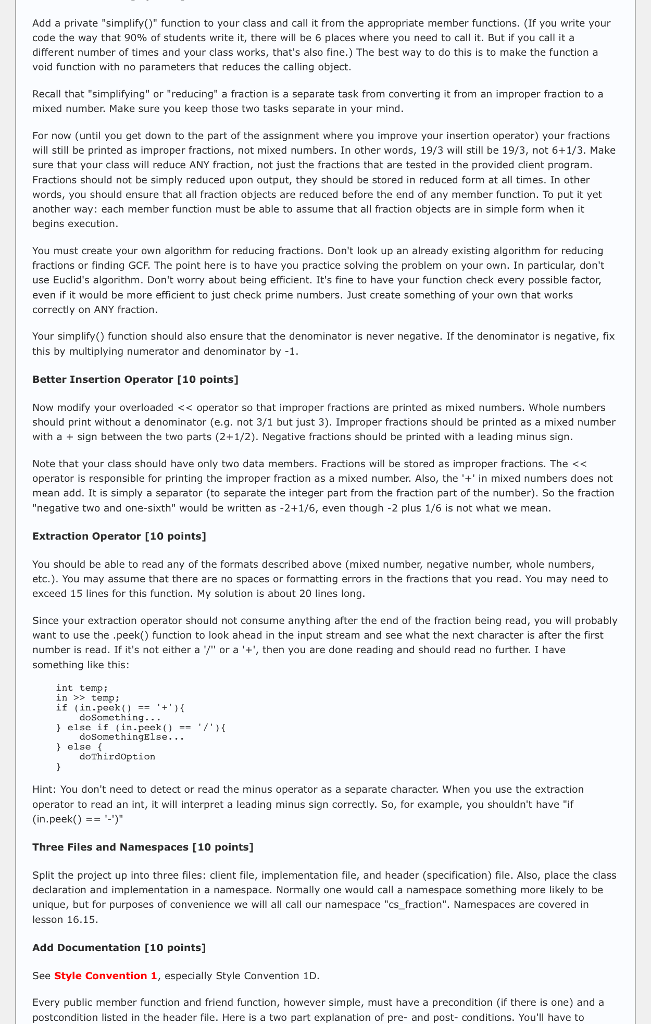
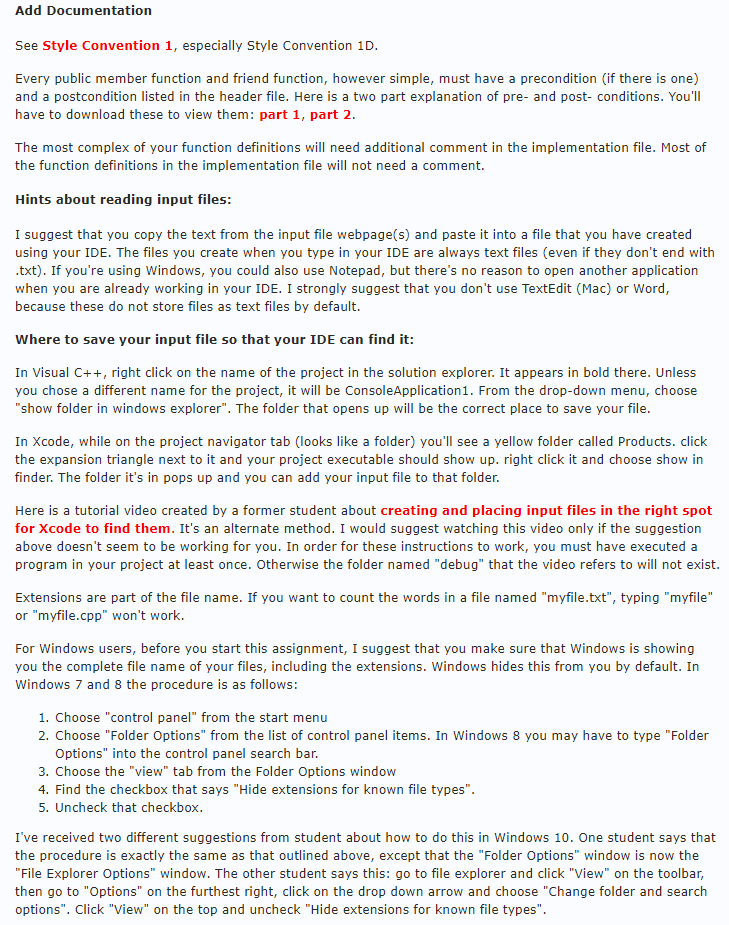
Add a private "simplify)" function to your class and call it from the appropriate member functions. (If you write your code the way that 90% of students write it, there will be 6 places where you need to call it. But if you call it a different number of times and your class works, that's also fine.) The best way to do this is to make the function a void function with no parameters that reduces the calling object Recall that "simplifying" or "reducing" a fraction is a separate task from converting it from an improper fraction to a mixed number. Make sure you keep those two tasks separate in your mind For now (until you get down to the part of the assignment where you improve your insertion operator) your fractions will still be printed as improper fractions, not mixed numbers. In other words, 19/3 will still be 19/3, not 6+1/3. Make sure that your class will reduce ANY fraction, not just the fractions that are tested in the provided client program. Fractions should not be simply reduced upon output, they should be stored in reduced form at all times. In ather words, you should ensure that all fraction objects are reduced before the end of any member function. To put it yet another way: each member function must be able to assume that all fraction objects are in simple form when it begins execution. You must create your own algorithm for reducing fractions. Don't look up an already existing algorithm for reducing fractions or finding GCF. The point here is to have you practice solving the problem on your own. In particular, don't use Euclid's algorithm. Don't worry about being efficient. It's fine to have your function check every possible facto, even if it would be more efficient to just check prime numbers, Just create something of your own that works correctly on ANY fraction. Your simplify() function should also ensure that the denominator is never negative. If the denominator is negative, fix this by multiplying numerator and denominator by -1 Better Insertion Operator [10 points] Now modify your overloaded > temp; } else if (in-peek ( )-H t else ( doSomething dosomethingElse. doThirdoption Hint: You don't need to detect or read the minus operator as a separate character. When you use the extraction operator to read an int, it will interpret a leading minus sign correctly. So, for example, you shouldn't have "if (in.peek() Three Files and Namespaces [10 points] Split the project up into three files: client file, implementation file, and header (specification) file. Also, place the class declaration and implementation in a namespace. Normally one would call a namespace something more likely to be unique, but for purposes of convenience we will all call our namespace "cs fraction". Namespaces are covered in lesson 16.15 Add Documentation [10 points] See Style Convention 1, especially Style Convention 1D Every public member function and friend function, however simple, must have a precondition (if there is one) and a postcondition listed in the header file. Here is a two part explanation of pre- and post- conditions. You'll have to Step by Step Solution
There are 3 Steps involved in it
1 Expert Approved Answer
Step: 1 Unlock

Question Has Been Solved by an Expert!
Get step-by-step solutions from verified subject matter experts
Step: 2 Unlock
Step: 3 Unlock
 Study Help