







Question: Reducing defects helps to reduce costs, but it does not make the business more competitive. 2) An item classified as spoilage has no value. 3)
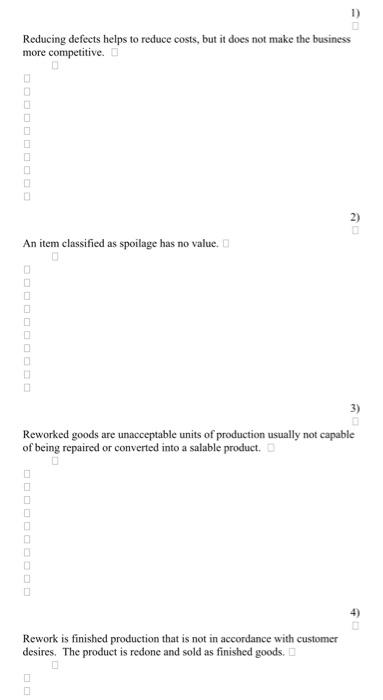
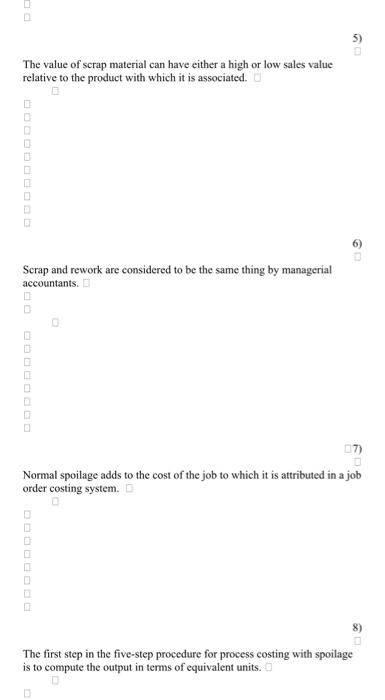
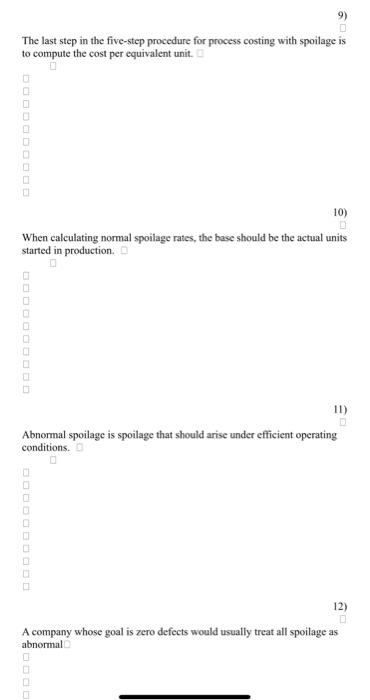
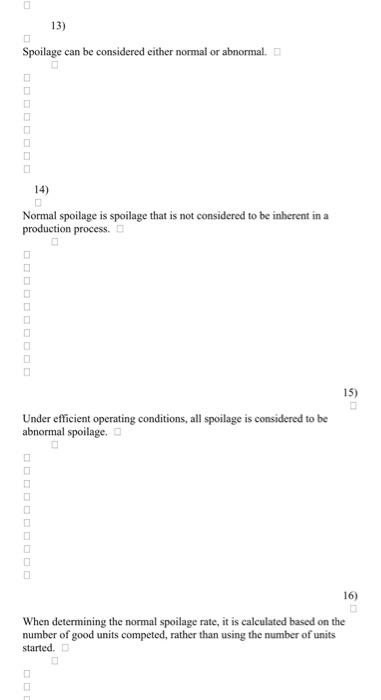
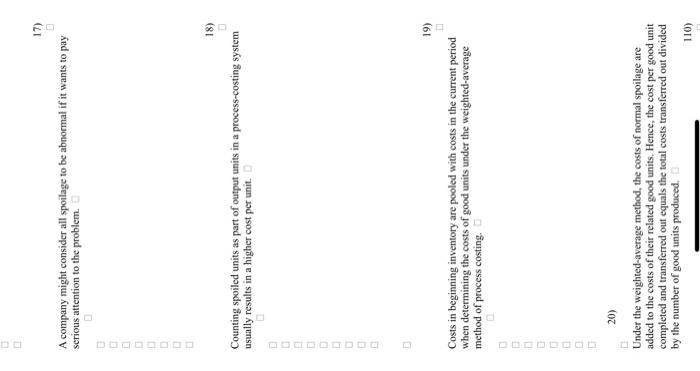
Reducing defects helps to reduce costs, but it does not make the business more competitive. 2) An item classified as spoilage has no value. 3) Reworked goods are unacceptable units of production usually not capable of being repaired or converted into a salable product. 4) Rework is finished production that is not in accordance with customer desires. The product is redone and sold as finished goods. The value of scrap material can have either a high or low sales value relative to the product with which it is associated. 6) Scrap and rework are considered to be the same thing by managerial accountants. 7) Normal spoilage adds to the cost of the job to which it is attributed in a job order costing system. 8) The first step in the five-step procedure for process costing with spoilage is to compute the output in terms of equivalent units. The last step in the five-step procedure for process costing with spoilage is to compute the cost per equivalent unit. 10) When calculating normal spoilage rates, the base should be the actual units started in production. 11) Abnomal spoilage is spoilage that should arise under efficient operating conditions. 12) A company whose goal is zero defects would usually treat all spoilage as abnormal Spoilage can be considered either normal or abnormal. 14) Normal spoilage is spoilage that is not considered to be inherent in a production process. 15) Under efficient operating conditions, all spoilage is considered to be abnormal spoilage. 16) When determining the normal spoilage rate, it is calculated based on the number of good units competed, rather than using the number of units started. 17) A company might consider all spoilage to be abnormal if it wants to pay serious attention to the problem. 18) Counting spoiled units as part of output units in a process-costing system usually results in a higher cost per unit. 19) Costs in beginning inventory are pooled with costs in the current period when determining the costs of good units under the weighted-average method of process costing. 20) Under the weighted-average method, the costs of normal spoilage are added to the costs of their related good units. Hence, the cost per good unit completed and transferred out equals the total costs transferred out divided by the number of good units produced Reducing defects helps to reduce costs, but it does not make the business more competitive. 2) An item classified as spoilage has no value. 3) Reworked goods are unacceptable units of production usually not capable of being repaired or converted into a salable product. 4) Rework is finished production that is not in accordance with customer desires. The product is redone and sold as finished goods. The value of scrap material can have either a high or low sales value relative to the product with which it is associated. 6) Scrap and rework are considered to be the same thing by managerial accountants. 7) Normal spoilage adds to the cost of the job to which it is attributed in a job order costing system. 8) The first step in the five-step procedure for process costing with spoilage is to compute the output in terms of equivalent units. The last step in the five-step procedure for process costing with spoilage is to compute the cost per equivalent unit. 10) When calculating normal spoilage rates, the base should be the actual units started in production. 11) Abnomal spoilage is spoilage that should arise under efficient operating conditions. 12) A company whose goal is zero defects would usually treat all spoilage as abnormal Spoilage can be considered either normal or abnormal. 14) Normal spoilage is spoilage that is not considered to be inherent in a production process. 15) Under efficient operating conditions, all spoilage is considered to be abnormal spoilage. 16) When determining the normal spoilage rate, it is calculated based on the number of good units competed, rather than using the number of units started. 17) A company might consider all spoilage to be abnormal if it wants to pay serious attention to the problem. 18) Counting spoiled units as part of output units in a process-costing system usually results in a higher cost per unit. 19) Costs in beginning inventory are pooled with costs in the current period when determining the costs of good units under the weighted-average method of process costing. 20) Under the weighted-average method, the costs of normal spoilage are added to the costs of their related good units. Hence, the cost per good unit completed and transferred out equals the total costs transferred out divided by the number of good units produced
Step by Step Solution
There are 3 Steps involved in it

Get step-by-step solutions from verified subject matter experts
 Study Help