







Question: Refer to Example 42 in text Section 185e. - Albert owns 100% of A Corporation, Betty is the sole proprietor of B Company, and Cai
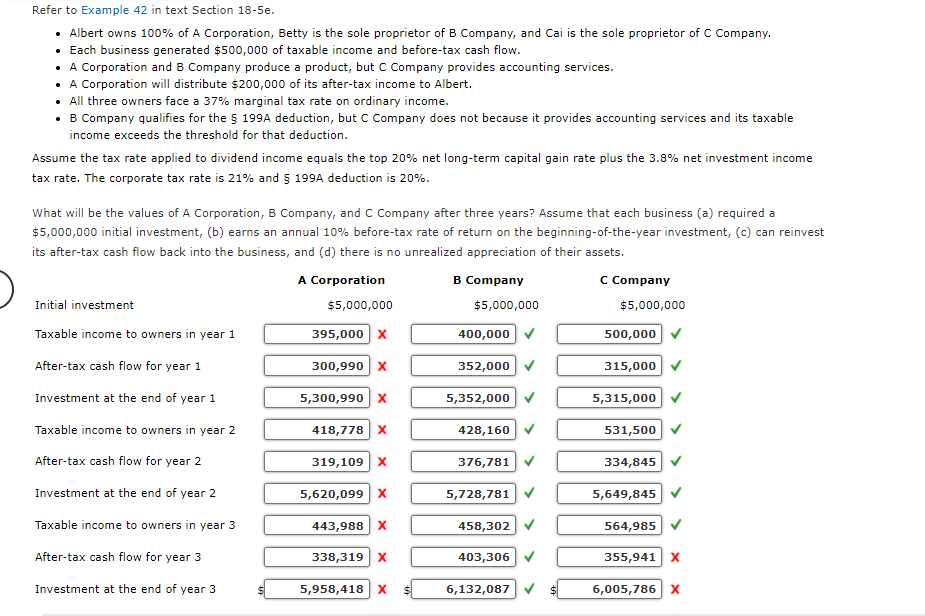
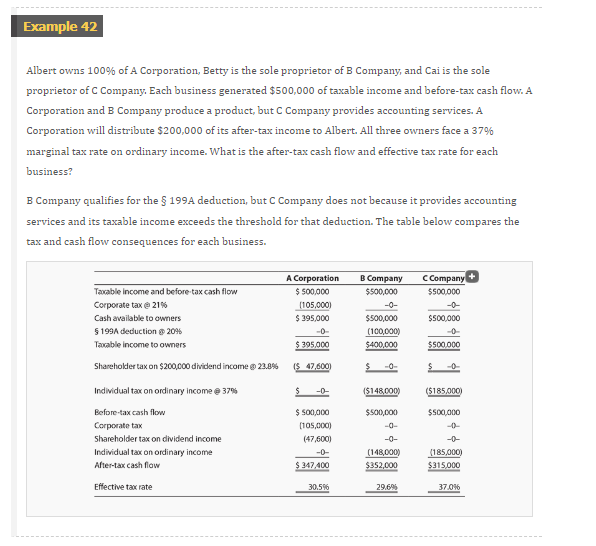
Refer to Example 42 in text Section 185e. - Albert owns 100% of A Corporation, Betty is the sole proprietor of B Company, and Cai is the sole proprietor of C Company. - Each business generated $500,000 of taxable income and before-tax cash flow. - A Corporation and B Company produce a product, but C Company provides accounting services. - A Corporation will distribute $200,000 of its after-tax income to Albert. - All three owners face a 37% marginal tax rate on ordinary income. - B Company qualifies for the $199 A deduction, but C Company does not because it provides accounting services and its taxable income exceeds the threshold for that deduction. Assume the tax rate applied to dividend income equals the top 20% net long-term capital gain rate plus the 3.8% net investment income tax rate. The corporate tax rate is 21% and 199A deduction is 20%. What will be the values of A Corporation, B Company, and C Company after three years? Assume that each business (a) required a $5,000,000 initial investment, (b) earns an annual 10% before-tax rate of return on the beginning-of-the-year investment, (c) can reinvest its after-tax cash flow back into the business, and (d) there is no unrealized appreciation of their assets. Albert owns 100% of A Corporation, Betty is the sole proprietor of B Company, and Cai is the sole proprietor of C Company. Each business generated $500,000 of taxable income and before-tax cash flow. A Corporation and B Company produce a product, but C Company provides accounting services. A Corporation will distribute $200,000 of its after-tax income to Albert All three owners face a 37% marginal tax rate on ordinary income. What is the after-tax cash flow and effective tax rate for each business? B Company qualifies for the 199 A deduction, but C Company does not because it provides accounting services and its taxable income exceeds the threshold for that deduction. The table below compares the tax and cash flow consequences for each business
Step by Step Solution
There are 3 Steps involved in it

Get step-by-step solutions from verified subject matter experts
 Study Help