





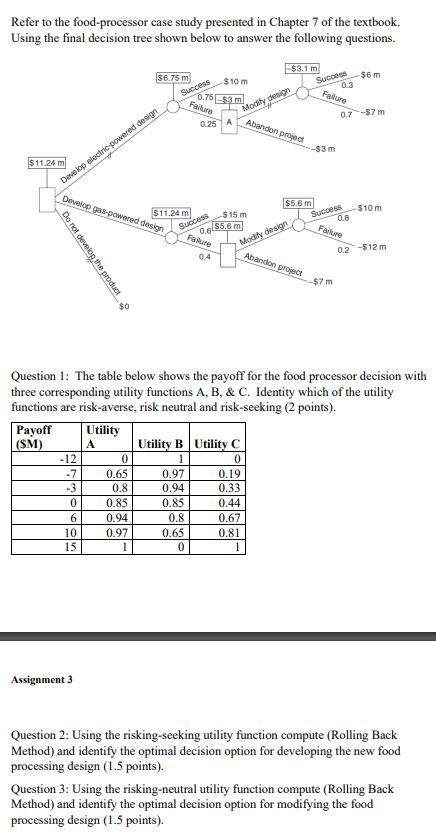
Question: Refer to the food-processor case study presented in Chapter 7 of the textbook Using the final decision tree shown below to answer the following questions.
Refer to the food-processor case study presented

Refer to the food-processor case study presented in Chapter 7 of the textbook Using the final decision tree shown below to answer the following questions. $3.1 m 56.75 m $10 m Suc6m 07555 s 0.7 -97m OZS A A Abandon Abandon projects $11.24 m Develop electric powered design Develop as powered design 55.6m 510 m Success $11.24 m 15 m de suas 55.6 m Failure Modily design 02-512 m 0.4 Abang Abandon projects Do not develop the product Question 1: The table below shows the payoff for the food processor decision with three corresponding utility functions A, B, & C. Identity which of the utility functions are risk-averse, risk neutral and risk-seeking (2 points). Utility Payoff (SM) Utility B Utility C -12 01 -71 0.65 0.97 0.19 0.8 0.94 0 0.85 0.85 0.44 6 0.94 08 10 0.97 081 15 10 Assignment 3 Question 2: Using the risking-seeking utility function compute (Rolling Back Method) and identify the optimal decision option for developing the new food processing design (1.5 points). Question 3: Using the risking-neutral utility function compute (Rolling Back Method) and identify the optimal decision option for modifying the food processing design (1.5 points). Refer to the food-processor case study presented in Chapter 7 of the textbook Using the final decision tree shown below to answer the following questions. $3.1 m 56.75 m $10 m Suc6m 07555 s 0.7 -97m OZS A A Abandon Abandon projects $11.24 m Develop electric powered design Develop as powered design 55.6m 510 m Success $11.24 m 15 m de suas 55.6 m Failure Modily design 02-512 m 0.4 Abang Abandon projects Do not develop the product Question 1: The table below shows the payoff for the food processor decision with three corresponding utility functions A, B, & C. Identity which of the utility functions are risk-averse, risk neutral and risk-seeking (2 points). Utility Payoff (SM) Utility B Utility C -12 01 -71 0.65 0.97 0.19 0.8 0.94 0 0.85 0.85 0.44 6 0.94 08 10 0.97 081 15 10 Assignment 3 Question 2: Using the risking-seeking utility function compute (Rolling Back Method) and identify the optimal decision option for developing the new food processing design (1.5 points). Question 3: Using the risking-neutral utility function compute (Rolling Back Method) and identify the optimal decision option for modifying the food processing design (1.5 points)

Step by Step Solution

There are 3 Steps involved in it

1 Expert Approved Answer
Step: 1 Unlock blur-text-image

Question Has Been Solved by an Expert!

Get step-by-step solutions from verified subject matter experts

Step: 2 Unlock
Step: 3 Unlock

Students Have Also Explored These Related General Management Questions!