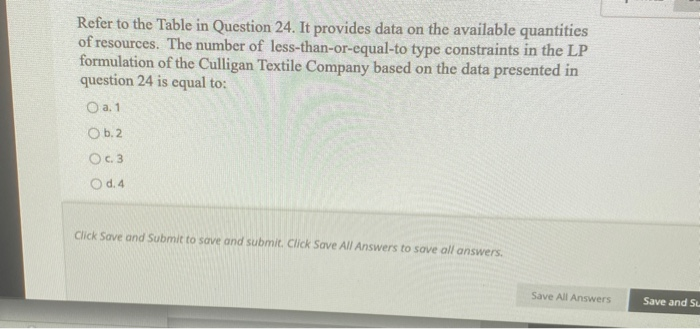
Question: Refer to the Table in Question 24. It provides data on the available quantities of resources. The number of less-than-or-equal-to type constraints in the LP
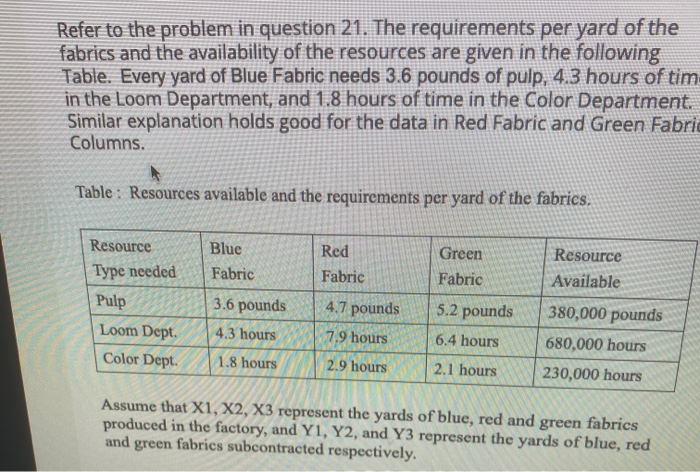
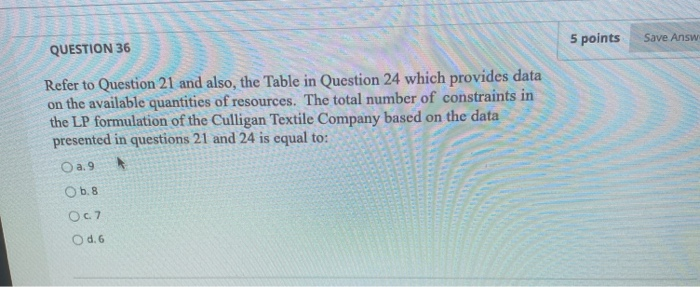
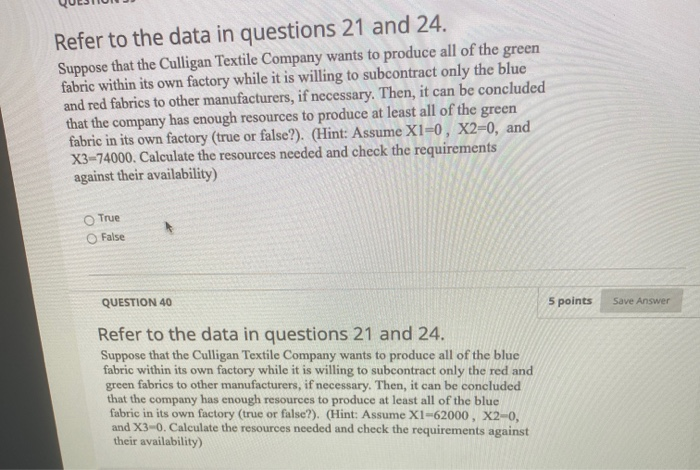
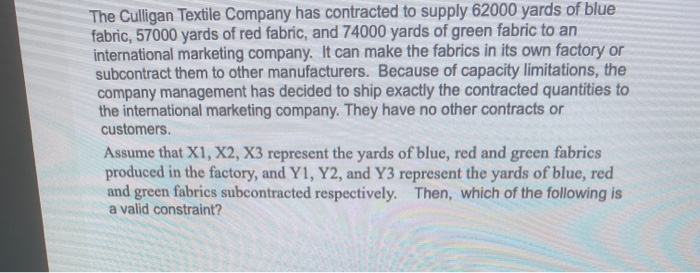
Refer to the Table in Question 24. It provides data on the available quantities of resources. The number of less-than-or-equal-to type constraints in the LP formulation of the Culligan Textile Company based on the data presented in question 24 is equal to: O a. 1 Ob.2 Oc3 O d. 4 Click Save and Submit to save and submit. Click Save All Answers to save all answers, Save All Answers Save and su Refer to the problem in question 21. The requirements per yard of the fabrics and the availability of the resources are given in the following Table. Every yard of Blue Fabric needs 3.6 pounds of pulp, 4.3 hours of tim in the Loom Department, and 1.8 hours of time in the Color Department. Similar explanation holds good for the data in Red Fabric and Green Fabric Columns Table : Resources available and the requirements per yard of the fabrics. Red Resource Type needed Pulp Blue Fabric Green Fabric Resource Available Fabric 3.6 pounds 5.2 pounds 4.7 pounds 7.9 hours 380,000 pounds Loom Dept. Color Dept. 4.3 hours 6.4 hours 680,000 hours 1.8 hours 2.9 hours 2.1 hours 230,000 hours Assume that X1, X2, X3 represent the yards of blue, red and green fabrics produced in the factory, and Y1, Y2, and Y3 represent the yards of blue, red and green fabrics subcontracted respectively, 5 points Save Answ QUESTION 36 Refer to Question 21 and also, the Table in Question 24 which provides data on the available quantities of resources. The total number of constraints in the LP formulation of the Culligan Textile Company based on the data presented in questions 21 and 24 is equal to: O a. 9 Ob. 8 Oc7 O 0.6 Refer to the data in questions 21 and 24. Suppose that the Culligan Textile Company wants to produce all of the green fabric within its own factory while it is willing to subcontract only the blue and red fabrics to other manufacturers, if necessary. Then, it can be concluded that the company has enough resources to produce at least all of the green fabric in its own factory (true or false?). (Hint: Assume X1-0, X2=0, and X3-74000. Calculate the resources needed and check the requirements against their availability) True False QUESTION 40 5 points Save Answer Refer to the data in questions 21 and 24. Suppose that the Culligan Textile Company wants to produce all of the blue fabric within its own factory while it is willing to subcontract only the red and green fabrics to other manufacturers, if necessary. Then, it can be concluded that the company has enough resources to produce at least all of the blue fabric in its own factory (true or false?). (Hint: Assume X1-62000, X2-0, and X3-0. Calculate the resources needed and check the requirements against their availability) The Culligan Textile Company has contracted to supply 62000 yards of blue fabric, 57000 yards of red fabric, and 74000 yards of green fabric to an international marketing company. It can make the fabrics in its own factory or subcontract them to other manufacturers. Because of capacity limitations, the company management has decided to ship exactly the contracted quantities to the international marketing company. They have no other contracts or customers. Assume that X1, X2, X3 represent the yards of blue, red and green fabrics produced in the factory, and Y1, Y2, and Y3 represent the yards of blue, red and green fabrics subcontracted respectively. Then, which of the following is a valid constraint? Refer to the Table in Question 24. It provides data on the available quantities of resources. The number of less-than-or-equal-to type constraints in the LP formulation of the Culligan Textile Company based on the data presented in question 24 is equal to: O a. 1 Ob.2 Oc3 O d. 4 Click Save and Submit to save and submit. Click Save All Answers to save all answers, Save All Answers Save and su Refer to the problem in question 21. The requirements per yard of the fabrics and the availability of the resources are given in the following Table. Every yard of Blue Fabric needs 3.6 pounds of pulp, 4.3 hours of tim in the Loom Department, and 1.8 hours of time in the Color Department. Similar explanation holds good for the data in Red Fabric and Green Fabric Columns Table : Resources available and the requirements per yard of the fabrics. Red Resource Type needed Pulp Blue Fabric Green Fabric Resource Available Fabric 3.6 pounds 5.2 pounds 4.7 pounds 7.9 hours 380,000 pounds Loom Dept. Color Dept. 4.3 hours 6.4 hours 680,000 hours 1.8 hours 2.9 hours 2.1 hours 230,000 hours Assume that X1, X2, X3 represent the yards of blue, red and green fabrics produced in the factory, and Y1, Y2, and Y3 represent the yards of blue, red and green fabrics subcontracted respectively, 5 points Save Answ QUESTION 36 Refer to Question 21 and also, the Table in Question 24 which provides data on the available quantities of resources. The total number of constraints in the LP formulation of the Culligan Textile Company based on the data presented in questions 21 and 24 is equal to: O a. 9 Ob. 8 Oc7 O 0.6 Refer to the data in questions 21 and 24. Suppose that the Culligan Textile Company wants to produce all of the green fabric within its own factory while it is willing to subcontract only the blue and red fabrics to other manufacturers, if necessary. Then, it can be concluded that the company has enough resources to produce at least all of the green fabric in its own factory (true or false?). (Hint: Assume X1-0, X2=0, and X3-74000. Calculate the resources needed and check the requirements against their availability) True False QUESTION 40 5 points Save Answer Refer to the data in questions 21 and 24. Suppose that the Culligan Textile Company wants to produce all of the blue fabric within its own factory while it is willing to subcontract only the red and green fabrics to other manufacturers, if necessary. Then, it can be concluded that the company has enough resources to produce at least all of the blue fabric in its own factory (true or false?). (Hint: Assume X1-62000, X2-0, and X3-0. Calculate the resources needed and check the requirements against their availability) The Culligan Textile Company has contracted to supply 62000 yards of blue fabric, 57000 yards of red fabric, and 74000 yards of green fabric to an international marketing company. It can make the fabrics in its own factory or subcontract them to other manufacturers. Because of capacity limitations, the company management has decided to ship exactly the contracted quantities to the international marketing company. They have no other contracts or customers. Assume that X1, X2, X3 represent the yards of blue, red and green fabrics produced in the factory, and Y1, Y2, and Y3 represent the yards of blue, red and green fabrics subcontracted respectively. Then, which of the following is a valid constraint









 Study Help