







Question: REFERENCE: https://drive.google.com/file/d/1MdBsPSii-8YR5miMVK9ISogvqRFD0NRN/view?usp=sharing please answer all items. i will give a high rate. with SOLUTIONS PLEASE. I ONLY NEED SOLUTIONS, i pasted the answer key for
REFERENCE: https://drive.google.com/file/d/1MdBsPSii-8YR5miMVK9ISogvqRFD0NRN/view?usp=sharing
please answer all items. i will give a high rate. with SOLUTIONS PLEASE. I ONLY NEED SOLUTIONS, i pasted the answer key for your guidance
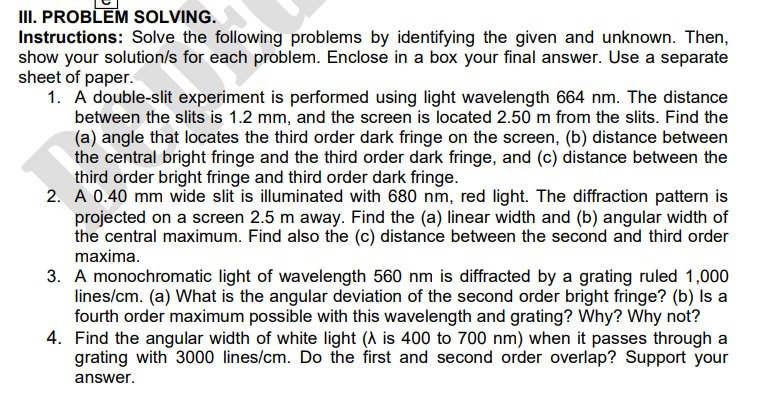
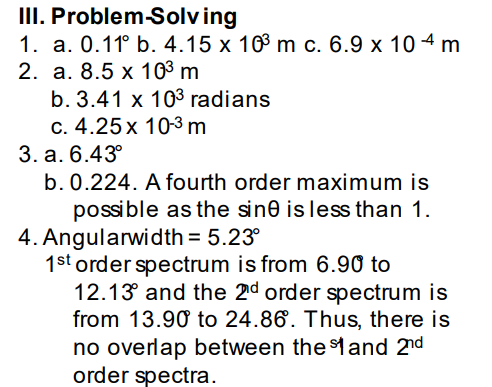
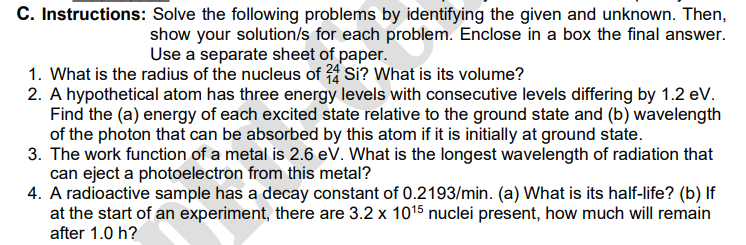
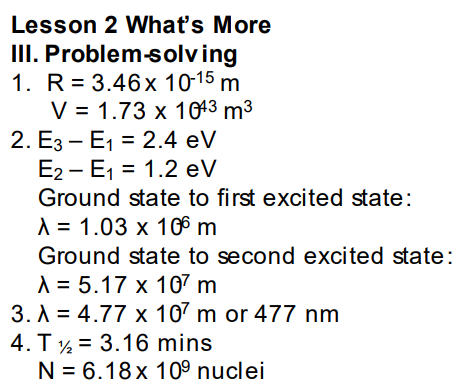
III. PROBLEM SOLVING. Instructions: Solve the following problems by identifying the given and unknown. Then, show your solution/s for each problem. Enclose in a box your final answer. Use a separate sheet of paper. 1. A double-slit experiment is performed using light wavelength 664 nm. The distance between the slits is 1.2 mm, and the screen is located 2.50 m from the slits. Find the (a) angle that locates the third order dark fringe on the screen, (b) distance between the central bright fringe and the third order dark fringe, and (c) distance between the third order bright fringe and third order dark fringe. 2. A 0.40 mm wide slit is illuminated with 680 nm, red light. The diffraction pattern is projected on a screen 2.5 m away. Find the (a) linear width and (b) angular width of the central maximum. Find also the (c) distance between the second and third order maxima. 3. A monochromatic light of wavelength 560 nm is diffracted by a grating ruled 1,000 lines/cm. (a) What is the angular deviation of the second order bright fringe? (b) Is a fourth order maximum possible with this wavelength and grating? Why? Why not? 4. Find the angular width of white light () is 400 to 700 nm) when it passes through a grating with 3000 lines/cm. Do the first and second order overlap? Support your answer.Ill. Problem-Solving 1. a. 0. 11 b. 4. 15 x 103 m c. 6.9 x 10 4m 2. a. 8.5 x 10³ m b. 3.41 x 10³ radians c. 4.25x 10⁻³m 3. a. 6.43 b. 0.224. A fourth order maximum is possible as the sine is less than 1. 4. Angularwidth = 5.23 1 st order spectrum is from 6.90 to 12.13 and the 2d order spectrum is from 13.90 to 24.86. Thus, there is no overlap between the land and order spectra.C. Instructions: Solve the following problems by identifying the given and unknown. Then, show your solution/s for each problem. Enclose in a box the final answer. Use a separate sheet of paper. 1. What is the radius of the nucleus of $4 Si? What is its volume? 2. A hypothetical atom has three energy levels with consecutive levels differing by 1.2 eV. Find the (a) energy of each excited state relative to the ground state and (b) wavelength of the photon that can be absorbed by this atom if it is initially at ground state. 3. The work function of a metal is 2.6 ev. What is the longest wavelength of radiation that can eject a photoelectron from this metal? 4. A radioactive sample has a decay constant of 0.2193/min. (a) What is its half-life? (b) If at the start of an experiment, there are 3.2 x 10¹⁵ nuclei present, how much will remain after 1.0 h?Lesson 2 What's More Ill. Problem-solving 1. R = 3.46x 10⁻¹⁵ m V = 1.73 x 1043 m3 2. E3 - E1 = 2.4 eV E2 - E1 = 1.2 eV Ground state to first excited state: A = 1.03 x 10⁵ m Ground state to second excited state: A = 5.17 x 10⁷ m 3. A = 4.77 x 10 m or 477 nm 4. T 1/2 = 3.16 mins N = 6.18x 10⁹ nuclei
Step by Step Solution
There are 3 Steps involved in it

Get step-by-step solutions from verified subject matter experts
 Study Help