







Question: REFERENCE: https://drive.google.com/file/d/1MdBsPSii-8YR5miMVK9ISogvqRFD0NRN/view?usp=sharing please answer all items. i will give a high rate. with SOLUTIONS PLEASE. What I Know Instructions: Read each question and write the
REFERENCE: https://drive.google.com/file/d/1MdBsPSii-8YR5miMVK9ISogvqRFD0NRN/view?usp=sharing
please answer all items. i will give a high rate. with SOLUTIONS PLEASE.
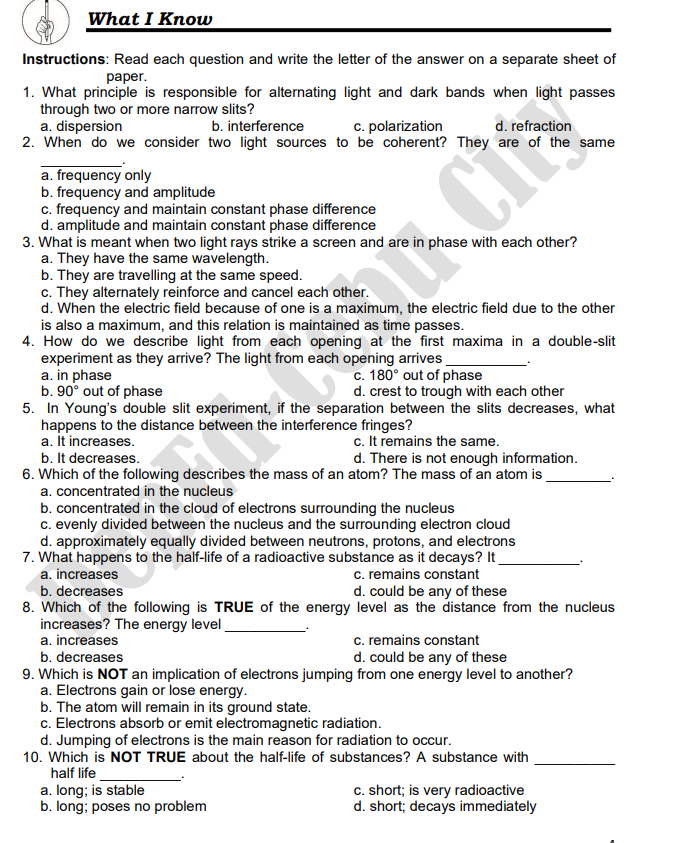
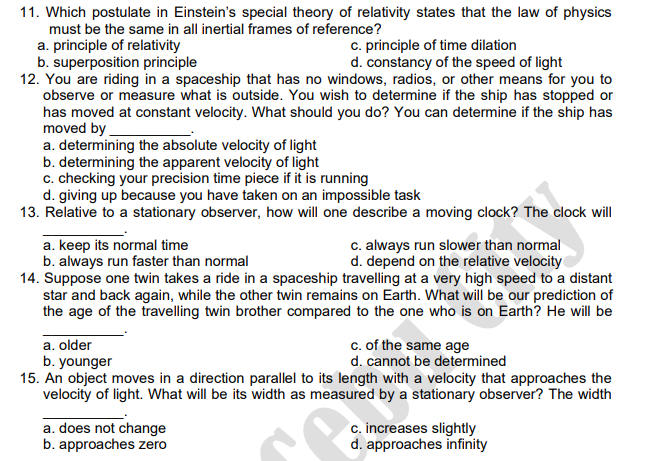
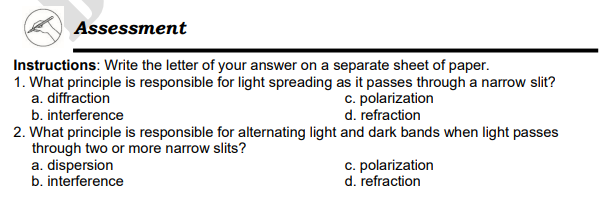
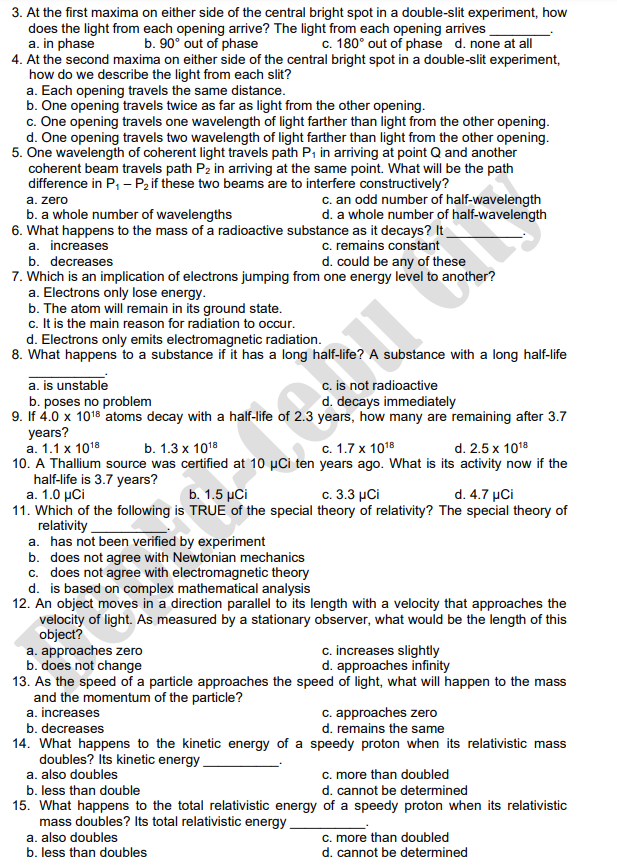
What I Know Instructions: Read each question and write the letter of the answer on a separate sheet of paper. 1. What principle is responsible for alternating light and dark bands when lig'lt passes through two or more narrow slits? a. dispersion b. interference c. polarization d. refraction 2. When do we consider two light sources to be coherent? They are of the same a. frequencytonly b. frequency and amplitude c. frequency and maintain constant phase difference d. amplitude and maintain constant phase difference 3. What is meant when two light rays strike a screen and are in phase with each other? a. They have the same wavelength. b. They are travelling at the same speed. c. They altemately reinforce and uncel each other. d. When the electric eld because of one is a maximum. the electric eld due to the other is also a maximum. and this relation is maintained as time passes. 4. How do we describe light from each opening at the rst maxima in a double-slit experiment as they arrive? The light from each opening arrives a. in phase c. 13c\" out of phase b. BU\" out of phase d. crest to trough with each other 5. In Young's double slit experiment, if the separation between the slits decreases. what happens to the distance between the interference fringes? a. It increases. c. It remains the same. b. It decreases. d. There is not enough information. 3. Which of the following describes the mass of an atom? The mass of an atom is a. concentrated. in the nucleus b. concentrated in the cloud of electrons surrounding the nucleus c. evenly divided between the nucleus and the surrounding electron cloud d. approximately equally divided between neutrons. protons. and electrons 1'. What happens to the half-life of a radioactive substance as it decays? It a. increases c. remains constant b. decreases d. could be any of these it. Which of the following is TRUE of the energy level as the distance from the nucleus increases? The energy level . a. increases c. remains constant b. decreases d. could be any of these 9. Which is NOT an implioltion of electrons jumping from one energy level to another? a. Electrons gain or lose energy. b. The atom will remain in its ground state. c. Electrons absorb or emit electromagnetic radiation. d. Jumping of electrons is the main reason for radiation to occur. it]. Which is HOT TRUE about the half-life of substances? A substance with half life . a. long; is stable c. short; is very radioactive b. long; poses no problem d. short; decays immediately 11. Which postulate in Einstein's special theory of relativity states that the law of physics must be the same in all inertial frames of reference? a. principle of relativity c. principle of time dilation b. superposition principle d. constancy of the speed of light 12. You are riding in a spaceship that has no windows, radios, or other means for you to observe or measure what is outside. You wish to determine if the ship has stopped or has moved at constant velocity. What should you do? You can determine if the ship has moved by a. determining the absolute velocity of light b. determining the apparent velocity of light c. checking your precision time piece if it is running d. giving up because you have taken on an impossible task 13. Relative to a stationary observer, how will one describe a moving clock? The clock will a. keep its normal time c. always run slower than normal b. always run faster than normal d. depend on the relative velocity 14. Suppose one twin takes a ride in a spaceship travelling at a very high speed to a distant star and back again, while the other twin remains on Earth. What will be our prediction of the age of the travelling twin brother compared to the one who is on Earth? He will be a. older c. of the same age b. younger d. cannot be determined 15. An object moves in a direction parallel to its length with a velocity that approaches the velocity of light. What will be its width as measured by a stationary observer? The width a. does not change c. increases slightly b. approaches zero d. approaches infinityAssessment Instructions: Write the letter of your answer on a separate sheet of paper. 1. What principle is responsible for light spreading as it passes through a narrow slit? a. diffraction c. polarization b. interference d. refraction 2. What principle is responsible for alternating light and dark bands when light passes through two or more narrow slits? a. dispersion c. polarization b. interference d. refraction3. At the rst maxima on either side of the central brig ht spot in a double-slit experiment. how does the light from each opening arrive? The light from each opening anives . a. in phase b. 90" out of phase c. 135\" out of phase d. none at all 4. At the second maxima on either side of the central bright spot in a double-slit experiment. how do we describe the light from each slit? a. Each opening travels the same distance. b. Cine opening travels twice as far as light from the other opening. c. lEllne opening travels one wavelength of light farther than light from the other opening. d. Cine opening travels two wavelength of light farther than light from the other opening. 5. lICJIne wavelength of coherent light travels path P1 in arriving at point Ct and another coherent beam travels path P2 in aniving at the same point. errat will be the path difference in P1 P: if these two beams are to interfere constructively? a. Zero c. an odd number of half-wavelength b. a whole number of wavelengths d. a whole number of half-wavelength B. What happens to the mass of a radioactive substance as it decays? it a. increases c. remains constant b. decreases d. could be any of these ?_ Which is an implication of electrons jumping from one energy level to another? a. Electrons only lose energy. b. The atom will remain in its ground state. c. it is the main reason for radiation to occur. d. Electrons only emits electromagnetic radiation. 5. What happens to a substance if it has a long halt-life? A substance with a long half-life a. is unstable c. is not radioactive b. poses no problem d. decays immediately 9. If 4.5 it 1'3"\" atoms dolly with a half-life at 2.3 years, how many are remaining after 3.? years? a. 1.1 x15\" b. 1.3.1.151\" c.1.?x1t'|\"' d. 2.5x1'\" 15. A Thallium source was certified at tillI "Cl ten years ago. What is its activity now if the half-life is 3.? years? a. 1.t.'.I pCi b. 1.5 pCi c. 3.3 pCi d. 4.? pCi 11. Which of the following is TRUE of the special theory of relativity? The special theory of relativity . a. has not been veried by experiment b. does not agree with Newer-Man mechanics c. does not agree wilh electromagnetic theory d. is based on complex mathematical analysis 12. An object moves it a direction parallel to its length with a velocity that approaches the velocity of light. As measured by a stationary observer, what would be the length of this object? a. approaches Zero c. increases slightly b. does not change d. approaches innity 13. As the speed of a particle approaches the speed of light1 what will happen to the malls and the momentum of the particle? a. increases c. approaches zero b. decreases d. remains the same 14. What happens to the kinetic energy of a speedy proton when its relativisc mass doubles? Its kinetic energy . a. also doubles c. more than doubled b. less than double d. cannot be determined 15. What happens to the total relativistic energy of a speedy proton when its relativistic mass doubles? Its total relativistic energy . a. also doubles c. more than doubled b. less than doubles d. cannot be determined
Step by Step Solution
There are 3 Steps involved in it

Get step-by-step solutions from verified subject matter experts
 Study Help