







Question: Reference link: https://drive.google.com/file/d/1Jiv9l_vNEqzpEl44l5hhaI7M9rmjfohy/view?usp=sharing please answer. with solutions and explanations please. I will read it. and please write nicely so that i can read it properly.
Reference link: https://drive.google.com/file/d/1Jiv9l_vNEqzpEl44l5hhaI7M9rmjfohy/view?usp=sharing
please answer. with solutions and explanations please. I will read it. and please write nicely so that i can read it properly. thank you so much i will give a high rate. ANSWER ALL ITEMS. refer for the link for the module.
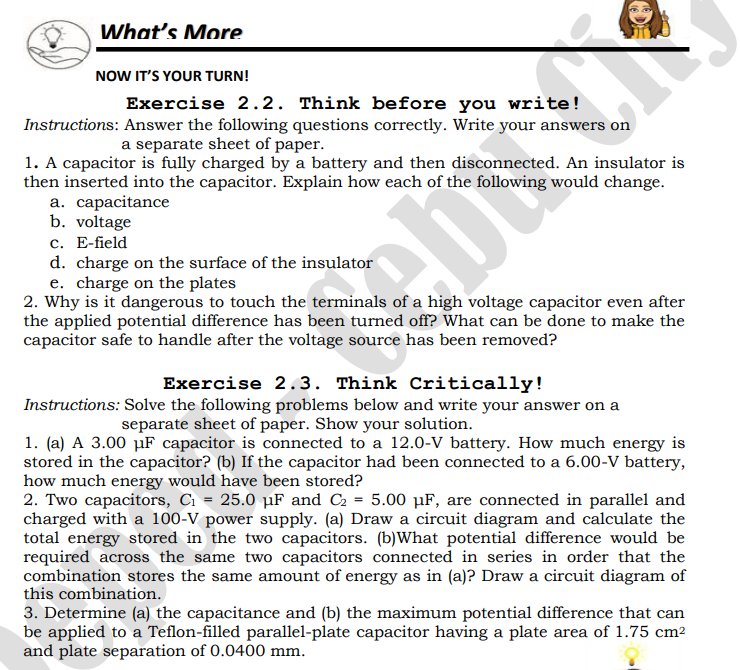
What's More NOW IT'S YOUR TURN! Exercise 2.2. Think before you write! Instructions: Answer the following questions correctly. Write your answers on a separate sheet of paper. 1. A capacitor is fully charged by a battery and then disconnected. An insulator is then inserted into the capacitor. Explain how each of the following would change. a. capacitance b. voltage c. E-field d. charge on the surface of the insulator e. charge on the plates 2. Why is it dangerous to touch the terminals of a high voltage capacitor even after the applied potential difference has been turned off? What can be done to make the capacitor safe to handle after the voltage source has been removed? Exercise 2.3. Think Critically! Instructions: Solve the following problems below and write your answer on a separate sheet of paper. Show your solution. 1. (a) A 3.00 pF capacitor is connected to a 12.0-V battery. How much energy is stored in the capacitor? (b) If the capacitor had been connected to a 6.00-V battery, how much energy would have been stored? 2. Two capacitors, Ci = 25.0 pF and C2 = 5.00 pF, are connected in parallel and charged with a 100-V power supply. (a) Draw a circuit diagram and calculate the total energy stored in the two capacitors. (b)What potential difference would be required across the same two capacitors connected in series in order that the combination stores the same amount of energy as in (a)? Draw a circuit diagram of this combination. 3. Determine (a) the capacitance and (b) the maximum potential difference that can be applied to a Teflon-filled parallel-plate capacitor having a plate area of 1.75 cm2 and plate separation of 0.0400 mm
Step by Step Solution
There are 3 Steps involved in it

Get step-by-step solutions from verified subject matter experts
 Study Help