







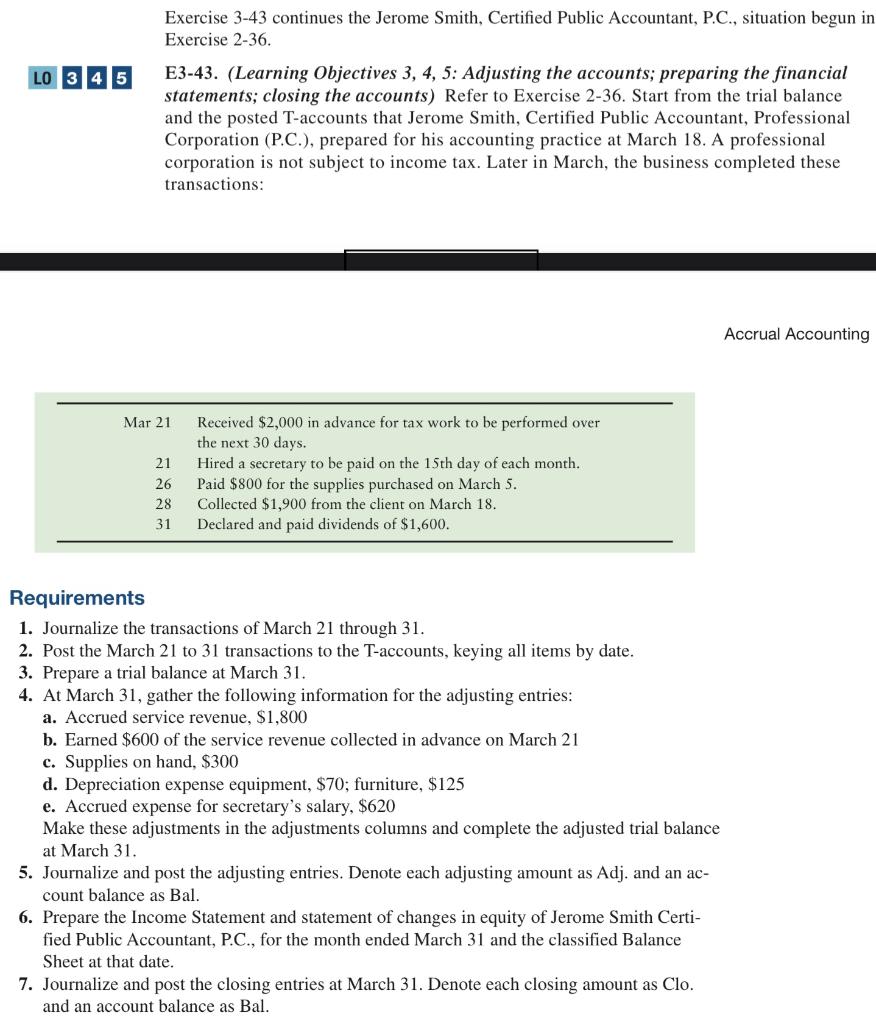
Question: Reference question LO 3 Exercise 3-43 continues the Jerome Smith, Certified Public Accountant, P.C., situation begun in Exercise 2-36. E3-43. (Learning Objectives 3, 4, 5:
Reference question
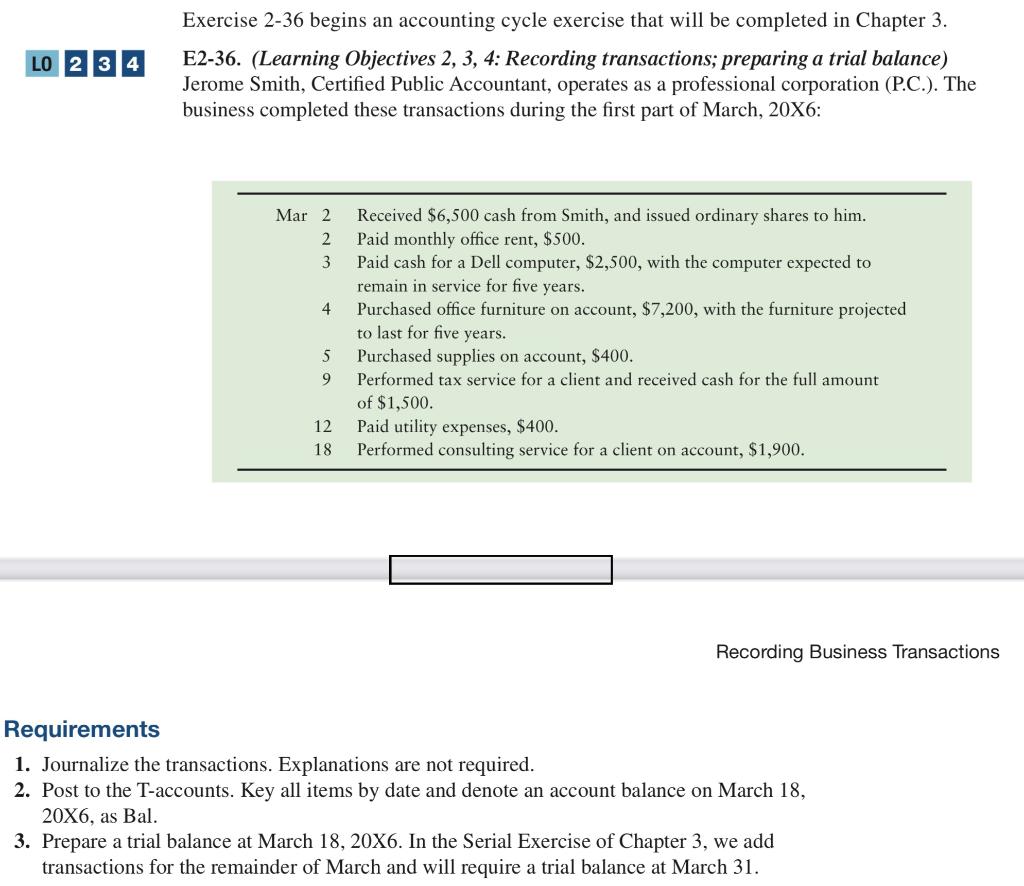
LO 3 Exercise 3-43 continues the Jerome Smith, Certified Public Accountant, P.C., situation begun in Exercise 2-36. E3-43. (Learning Objectives 3, 4, 5: Adjusting the accounts; preparing the financial statements; closing the accounts) Refer to Exercise 2-36. Start from the trial balance and the posted T-accounts that Jerome Smith, Certified Public Accountant, Professional Corporation (P.C.), prepared for his accounting practice at March 18. A professional corporation is not subject to income tax. Later in March, the business completed these transactions: Accrual Accounting Mar 21 21 26 Received $2,000 in advance for tax work to be performed over the next 30 days. Hired a secretary to be paid on the 15th day of each month. Paid $800 for the supplies purchased on March 5. Collected $1,900 from the client on March 18. Declared and paid dividends of $1,600. 28 31 Requirements 1. Journalize the transactions of March 21 through 31. 2. Post the March 21 to 31 transactions to the T-accounts, keying all items by date. 3. Prepare a trial balance at March 31. 4. At March 31, gather the following information for the adjusting entries: a. Accrued service revenue, $1,800 b. Earned $600 of the service revenue collected in advance on March 21 c. Supplies on hand, $300 d. Depreciation expense equipment, $70; furniture, $125 e. Accrued expense for secretary's salary, $620 Make these adjustments in the adjustments columns and complete the adjusted trial balance at March 31. 5. Journalize and post the adjusting entries. Denote each adjusting amount as Adj. and an ac- count balance as Bal. 6. Prepare the Income Statement and statement of changes in equity of Jerome Smith Certi- fied Public Accountant, P.C., for the month ended March 31 and the classified Balance Sheet at that date. 7. Journalize and post the closing entries at March 31. Denote each closing amount as Clo. and an account balance as Bal. LO 2 Exercise 2-36 begins an accounting cycle exercise that will be completed in Chapter 3. E2-36. (Learning Objectives 2, 3, 4: Recording transactions; preparing a trial balance) Jerome Smith, Certified Public Accountant, operates as a professional corporation (P.C.). The business completed these transactions during the first part of March, 20X6: Mar 2 2 3 4 Received $6,500 cash from Smith, and issued ordinary shares to him. Paid monthly office rent, $500. Paid cash for a Dell computer, $2,500, with the computer expected to remain in service for five years. Purchased office furniture on account, $7,200, with the furniture projected to last for five years. Purchased supplies on account, $400. Performed tax service for a client and received cash for the full amount of $1,500. Paid utility expenses, $400. Performed consulting service for a client on account, $1,900. 5 9 12 18 Recording Business Transactions Requirements 1. Journalize the transactions. Explanations are not required. 2. Post to the T-accounts. Key all items by date and denote an account balance on March 18, 20X6, as Bal. 3. Prepare a trial balance at March 18, 20X6. In the Serial Exercise of Chapter 3, we add transactions for the remainder of March and will require a trial balance at March 31
Step by Step Solution
There are 3 Steps involved in it

Get step-by-step solutions from verified subject matter experts
 Study Help