







Question: Reference Reference Reference Reference Requirements 1. Compute the payback period, the ARR, and the NPV of these two plans. What are the strengths and weaknesses
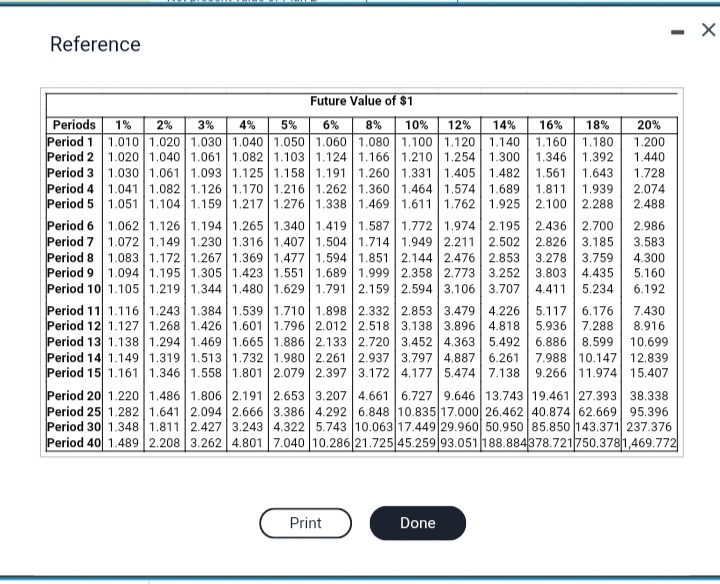
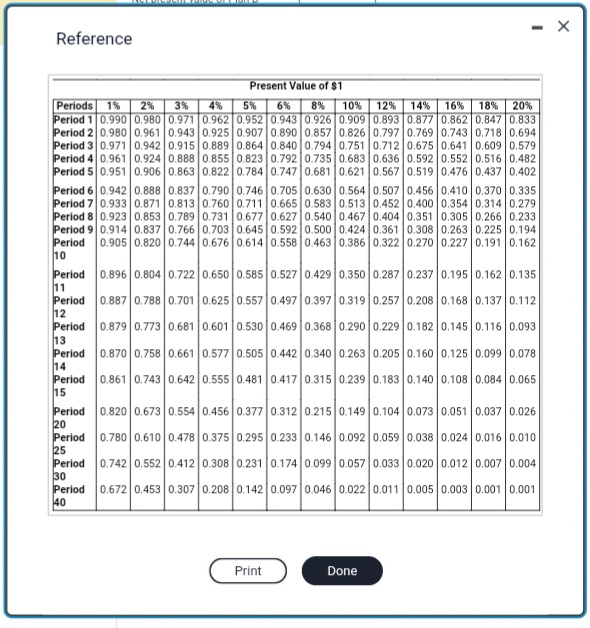
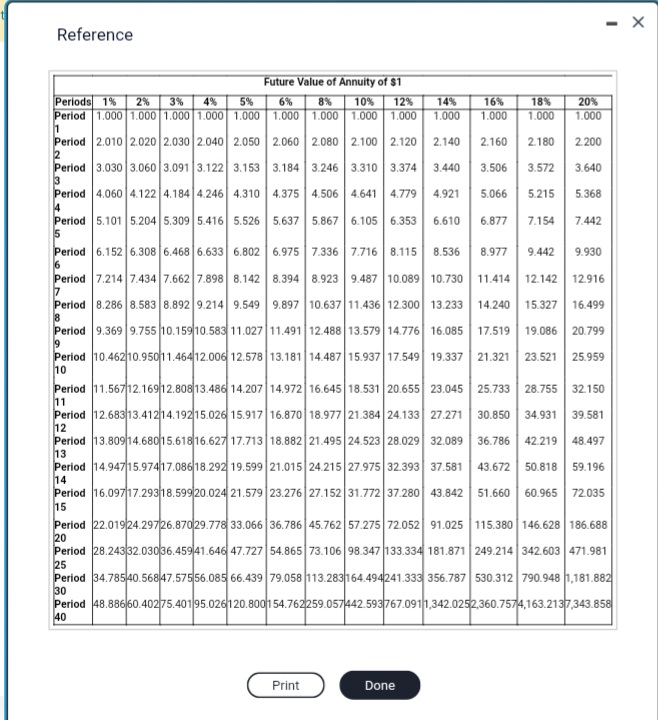
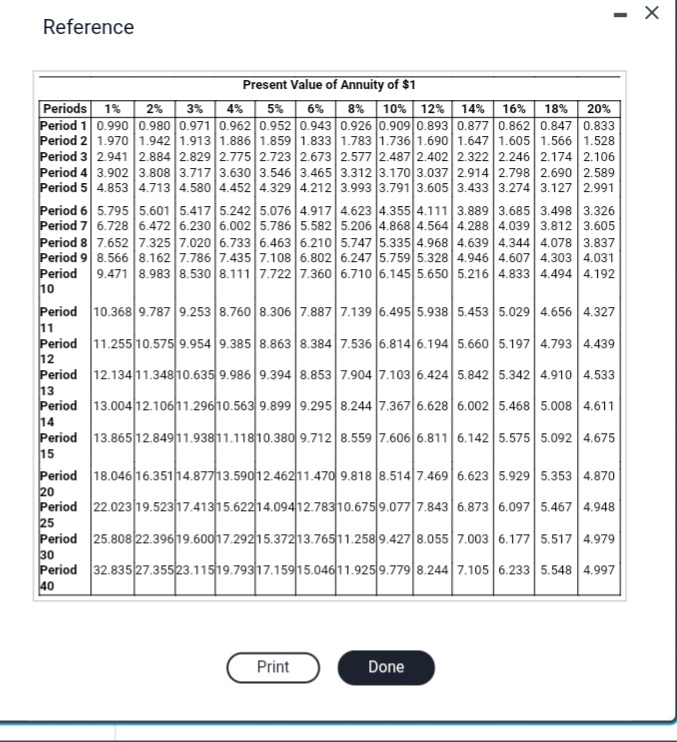
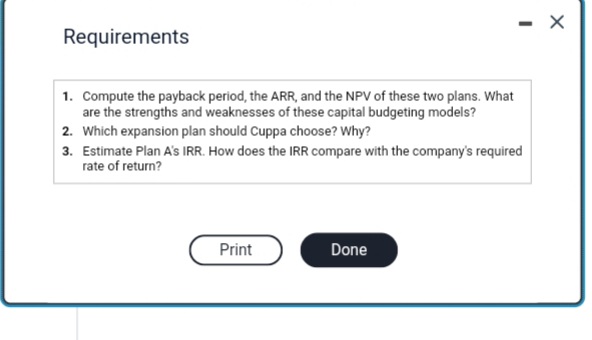
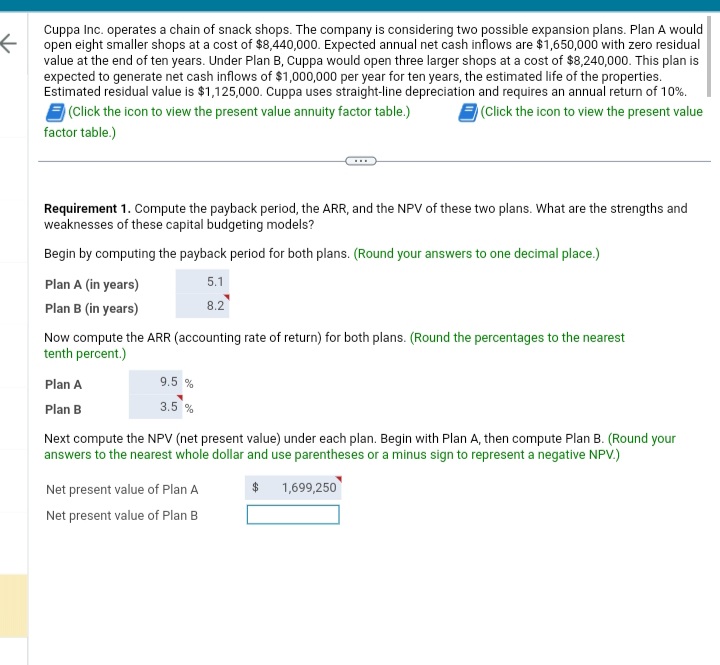
Reference Reference Reference Reference Requirements 1. Compute the payback period, the ARR, and the NPV of these two plans. What are the strengths and weaknesses of these capital budgeting models? 2. Which expansion plan should Cuppa choose? Why? 3. Estimate Plan A's IRR. How does the IRR compare with the company's required rate of return? Cuppa Inc. operates a chain of snack shops. The company is considering two possible expansion plans. Plan A would open eight smaller shops at a cost of $8,440,000. Expected annual net cash inflows are $1,650,000 with zero residual value at the end of ten years. Under Plan B, Cuppa would open three larger shops at a cost of $8,240,000. This plan is expected to generate net cash inflows of $1,000,000 per year for ten years, the estimated life of the properties. Estimated residual value is $1,125,000. Cuppa uses straight-line depreciation and requires an annual return of 10%. (Click the icon to view the present value annuity factor table.) Click the icon to view the present value factor table.) Requirement 1. Compute the payback period, the ARR, and the NPV of these two plans. What are the strengths and weaknesses of these capital budgeting models? Begin by computing the payback period for both plans. (Round your answers to one decimal place.) Now compute the ARR (accounting rate of return) for both plans. (Round the percentages to the nearest tenth percent.) Next compute the NPV (net present value) under each plan. Begin with Plan A, then compute Plan B. (Round your answers to the nearest whole dollar and use parentheses or a minus sign to represent a negative NPV.)
Step by Step Solution
There are 3 Steps involved in it

Get step-by-step solutions from verified subject matter experts
 Study Help