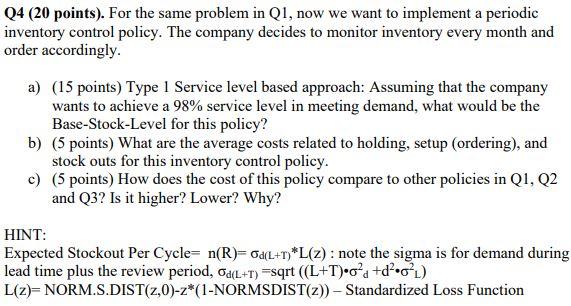
Question: Reference to this question Q4 (20 points). For the same problem in Q1, now we want to implement a periodic inventory control policy. The company
Reference to this question
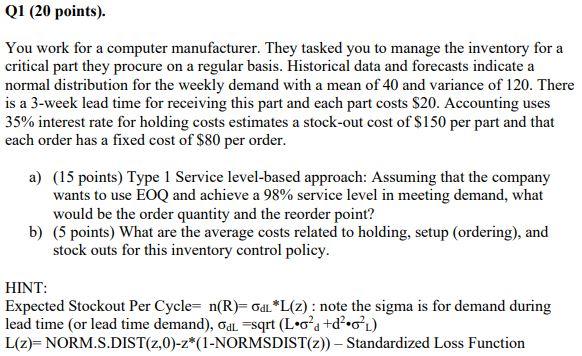
Q4 (20 points). For the same problem in Q1, now we want to implement a periodic inventory control policy. The company decides to monitor inventory every month and order accordingly. a) (15 points) Type 1 Service level based approach: Assuming that the company wants to achieve a 98% service level in meeting demand, what would be the Base-Stock-Level for this policy? b) (5 points) What are the average costs related to holding, setup (ordering), and stock outs for this inventory control policy. c) (5 points) How does the cost of this policy compare to other policies in Q1, Q2 and Q3? Is it higher? Lower? Why? HINT: Expected Stockout Per Cycle= n(R)= G4(L+1)*L(z): note the sigma is for demand during lead time plus the review period, Od(L+T)=sqrt ((L+T)od td ol) L(z)=NORM.S.DIST(2,0)-z*(1-NORMSDIST(z)) - Standardized Loss Function Q1 (20 points). You work for a computer manufacturer. They tasked you to manage the inventory for a critical part they procure on a regular basis. Historical data and forecasts indicate a normal distribution for the weekly demand with a mean of 40 and variance of 120. There is a 3-week lead time for receiving this part and each part costs $20. Accounting uses 35% interest rate for holding costs estimates a stock-out cost of $150 per part and that each order has a fixed cost of $80 per order. a) (15 points) Type 1 Service level-based approach: Assuming that the company wants to use EOQ and achieve a 98% service level in meeting demand, what would be the order quantity and the reorder point? b) (5 points) What are the average costs related to holding, setup (ordering), and stock outs for this inventory control policy. HINT: Expected Stockout Per Cycle= n(R)= OaL*L(z): note the sigma is for demand during lead time (or lead time demand), Oal =sqrt (Los+dol) L(z)= NORM.S.DIST(2,0)-z*(1-NORMSDIST(z)) - Standardized Loss Function Q4 (20 points). For the same problem in Q1, now we want to implement a periodic inventory control policy. The company decides to monitor inventory every month and order accordingly. a) (15 points) Type 1 Service level based approach: Assuming that the company wants to achieve a 98% service level in meeting demand, what would be the Base-Stock-Level for this policy? b) (5 points) What are the average costs related to holding, setup (ordering), and stock outs for this inventory control policy. c) (5 points) How does the cost of this policy compare to other policies in Q1, Q2 and Q3? Is it higher? Lower? Why? HINT: Expected Stockout Per Cycle= n(R)= G4(L+1)*L(z): note the sigma is for demand during lead time plus the review period, Od(L+T)=sqrt ((L+T)od td ol) L(z)=NORM.S.DIST(2,0)-z*(1-NORMSDIST(z)) - Standardized Loss Function Q1 (20 points). You work for a computer manufacturer. They tasked you to manage the inventory for a critical part they procure on a regular basis. Historical data and forecasts indicate a normal distribution for the weekly demand with a mean of 40 and variance of 120. There is a 3-week lead time for receiving this part and each part costs $20. Accounting uses 35% interest rate for holding costs estimates a stock-out cost of $150 per part and that each order has a fixed cost of $80 per order. a) (15 points) Type 1 Service level-based approach: Assuming that the company wants to use EOQ and achieve a 98% service level in meeting demand, what would be the order quantity and the reorder point? b) (5 points) What are the average costs related to holding, setup (ordering), and stock outs for this inventory control policy. HINT: Expected Stockout Per Cycle= n(R)= OaL*L(z): note the sigma is for demand during lead time (or lead time demand), Oal =sqrt (Los+dol) L(z)= NORM.S.DIST(2,0)-z*(1-NORMSDIST(z)) - Standardized Loss Function









 Study Help