







Question: Reflection Paper for this please. Explain everything in paragraph form. Joint and Solidary Obligations Art. 1207. The concurrence of two or more creditors or of
Reflection Paper for this please. Explain everything in paragraph form.
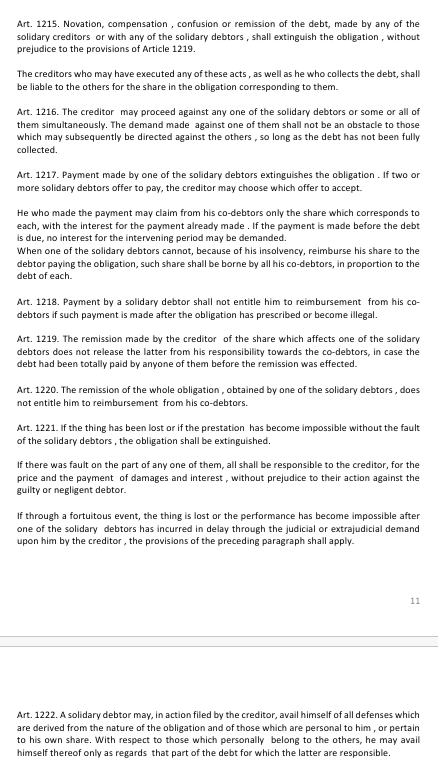
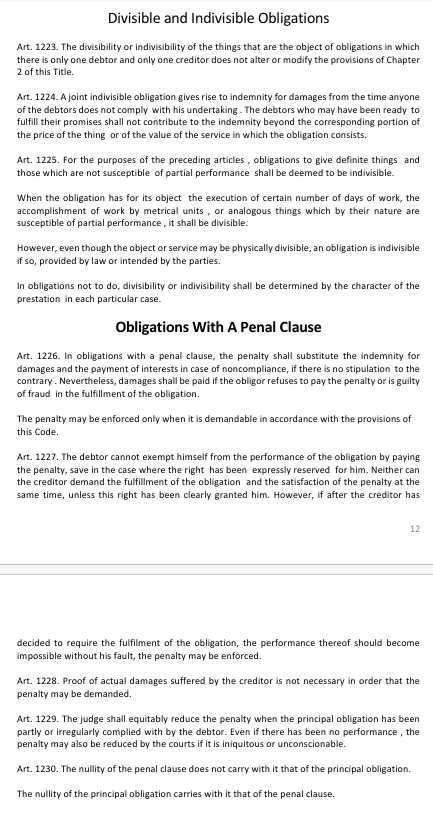
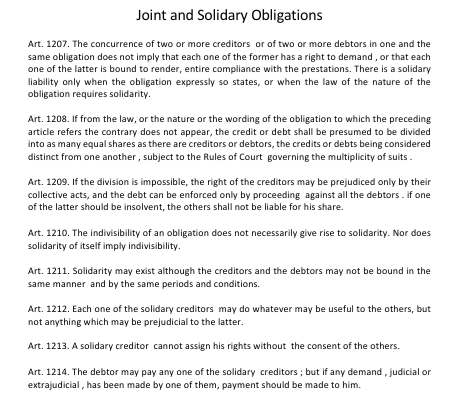
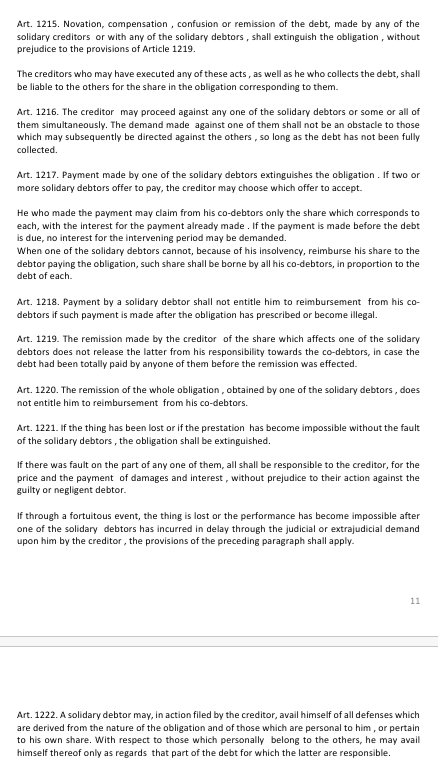
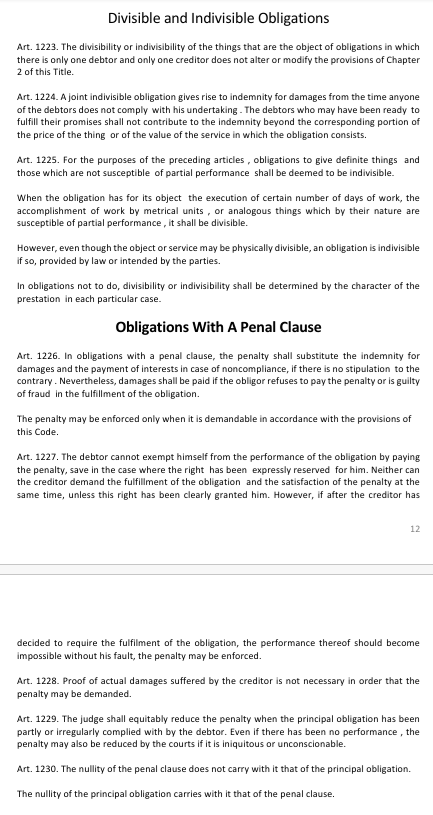
Joint and Solidary Obligations Art. 1207. The concurrence of two or more creditors or of two or more debtors in one and the same obligation does not imply that each one of the former has a right to demand , or that each one of the latter is bound to render, entire compliance with the prestations. There is a solidary liability only when the obligation expressly so states, or when the law of the nature of the obligation requires solidarity. Art. 1208. If from the law, or the nature or the wording of the obligation to which the preceding article refers the contrary does not appear, the credit or debt shall be presumed to be divided into as many equal shares as there are creditors or debtors, the credits or debts being considered distinct from one another , subject to the Rules of Court governing the multiplicity of suits - Art. 1209. If the division is impossible, the right of the creditors may be prejudiced only by their collective acts, and the debt can be enforced only by proceeding against all the debtors . If one of the latter should be insolvent, the others shall not be liable for his share. Art. 1210. The indivisibility of an obligation does not necessarily give rise to solidarity. Nor does solidarity of itself imply indivisibility. Art. 1211. Solidarity may exist although the creditors and the debtors may not be bound in the same manner and by the same periods and conditions. Art. 1212. Each one of the solidary creditors may do whatever may be useful to the others, but not anything which may be prejudicial to the latter. Art. 1213. A solidary creditor cannot assign his rights without the consent of the others. Art. 1214. The debtor may pay any one of the solidary creditors ; but if any demand , judicial or extrajudicial , has been made by one of them, payment should be made to him.Art. 1215. Novation, compensation , confusion or remission of the debt, made by any of the solidary creditors or with any of the solidary debtors , shall extinguish the obligation , without prejudice to the provisions of Article 1219. The creditors who may have executed any of these acts , as well as he who collects the debt, shall be liable to the others for the share in the obligation corresponding to them. Art. 1216. The creditor may proceed against any one of the solidary debtors or some or all of them simultaneously. The demand made against one of them shall not be an obstacle to those which may subsequently be directed against the others , so long as the debt has not been fully collected. Art. 1217. Payment made by one of the solidary debtors extinguishes the obligation . If two or more solidary debtors offer to pay, the creditor may choose which offer to accept. He who made the payment may claim from his co-debtors only the share which corresponds to each, with the interest for the payment already made . If the payment is made before the debt is due, no interest for the intervening period may be demanded. When one of the solidary debtors cannot, because of his insolvency, reimburse his share to the debtor paying the obligation, such share shall be borne by all his co-debtors, in proportion to the debt of each. Art. 1218. Payment by a solidary debtor shall not entitle him to reimbursement from his co- debtors if such payment is made after the obligation has prescribed or become illegal. Art. 1219. The remission made by the creditor of the share which affects one of the solidary debtors does not release the latter from his responsibility towards the co-debtors, in case the debt had been totally paid by anyone of them before the remission was effected. Art. 1220. The remission of the whole obligation , obtained by one of the solidary debtors , does not entitle him to reimbursement from his co-debtors. Art. 1221. If the thing has been lost or if the prestation has become impossible without the fault of the solidary debtors , the obligation shall be extinguished. If there was fault on the part of any one of them, all shall be responsible to the creditor, for the price and the payment of damages and interest , without prejudice to their action against the guilty or negligent debtor. If through a fortuitous event, the thing is lost or the performance has become impossible after one of the solidary debtors has incurred in delay through the judicial or extrajudicial demand upon him by the creditor , the provisions of the preceding paragraph shall apply- 11 Art. 1222. A solidary debtor may, in action filed by the creditor, avail himself of all defenses which are derived from the nature of the obligation and of those which are personal to him , or pertain to his own share. With respect to those which personally belong to the others, he may avail himself thereof only as regards that part of the debt for which the latter are responsible.Divisible and Indivisible Obligations Art. 1223. The divisibility or indivisibility of the things that are the object of obligations in which there is only one debtor and only one creditor does not alter or modify the provisions of Chapter 2 of this Title. Art. 1224. A joint indivisible obligation gives rise to indemnity for damages from the time anyone of the debtors does not comply with his undertaking . The debtors who may have been ready to fulfill their promises shall not contribute to the indemnity beyond the corresponding portion of the price of the thing or of the value of the service in which the obligation consists. Art. 1225. For the purposes of the preceding articles , obligations to give definite things and those which are not susceptible of partial performance shall be deemed to be indivisible. When the obligation has for its object the execution of certain number of days of work, the accomplishment of work by metrical units , or analogous things which by their nature are susceptible of partial performance , it shall be divisible. However, even though the object or service may be physically divisible, an obligation is indivisible If so, provided by law or intended by the parties. In obligations not to do, divisibility or indivisibility shall be determined by the character of the prestation in each particular case. Obligations With A Penal Clause Art. 1226. In obligations with a penal clause, the penalty shall substitute the indemnity for damages and the payment of interests in case of noncompliance, if there is no stipulation to the contrary . Nevertheless, damages shall be paid if the obligor refuses to pay the penalty or is guilty of fraud in the fulfillment of the obligation. The penalty may be enforced only when it is demandable in accordance with the provisions of this Code. Art. 1227. The debtor cannot exempt himself from the performance of the obligation by paying the penalty, save in the case where the right has been expressly reserved for him. Neither can the creditor demand the fulfillment of the obligation and the satisfaction of the penalty at the same time, unless this right has been clearly granted him. However, If after the creditor has 12 decided to require the fulfilment of the obligation, the performance thereof should become Impossible without his fault, the penalty may be enforced. Art. 1228. Proof of actual damages suffered by the creditor is not necessary in order that the penalty may be demanded. Art. 1229. The judge shall equitably reduce the penalty when the principal obligation has been partly or irregularly complied with by the debtor. Even if there has been no performance , the penalty may also be reduced by the courts if it is iniquitous or unconscionable. Art. 1230. The nullity of the penal clause does not carry with it that of the principal obligation. The nullity of the principal obligation carries with it that of the penal clause
Step by Step Solution
There are 3 Steps involved in it

Get step-by-step solutions from verified subject matter experts
 Study Help