







Question: Regular expressions are built up using three operations: union (?), concatenation (? or placing regular expressions next to one another), and Kleene star ( ?
Regular expressions are built up using three operations: union (?), concatenation (? or placing regular expressions next to one another), and Kleene star ( ? ). In this question, youll explore whether some of these are superfluous. Recall that regular expressions R1 and R2 are called equivalent if the languages they describe are equal sets, that is if L(R1) = L(R2).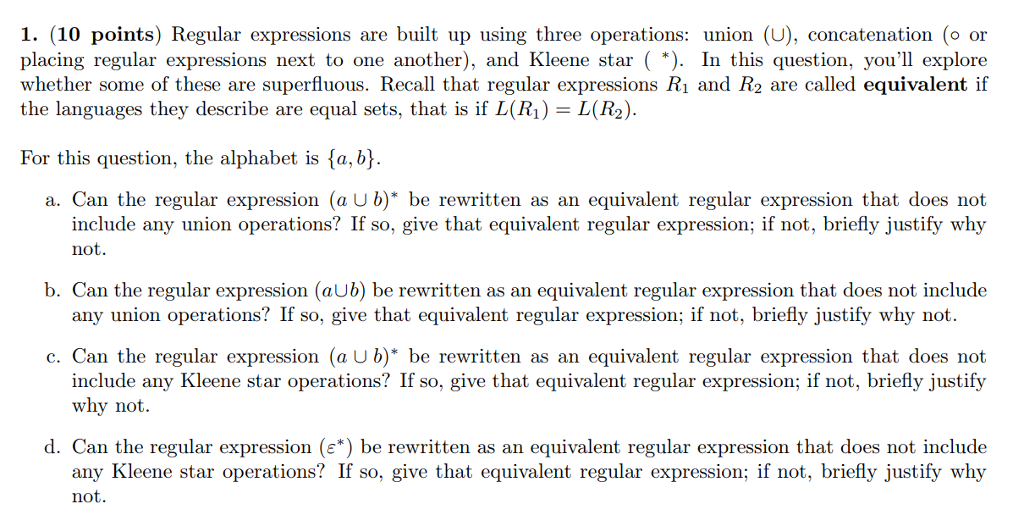
1. (10 points) Regular expressions are built up using three operations: union (U), concatenation (o or placing regular expressions next to one another), and Kleene star () In this question, you'll explore whether some of these are superfluous. Recall that regular expressions Ri and R2 are called equivalent if the languages they describe are equal sets, that is if L(R)L(R2). For this question, the alphabet is (a, b a. Can the regular expression (a U b)" be rewritten as an equivalent regular expression that does not include any union operations? If so, give that equivalent regular expression; if not, briefly justify why not. b. Can the regular expression (aUb) be rewritten as an equivalent regular expression that does not include any union operations? If so, give that equivalent regular expression; if not, briefly justify why not. c. Can the regular expression (aUb) be rewritten as an equivalent regular expression that does not include any Kleene star operations? If so, give that equivalent regular expression; if not, briefly justify why not. d. Can the regular expression (e*) be rewritten as an equivalent regular expression that does not include any Kleene star operations? If so, give that equivalent regular expression; if not, briefly justify why not
Step by Step Solution
There are 3 Steps involved in it

Get step-by-step solutions from verified subject matter experts
 Study Help