Question: Reiterates thesis, summarizes main points, identifies areas of recommendation, and/or draws conclusion(s) (1) References Cited Sensory Table Offers olfactory, tactile, auditory, and visual categories Provides
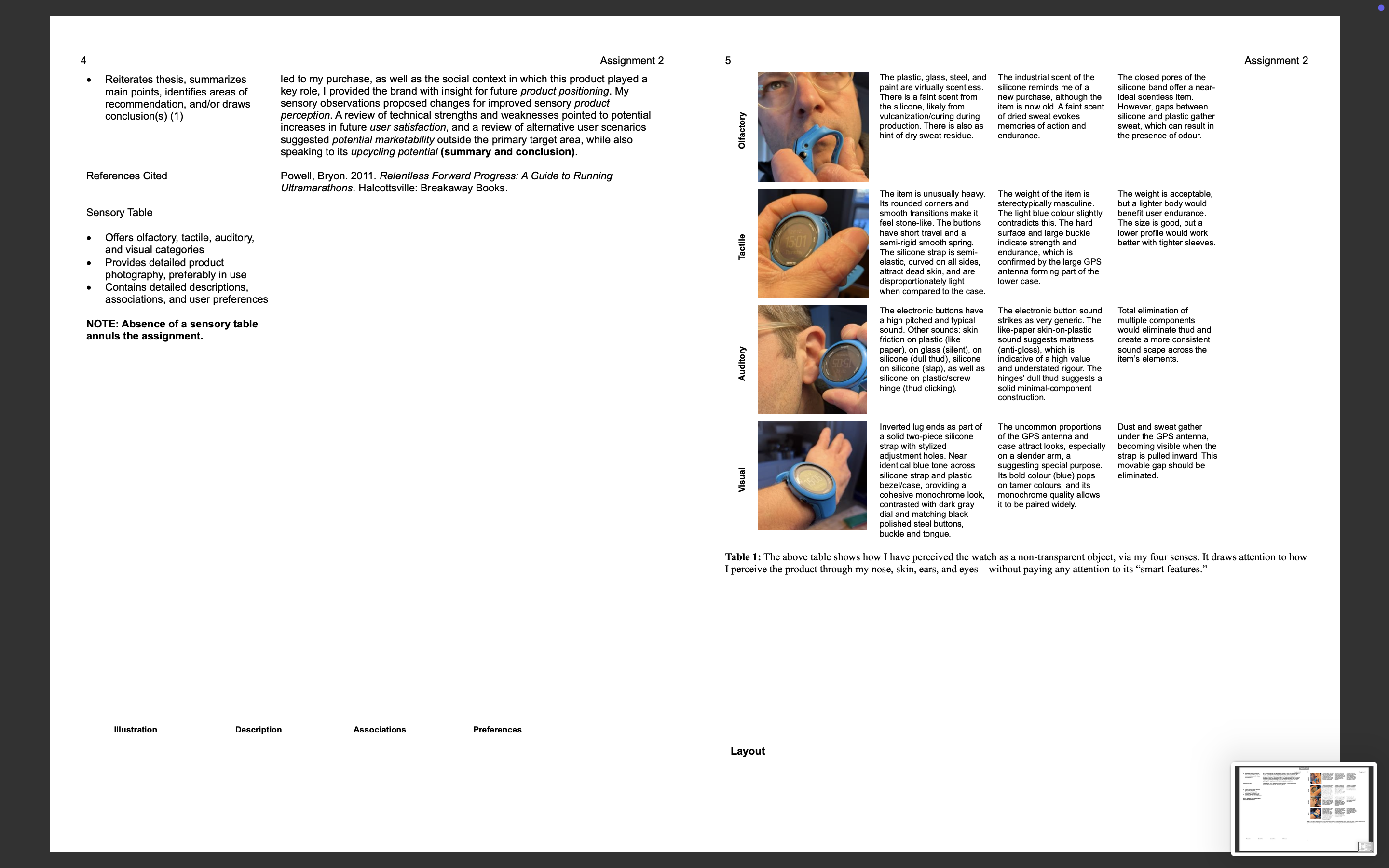
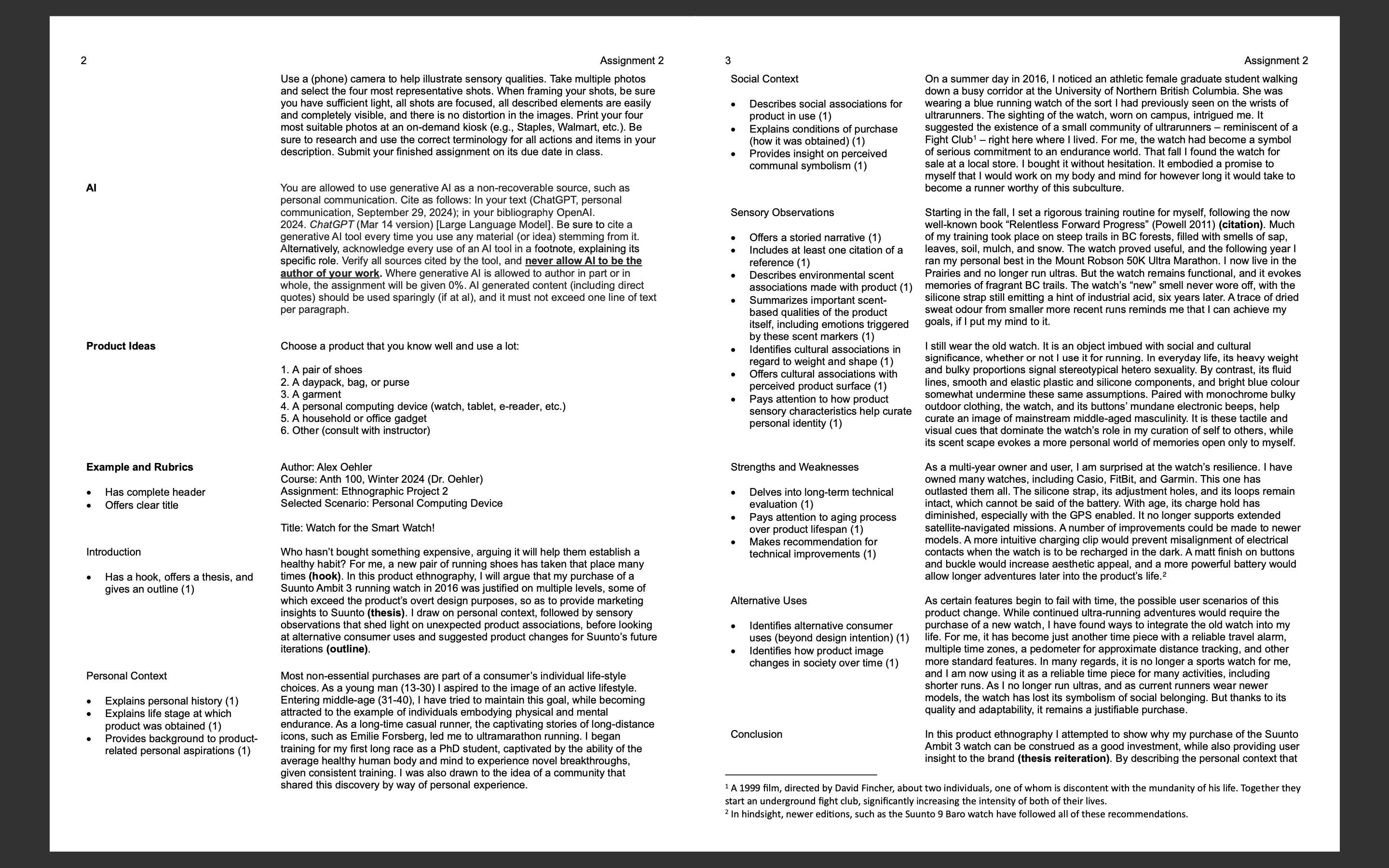
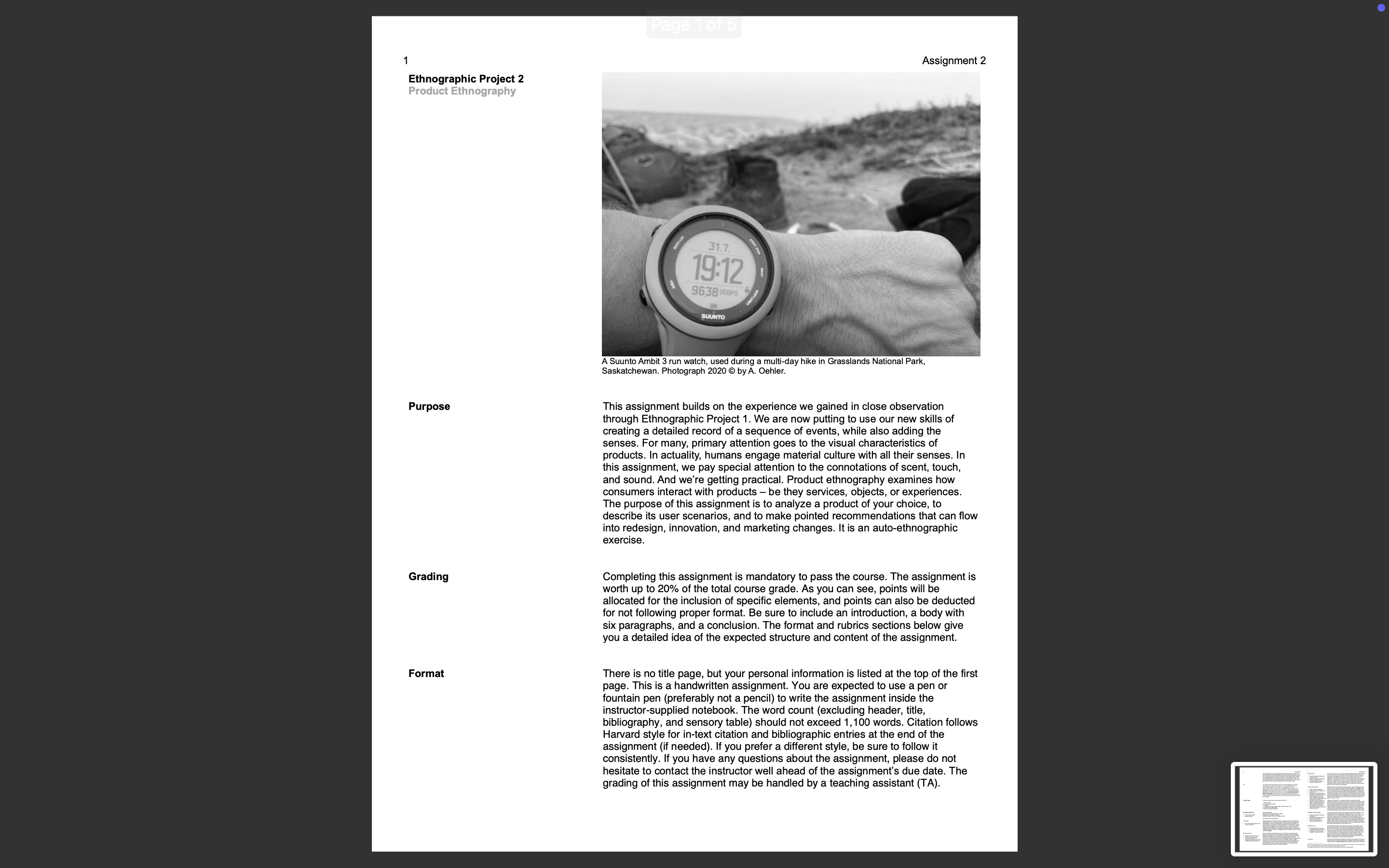
Reiterates thesis, summarizes main points, identifies areas of recommendation, and/or draws conclusion(s) (1) References Cited Sensory Table Offers olfactory, tactile, auditory, and visual categories Provides detailed product photography, preferably in use Contains detailed descriptions, associations, and user preferences NOTE: Absence of a sensory table annuls the assignment. Assignment 2 led to my purchase, as well as the social context in which this product played a key role, | provided the brand with insight for future product positioning. My sensory observations proposed changes for improved sensory product perception. A review of technical strengths and weaknesses pointed to potential increases in future user satisfaction, and a review of alternative user scenarios suggested potential marketability outside the primary target area, while also speaking to its upcycling potential (summary and conclusion). Powell, Bryon. 2011. Relentless Forward Progress: A Guide to Running Ultramarathons. Halcottsville: Breakaway Books. llustration Description Associations Preferences The plastic, glass, steel, and paint are virtually scentless. There is a faint scent from the silicone, likely from wulcanization/curing during production. There is also as. hint of dry sweat residue. The item is unusually heavy. Its rounded comers and smooth transitions make it feel stone-like. The buttons have short travel and a id smooth spring. The silicone strap is semi- elastic, curved on all sides, attract dead skin, and are disproportionately light when compared to the case. The electronic butions have a high pitched and typical sound. Other sounds: skin friction on plastic (like paper), on glass (silent), on silicone (dull thud), silicone on silicone (slap), as well as silicone on plastic/screw hinge (thud clicking). Inverted lug ends as part of a solid two-piece silicone strap with stylized adjustment holes. Near identical blue tone across silicone strap and plastic bezel/case, providing a cohesive monochrome look, contrasted with dark gray dial and matching black polished steel buttons, buckle and tongue. The industri silicone rer new purchase, although the item is now old. A faint scent of dried sweat evokes 'memories of action and endurance. The weight of the item is stereotypically masculine. The light blue colour siightly contradicts this. The hard surface and large buckle indicate strength and endurance, which is confirmed by the large GPS antenna forming part of the lower case. The electronic button sound strikes as very generic. The like-paper skin-on-plastic sound suggests mattness (anti-gloss), which is icative of a high value and understated rigour. The hinges' dull thud suggests a solid minimal-component construction. The uncommon proportions of the GPS antenna and case atiract looks, especially ona slender am, a suggesting special purpose. Its bold colour (blue) pops on tamer colours, and its monochrome quality allows itto be paired widely. Assignment 2 The closed pores of the icone band offer a near- ideal scentless item. However, gaps between icone and plastic gather sweat, which can resultin the presence of odour. The weight is acceptable, but a lighter body would benefit user endurance. The size is good, but a lower profile would work better with tighter sleeves. Total elimination of multiple components would eliminate thud and create a more consistent sound scape across the item's elements. Dust and sweat gather under the GPS antenna, becoming visible when the strap is pulled inward. This movable gap should be eliminated. Table 1: The above table shows how I have perceived the watch as a non-transparent object, via my four senses. It draws attention to how T perceive the product through my nose, skin, ears, and eyes without paying any attention to its \"smart features.\" Product Ideas Example and Rubrics Has complete header o Offers clear title Introduction * Has ahook, offers a thesis, and gives an outline (1) Personal Context Explains personal history (1) Explains life stage at which product was obtained (1) Provides background to product- related personal aspirations (1) Assignment 2 Use a (phone) camera to help illustrate sensory qualities. Take multiple photos and select the four most representative shots. When framing your shots, be sure you have sufficient light, all shots are focused, all described elements are easily and completely visible, and there is no distortion in the images. Print your four most suitable photos at an on-demand kiosk (e.g., Staples, Walmart, etc.). Be sure to research and use the correct terminology for all actions and items in your description. Submit your finished assignment on its due date in class. You are allowed to use generative Al as a non-recoverable source, such as personal communication. Cite as follows: In your text (ChatGPT, personal communication, September 29, 2024); in your bibliography OpenAl. 2024. ChatGPT (Mar 14 version) [Large Language Model]. Be sure to cite a generative Al tool every time you use any material (or idea) stemming from it. Alternatively, acknowledge every use of an Al tool in a footnote, explaining its specific role. Verify all sources cited by the tool, and never allow Al to be the author of your work. Where generative Al is allowed to author in part or in whole, the assignment will be given 0%. Al generated content (including direct quotes) should be used sparingly (if at al), and it must not exceed one line of text per paragraph. Choose a product that you know well and use a lot: 1. A pair of shoes 2. A daypack, bag, or purse 3. A garment 4. A personal computing device (watch, tablet, e-reader, etc.) 5. A household or office gadget 6. Other (consult with instructor) Author: Alex Oehler Course: Anth 100, Winter 2024 (Dr. Oehler) Assignment: Ethnographic Project 2 Selected Scenario: Personal Computing Device Title: Watch for the Smart Watch! Who hasn't bought something expensive, arguing it will help them establish a healthy habit? For me, a new pair of running shoes has taken that place many times (hook). In this product ethnography, | will argue that my purchase of a Suunto Ambit 3 running watch in 2016 was justified on multiple levels, some of which exceed the product's overt design purposes, so as to provide marketing insights to Suunto (thesis). | draw on personal context, followed by sensory observations that shed light on unexpected product associations, before looking at alternative consumer uses and suggested product changes for Suunto's future iterations (outline). Most non-essential purchases are part of a consumer's individual life-style choices. As a young man (13-30) | aspired to the image of an active lifestyle. Entering middie-age (31-40), | have tried to maintain this goal, while becoming attracted to the example of individuals embodying physical and mental endurance. As a long-time casual runner, the captivating stories of long-distance icons, such as Emilie Forsberg, led me to ultramarathon running. | began training for my first long race as a PhD student, captivated by the ability of the average healthy human body and mind to experience novel breakthroughs, given consistent training. | was also drawn to the idea of a community that shared this discovery by way of personal experience. 3 Social Context Describes social associations for product in use (1) Explains conditions of purchase (how it was obtained) (1) Provides insight on perceived communal symbolism (1) Sensory Observations Offers a storied narrative (1) Includes at least one citation of a reference (1) Describes environmental scent associations made with product (1) Summarizes important scent- based qualities of the product itself, including emotions triggered by these scent markers (1) Identifies cultural associations in regard to weight and shape (1) Offers cultural associations with perceived product surface (1) Pays attention to how product sensory characteristics help curate personal identity (1) Strengths and Weaknesses o Delves into long-term technical evaluation (1) Pays attention to aging process over product lifespan (1) Makes recommendation for technical improvements (1) Alternative Uses Identifies alternative consumer uses (beyond design intention) (1) Identifies how product image changes in society over time (1) Conclusion Assignment 2 On a summer day in 2016, | noticed an athletic female graduate student walking down a busy corridor at the University of Northern British Columbia. She was wearing a blue running watch of the sort | had previously seen on the wrists of ultrarunners. The sighting of the watch, worn on campus, intrigued me. It suggested the existence of a small community of ultrarunners reminiscent of a Fight Club' right here where | lived. For me, the watch had become a symbol of serious commitment to an endurance world. That fall I found the watch for sale at a local store. | bought it without hesitation. It embodied a promise to myself that | would work on my body and mind for however long it would take to become a runner worthy of this subculture. Starting in the fall, | set a rigorous training routine for myself, following the now well-known book \"Relentless Forward Progress\" (Powell 2011) (citation). Much of my training took place on steep trails in BC forests, filled with smells of sap, leaves, soil, mulch, and snow. The watch proved useful, and the following year | ran my personal best in the Mount Robson 50K Ultra Marathon. | now live in the Prairies and no longer run ultras. But the watch remains functional, and it evokes memories of fragrant BC trails. The watch's \"new\" smell never wore off, with the silicone strap still emitting a hint of industrial acid, six years later. A trace of dried sweat odour from smaller more recent runs reminds me that | can achieve my goals, if | put my mind to it. | still wear the old watch. It is an object imbued with social and cultural significance, whether or not | use it for running. In everyday life, its heavy weight and bulky proportions signal stereotypical hetero sexuality. By contrast, its fluid lines, smooth and elastic plastic and silicone components, and bright blue colour somewhat undermine these same assumptions. Paired with monochrome bulky outdoor clothing, the watch, and its buttons' mundane electronic beeps, help curate an image of mainstream middle-aged masculinity. It is these tactile and visual cues that dominate the watch's role in my curation of self to others, while its scent scape evokes a more personal world of memories open only to myself. As a multi-year owner and user, | am surprised at the watch's resilience. | have owned many watches, including Casio, FitBit, and Garmin. This one has outlasted them all. The silicone strap, its adjustment holes, and its loops remain intact, which cannot be said of the battery. With age, its charge hold has diminished, especially with the GPS enabled. It no longer supports extended satellite-navigated missions. A number of improvements could be made to newer models. A more intuitive charging clip would prevent misalignment of electrical contacts when the watch is to be recharged in the dark. A matt finish on buttons and buckle would increase aesthetic appeal, and a more powerful battery would allow longer adventures later into the product's life.2 As certain features begin to fail with time, the possible user scenarios of this product change. While continued ultra-running adventures would require the purchase of a new watch, | have found ways to integrate the old watch into my life. For me, it has become just another time piece with a reliable travel alarm, multiple time zones, a pedometer for approximate distance tracking, and other more standard features. In many regards, it is no longer a sports watch for me, and | am now using it as a reliable time piece for many activities, including shorter runs. As | no longer run ultras, and as current runners wear newer models, the watch has lost its symbolism of social belonging. But thanks to its quality and adaptability, it remains a justifiable purchase. In this product ethnography | attempted to show why my purchase of the Suunto Ambit 3 watch can be construed as a good investment, while also providing user insight to the brand (thesis reiteration). By describing the personal context that A 1999 film, directed by David Fincher, about two individuals, one of whom is discontent with the mundanity of his life. Together they start an underground fight club, significantly increasing the intensity of both of their lives. 2In hindsight, newer editions, such as the Suunto 9 Baro watch have followed all of these recommendations. 1 Ethnographic Project 2 Purpose Grading Format Assignment 2 A Suunto Ambit 3 run watch, used during a multi-day hike in Grasslands National Park, Saskatchewan. Photograph 2020 by A. Oehler. This assignment builds on the experience we gained in close observation through Ethnographic Project 1. We are now putting to use our new skills of creating a detailed record of a sequence of events, while also adding the senses. For many, primary attention goes to the visual characteristics of products. In actuality, humans engage material culture with all their senses. In this assignment, we pay special attention to the connotations of scent, touch, and sound. And we're getting practical. Product ethnography examines how consumers interact with products be they services, objects, or experiences. The purpose of this assignment is to analyze a product of your choice, to describe its user scenarios, and to make pointed recommendations that can flow into redesign, innovation, and marketing changes. It is an auto-ethnographic exercise. Completing this assignment is mandatory to pass the course. The assignment is worth up to 20% of the total course grade. As you can see, points will be allocated for the inclusion of specific elements, and points can also be deducted for not following proper format. Be sure to include an introduction, a body with six paragraphs, and a conclusion. The format and rubrics sections below give you a detailed idea of the expected structure and content of the assignment. There is no title page, but your personal information is listed at the top of the first page. This is a handwritten assignment. You are expected to use a pen or fountain pen (preferably not a pencil) to write the assignment inside the instructor-supplied notebook. The word count (excluding header, title, bibliography, and sensory table) should not exceed 1,100 words. Citation follows Harvard style for in-text citation and bibliographic entries at the end of the assignment (if needed). If you prefer a different style, be sure to follow it consistently. If you have any questions about the assignment, please do not hesitate to contact the instructor well ahead of the assignment's due date. The grading of this assignment may be handled by a teaching assistant (TA)
Step by Step Solution
There are 3 Steps involved in it
1 Expert Approved Answer
Step: 1 Unlock
Question Has Been Solved by an Expert!
Get step-by-step solutions from verified subject matter experts
Step: 2 Unlock
Step: 3 Unlock
Students Have Also Explored These Related Business Writing Questions!









 Study Help