







Question: Relation scheme diagram OBJECTIVE: INTRODUCTION: Provide practice in the use & mechanics of using colliding foreign keys to enforce a business rule. In general, the
Relation scheme diagram
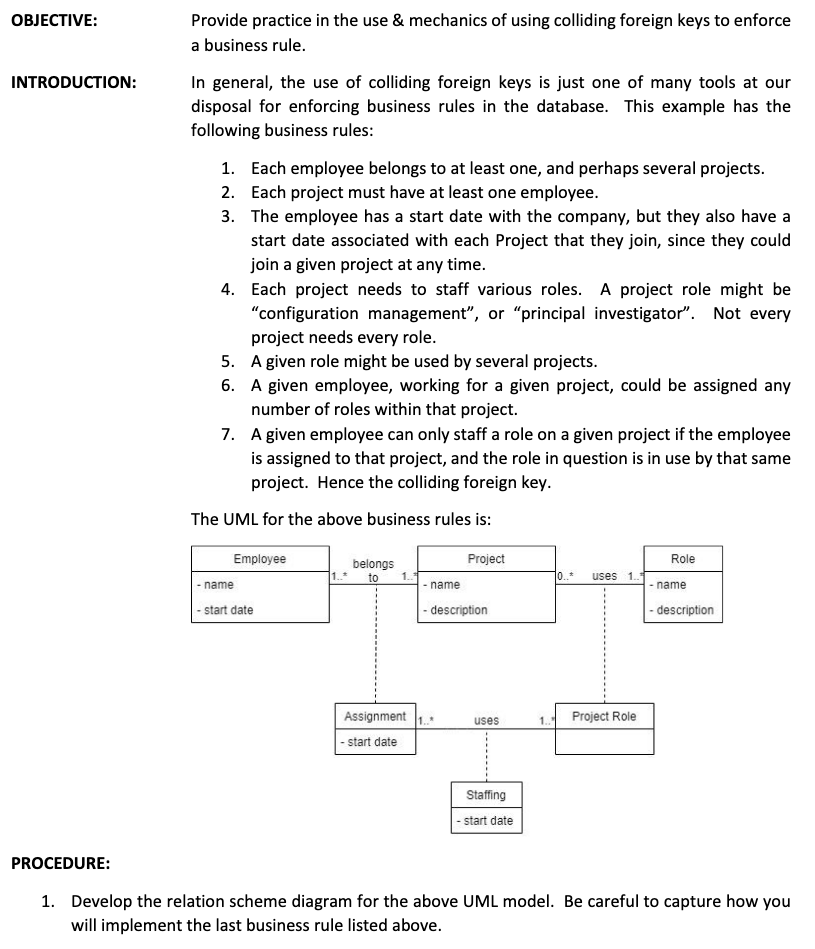
OBJECTIVE: INTRODUCTION: Provide practice in the use & mechanics of using colliding foreign keys to enforce a business rule. In general, the use of colliding foreign keys is just one of many tools at our disposal for enforcing business rules in the database. This example has the following business rules: 1. Each employee belongs to at least one, and perhaps several projects. 2. Each project must have at least one employee. 3. The employee has a start date with the company, but they also have a start date associated with each Project that they join, since they could join a given project at any time. 4. Each project needs to staff various roles. A project role might be "configuration management", or "principal investigator. Not every project needs every role. 5. A given role might be used by several projects. 6. A given employee, working for a given project, could be assigned any number of roles within that project. 7. A given employee can only staff a role on a given project if the employee is assigned to that project, and the role in question is in use by that same project. Hence the colliding foreign key. The UML for the above business rules is: Project belongs 11.. to 10.* Employee - name - start date uses 1.. - name Role -name - description description uses 1. Project Role Assignment - start date Staffing - start date PROCEDURE: 1. Develop the relation scheme diagram for the above UML model. Be careful to capture how you will implement the last business rule listed above
Step by Step Solution
There are 3 Steps involved in it

Get step-by-step solutions from verified subject matter experts
 Study Help