







Question: Relational Algebra Question Can you please solve the question c and d? I know there is a policy but if you can solve them all
Relational Algebra Question
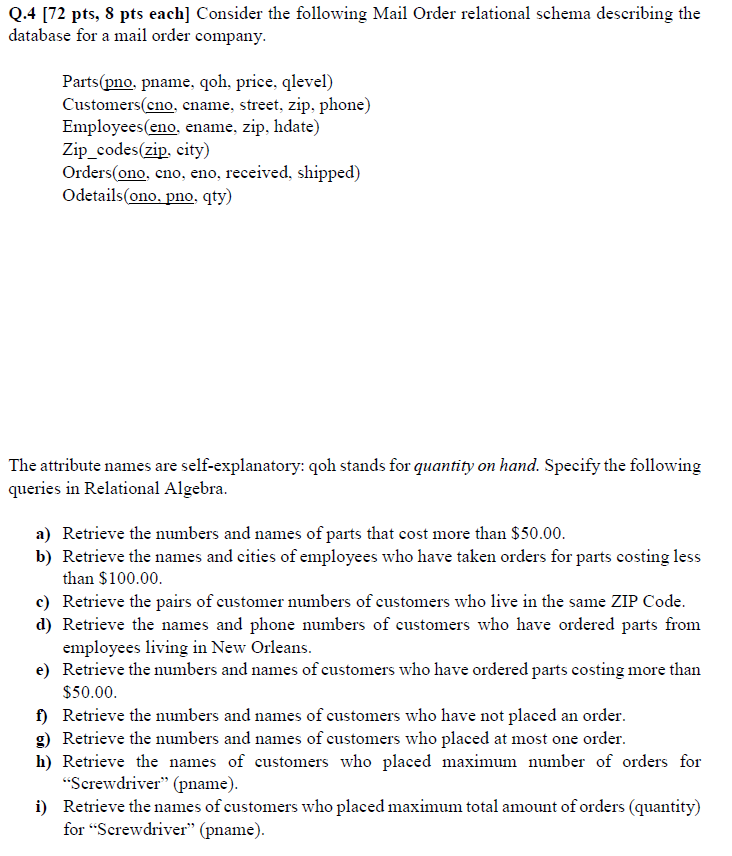 Can you please solve the question c and d? I know there is a policy but if you can solve them all much appreciated :)
Can you please solve them step by step and write your assumptions? Also, can you please write down why you used that operation and what does it do for this question? Simply, can you please explain your approach to the problem and how you solve it? Thank you so much :)
Q.4 [72 pts, 8 pts each] Consider the following Mail Order relational schema describing the database for a mail order company. Parts(pno, pname, qoh, price, Zlevel) Customers(cno, cname, street, zip, phone) Employees(eno, ename, zip, hdate) Zip codes(zip, city) Orders(ono, cno, eno, received, shipped) Odetails (ono, pno, qty) The attribute names are self-explanatory: qoh stands for quantity on hand. Specify the following queries in Relational Algebra. a) Retrieve the numbers and names of parts that cost more than $50.00. b) Retrieve the names and cities of employees who have taken orders for parts costing less than $100.00. c) Retrieve the pairs of customer numbers of customers who live in the same ZIP Code. d) Retrieve the names and phone numbers of customers who have ordered parts from employees living in New Orleans. e) Retrieve the numbers and names of customers who have ordered parts costing more than $50.00 f) Retrieve the numbers and names of customers who have not placed an order. g) Retrieve the numbers and names of customers who placed at most one order. h) Retrieve the names of customers who placed maximum number of orders for Screwdriver" (pname). i) Retrieve the names of customers who placed maximum total amount of orders (quantity) for Screwdriver" (pname)
Step by Step Solution
There are 3 Steps involved in it

Get step-by-step solutions from verified subject matter experts
 Study Help