



Question: Relays are especially common within industrial settings. The machine is essentially an electromechanical switch that facilitates the opening and closing of electrical contacts. An example
Relays are especially common within industrial settings. The machine is essentially an electromechanical switch that facilitates the opening and closing of electrical contacts. An example relay is shown in Fig. 1 below and operates as follows: 1) when a push-button is pressed, electric current flows through the coil, generating a field in the magnetic structure; 2) the force that is generated draws the movable component toward the fixed component, enabling an electrical contact to be made. The big advantage of using a relay is that a relatively low-level current can be used to control the opening and closing of a circuit that can carry large currents. In the example below, a 120 VAC contact energizes the relay, making a connection in a 240 VAC circuit. Fig. 2 provides common circuit symbols for relays.
YOUR TASK: For the relay shown in Fig. 3, calculate the smallest current necessary to hold the ferromagnetic plate at a distance of 0.5 cm from the stationary core given that the torque is 10 N-m.For this task, assume the core material is infinitely permeable. Leakage and fringing can be neglected. The core depth is 1 cm.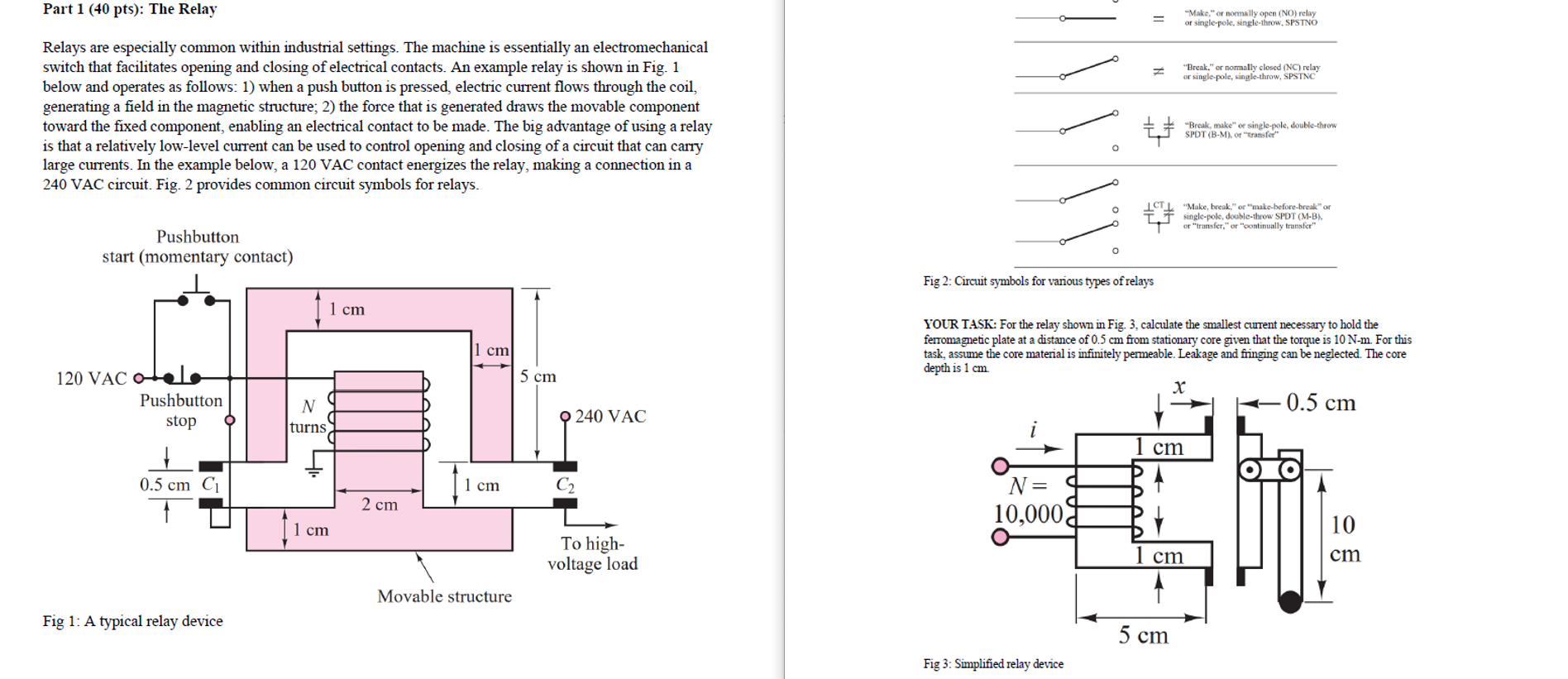
Part 1 (40 pts): The Relay "Make," or normally open (NO) relay or single-pole,single-throw, SPSTNO "Break," or normally closed (NC) relay or single pole,single-throw, SPSTNC Relays are especially common within industrial settings. The machine is essentially an electromechanical switch that facilitates opening and closing of electrical contacts. An example relay is shown in Fig. 1 below and operates as follows: 1) when a push button is pressed, electric current flows through the coil, generating a field in the magnetic structure; 2) the force that is generated draws the movable component toward the fixed component, enabling an electrical contact to be made. The big advantage of using a relay is that a relatively low-level current can be used to control opening and closing of a circuit that can carry large currents. In the example below, a 120 VAC contact energizes the relay, making a connection in a 240 VAC circuit. Fig. 2 provides common circuit symbols for relays. I "Break, make" or single-pole, double-throw SPDT (B-M), or transfer ICTL. "Make, break," or "make-before-break" or IT single-pole, double-throw SPDT (M-B) or "transfer," or "continually transfer" Pushbutton start (momentary contact) o Fig 2: Circuit symbols for various types of relays 1 cm cm YOUR TASK: For the relay shown in Fig. 3. calculate the smallest curent necessary to hold the ferromagnetic plate at a distance of 0.5 cm from stationary core given that the torque is 10 N-m. For this task, assume the core material is infinitely permeable. Leakage and fringing can be neglected. The core depth is 1 cm 0.5 cm 120 VAC Otels Pushbutton stop 5 cm N turns 240 VAC 1 cm 0.5 cm C 1 cm 2 cm N= 10,0003 1 cm 10 To high- 1 cm cm voltage load Movable structure Fig 1: A typical relay device 5 cm Fig 3: Simplified relay device Part 1 (40 pts): The Relay "Make," or normally open (NO) relay or single-pole,single-throw, SPSTNO "Break," or normally closed (NC) relay or single pole,single-throw, SPSTNC Relays are especially common within industrial settings. The machine is essentially an electromechanical switch that facilitates opening and closing of electrical contacts. An example relay is shown in Fig. 1 below and operates as follows: 1) when a push button is pressed, electric current flows through the coil, generating a field in the magnetic structure; 2) the force that is generated draws the movable component toward the fixed component, enabling an electrical contact to be made. The big advantage of using a relay is that a relatively low-level current can be used to control opening and closing of a circuit that can carry large currents. In the example below, a 120 VAC contact energizes the relay, making a connection in a 240 VAC circuit. Fig. 2 provides common circuit symbols for relays. I "Break, make" or single-pole, double-throw SPDT (B-M), or transfer ICTL. "Make, break," or "make-before-break" or IT single-pole, double-throw SPDT (M-B) or "transfer," or "continually transfer" Pushbutton start (momentary contact) o Fig 2: Circuit symbols for various types of relays 1 cm cm YOUR TASK: For the relay shown in Fig. 3. calculate the smallest curent necessary to hold the ferromagnetic plate at a distance of 0.5 cm from stationary core given that the torque is 10 N-m. For this task, assume the core material is infinitely permeable. Leakage and fringing can be neglected. The core depth is 1 cm 0.5 cm 120 VAC Otels Pushbutton stop 5 cm N turns 240 VAC 1 cm 0.5 cm C 1 cm 2 cm N= 10,0003 1 cm 10 To high- 1 cm cm voltage load Movable structure Fig 1: A typical relay device 5 cm Fig 3: Simplified relay device
Step by Step Solution
There are 3 Steps involved in it

Get step-by-step solutions from verified subject matter experts