







Question: Remaining How Did I Do ? Uses: ( 2 / 3 ) Consider a simple harmonic oscillator that consists of a 1
Remaining "How Did I Do Uses:
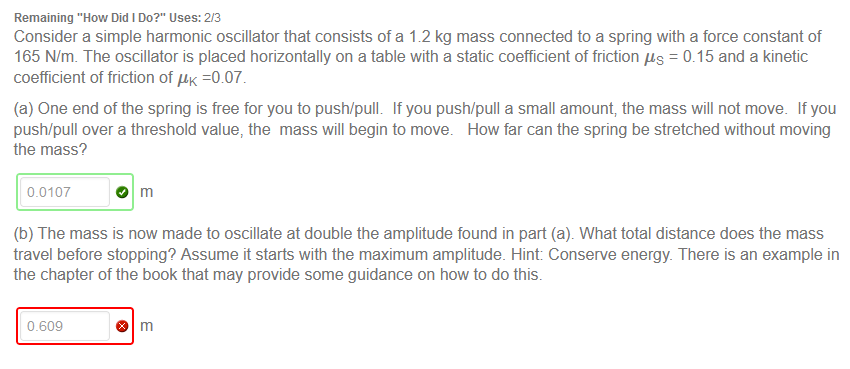
Consider a simple harmonic oscillator that consists of a kg mass connected to a spring with a force constant of mathrm~Nmathrmm The oscillator is placed horizontally on a table with a static coefficient of friction mumathrmS and a kinetic coefficient of friction of mumathrmK
a One end of the spring is free for you to pushpull If you pushpull a small amount, the mass will not move. If you pushpull over a threshold value, the mass will begin to move. How far can the spring be stretched without moving the mass?
b The mass is now made to oscillate at double the amplitude found in part a What total distance does the mass travel before stopping? Assume it starts with the maximum amplitude. Hint: Conserve energy. There is an example in the chapter of the book that may provide some guidance on how to do this.
Step by Step Solution
There are 3 Steps involved in it
1 Expert Approved Answer
Step: 1 Unlock

Question Has Been Solved by an Expert!
Get step-by-step solutions from verified subject matter experts
Step: 2 Unlock
Step: 3 Unlock
 Study Help