







Question: Look at the given synthesis and the provided reagents. Fill in the blanks with the single letter codeof the appropriate reagent, or the appropriate

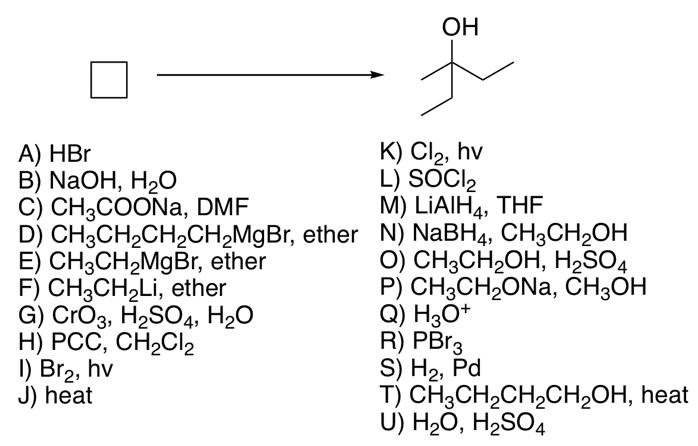

Look at the given synthesis and the provided reagents. Fill in the blanks with the single letter codeof the appropriate reagent, or the appropriate descriptive vocabulary word/phrase for non-reagents to complete the synthesis and description. spelling. carefully! OH A) HBr B) NaOH, HO C) CH3COONa, DMF K) Cl2, hv L) SOCI M) LiAlH4, THF D) CH3CH2CH2CH2MgBr, ether N) NaBH4, CH3CH2OH E) CH3CH2MgBr, ether F) CH3CH2Li, ether G) CrO3, H2SO4, HO H) PCC, CH2Cl2 I) Br2, hv J) heat O) CH3CH2OH, H2SO4 P) CH3CH2ON, CH3OH Q) H3O+ R) PB3 S) H2, Pd T) CH3CH2CH2CH2OH, heat U) H2O, H2SO4 -First we add reagent S to form the molecule butane (IUPAC name). -Then reagent / to form a bromo functional group in a free radical bromination reaction. -This can be converted to a functional group hydroxyl by first adding reagent C in a SN2 mechanism then following up with reagent U to give the desired group via a Ester Hydrolysis reaction. -A(n) oxidation (oxidation, reduction, substitution, hydrolysis, other) with reagent H will give the functional group carbonyl, which can be reacted first with E followed by reagent Q workup to give the desired product.
Step by Step Solution
There are 3 Steps involved in it
Solutions Step 1 Oxidizing agent ... View full answer

Get step-by-step solutions from verified subject matter experts
 Study Help