Question: Repor format for engineering economic tasks . Problem identification Policy issues Environmental issue Economic issue All about the task Alternative #1 proposal Analysis of economic
Repor format for engineering economic tasks.
- Problem identification
- Policy issues
- Environmental issue
- Economic issue
- All about the task
- Alternative #1 proposal
- Analysis of economic data in supporting the proposal.
- Reasons for having alternative #1
- Integrate the analysis with the support criteria assessment set by the group.
- Alternative # 2 proposal
- Analysis of economic data in supporting the proposal.
- Reasons for having alternative#2
- Integrate the analysis with the support criteria assessment set by the group.
- Alternatives #3 proposal
- Analysis of economic data in supporting the proposal.
- Reasons for having alternative #3
- Integrate the analysis with the support criteria assessment set by the group.
- Decision making.
- Reason for having the conclusion as mentioned in 9.
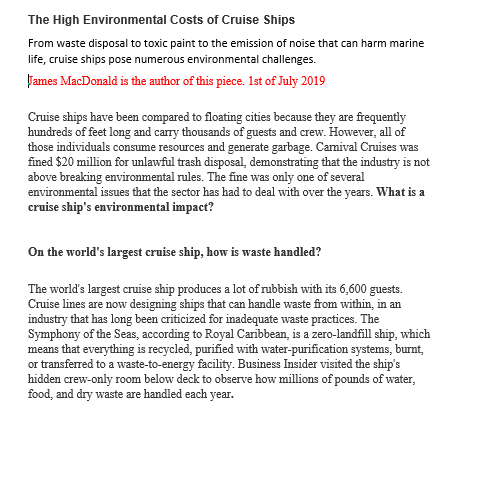
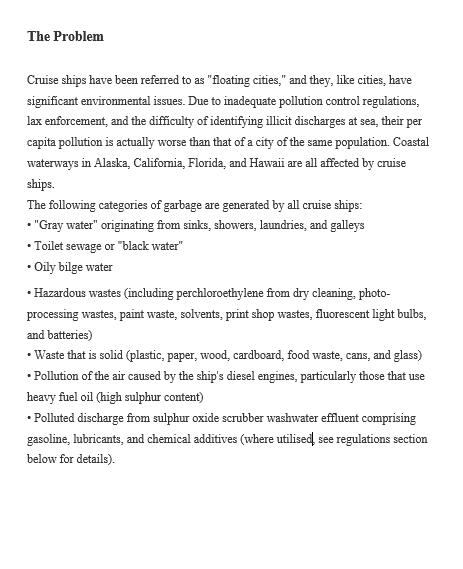
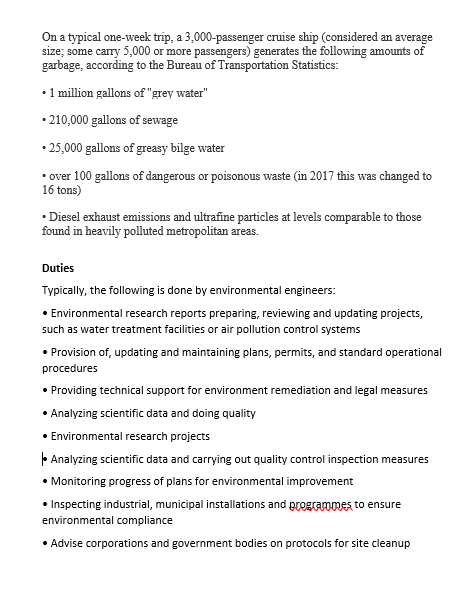
The High Environmental Costs of Cruise Ships From waste disposal to toxic paint to the emission of noise that can harm marine life, cruise ships pose numerous environmental challenges. James MacDonald is the author of this piece. 1st of July 2019 Cruise ships have been compared to floating cities because they are frequently hundreds of feet long and carry thousands of guests and crew. However, all of those individuals consume resources and generate garbage. Carnival Cruises was fined $20 million for unlawful trash disposal, demonstrating that the industry is not above breaking environmental rules. The fine was only one of several environmental issues that the sector has had to deal with over the years. What is a cruise ship's environmental impact? On the world's largest cruise ship, how is waste handled? The world's largest cruise ship produces a lot of rubbish with its 6,600 guests. Cruise lines are now designing ships that can handle waste from within, in an industry that has long been criticized for inadequate waste practices. The Symphony of the Seas, according to Royal Caribbean, is a zero-landfill ship, which means that everything is recycled, purified with water-purification systems, burnt, or transferred to a waste-to-energy facility. Business Insider visited the ship's hidden crew-only room below deck to observe how millions of pounds of water, food and dry waste are handled each year. The Problem Cruise ships have been referred to as "floating cities," and they, like cities, have significant environmental issues. Due to inadequate pollution control regulations, lax enforcement, and the difficulty of identifying illicit discharges at sea, their per capita pollution is actually worse than that of a city of the same population. Coastal waterways in Alaska, California, Florida, and Hawaii are all affected by cruise ships The following categories of garbage are generated by all cruise ships: "Gray water" originating from sinks, showers, laundries, and galleys Toilet sewage or "black water" Oily bilge water Hazardous wastes (including perchloroethylene from dry cleaning, photo- processing wastes, paint waste, solvents, print shop wastes, fluorescent light bulbs, and batteries) Waste that is solid (plastic, paper, wood, cardboard, food waste, cans, and glass) Pollution of the air caused by the ship's diesel engines, particularly those that use heavy fuel oil (high sulphur content) Polluted discharge from sulphur oxide scrubber washwater effluent comprising gasoline, lubricants, and chemical additives (where utilised see regulations section below for details). On a typical one-week trip, a 3,000-passenger cruise ship (considered an average size: some carry 5,000 or more passengers) generates the following amounts of garbage, according to the Bureau of Transportation Statistics: 1 million gallons of "grey water" 210,000 gallons of sewage 25,000 gallons of greasy bilge water over 100 gallons of dangerous or poisonous waste (in 2017 this was changed to 16 tons) Diesel exhaust emissions and ultrafine particles at levels comparable to those found in heavily polluted metropolitan areas. Duties Typically, the following is done by environmental engineers: Environmental research reports preparing, reviewing and updating projects, such as water treatment facilities or air pollution control systems Provision of, updating and maintaining plans, permits, and standard operational procedures Providing technical support for environment remediation and legal measures Analyzing scientific data and doing quality Environmental research projects | Analyzing scientific data and carrying out quality control inspection measures Monitoring progress of plans for environmental improvement Inspecting industrial, municipal installations and programmes to ensure environmental compliance Advise corporations and government bodies on protocols for site cleanup









 Study Help