Question: represent the horizontal Will use t (time) for the horizontal axis and h (height) Equations/Formulas You Will Need: 1 . h (t ) = -16+2
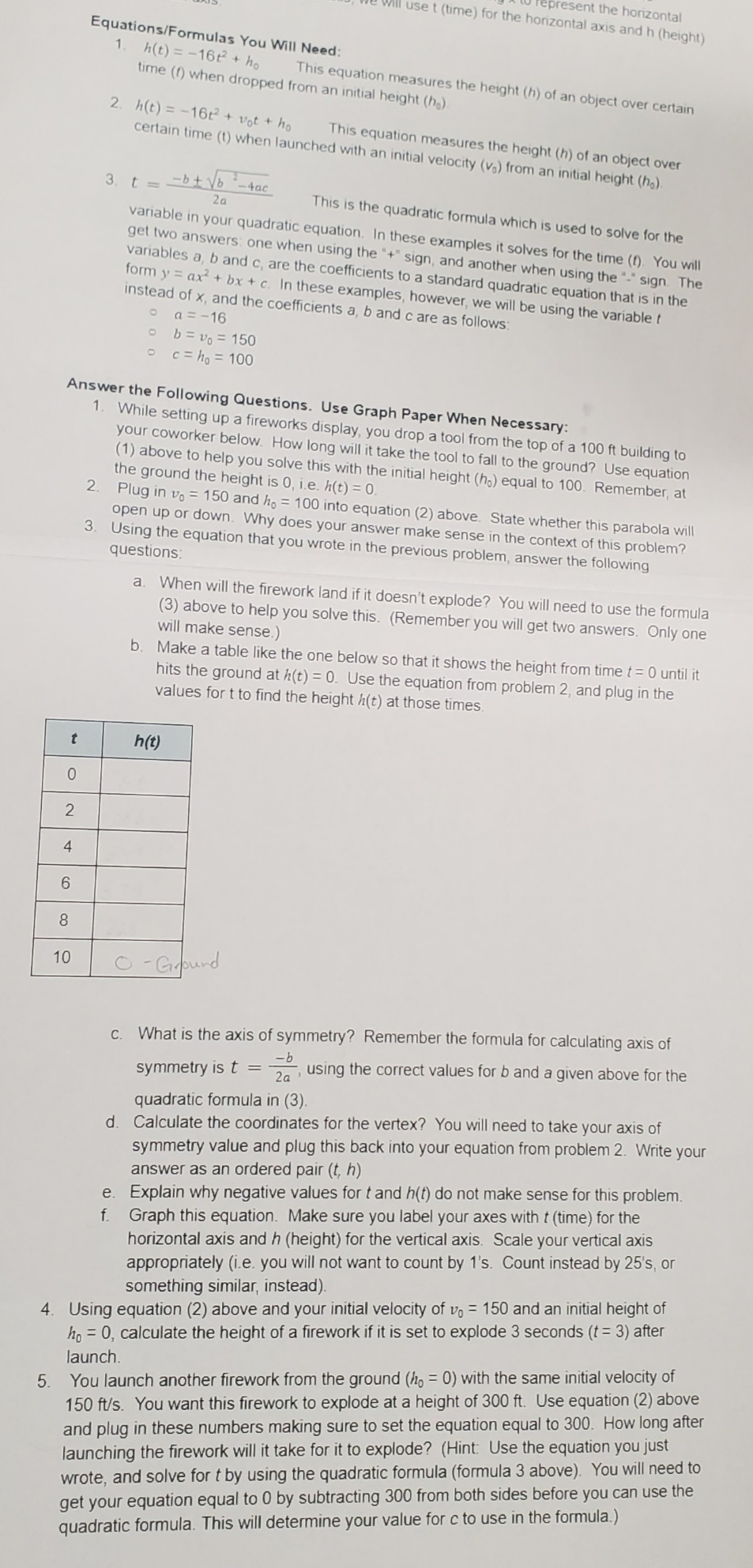
represent the horizontal Will use t (time) for the horizontal axis and h (height) Equations/Formulas You Will Need: 1 . h (t ) = -16+2 + ho This equation measures the height (h) of an object over certain time (() when dropped from an initial height (ho) 2. h(t) =-16t2+ Not + ho This equation measures the height (h) of an object over certain time (t) when launched with an initial velocity (Va) from an initial height (ho) 3. t - -b+ \\b -4ac 2a This is the quadratic formula which is used to solve for the variable in your quadratic equation. In these examples it solves for the time (t). You will get two answers: one when using the "+" sign, and another when using the "-" sign. The variables a, b and c, are the coefficients to a standard quadratic equation that is in the form y = ax? + bx + c. In these examples, however, we will be using the variable instead of x, and the coefficients a, b and c are as follows: o a=-16 o b = vo = 150 c= ho = 100 Answer the Following Questions. Use Graph Paper When Necessary: 1. While setting up a fireworks display, you drop a tool from the top of a 100 ft building to your coworker below. How long will it take the tool to fall to the ground? Use equation (1) above to help you solve this with the initial height (ho) equal to 100. Remember, at the ground the height is 0, i.e. h(t) = 0. 2. Plug in vo = 150 and ho = 100 into equation (2) above. State whether this parabola will open up or down. Why does your answer make sense in the context of this problem? 3. Using the equation that you wrote in the previous problem, answer the following questions: a. When will the firework land if it doesn't explode? You will need to use the formula (3) above to help you solve this. (Remember you will get two answers. Only one will make sense.) b. Make a table like the one below so that it shows the height from time t = 0 until it hits the ground at h(t) = 0. Use the equation from problem 2, and plug in the values for t to find the height h(t) at those times. h (t) O 2 4 6 10 O - Ground C. What is the axis of symmetry? Remember the formula for calculating axis of - b symmetry is t = 2, using the correct values for b and a given above for the quadratic formula in (3). d. Calculate the coordinates for the vertex? You will need to take your axis of symmetry value and plug this back into your equation from problem 2. Write your answer as an ordered pair (t, h) Explain why negative values for t and h(t) do not make sense for this problem. e. f. Graph this equation. Make sure you label your axes with t (time) for the horizontal axis and h (height) for the vertical axis. Scale your vertical axis appropriately (i.e. you will not want to count by 1's. Count instead by 25's, or something similar, instead). 4. Using equation (2) above and your initial velocity of vo = 150 and an initial height of ho = 0, calculate the height of a firework if it is set to explode 3 seconds (t = 3) after launch. 5. You launch another firework from the ground (h, = 0) with the same initial velocity of 150 ft/s. You want this firework to explode at a height of 300 ft. Use equation (2) above and plug in these numbers making sure to set the equation equal to 300. How long after launching the firework will it take for it to explode? (Hint: Use the equation you just wrote, and solve for t by using the quadratic formula (formula 3 above). You will need to get your equation equal to 0 by subtracting 300 from both sides before you can use the quadratic formula. This will determine your value for c to use in the formula.)









 Study Help