







Question: Representing Data Numerically Unit Application Application Overview Goals The national park system is made up of numerous national parks spread throughout the United States
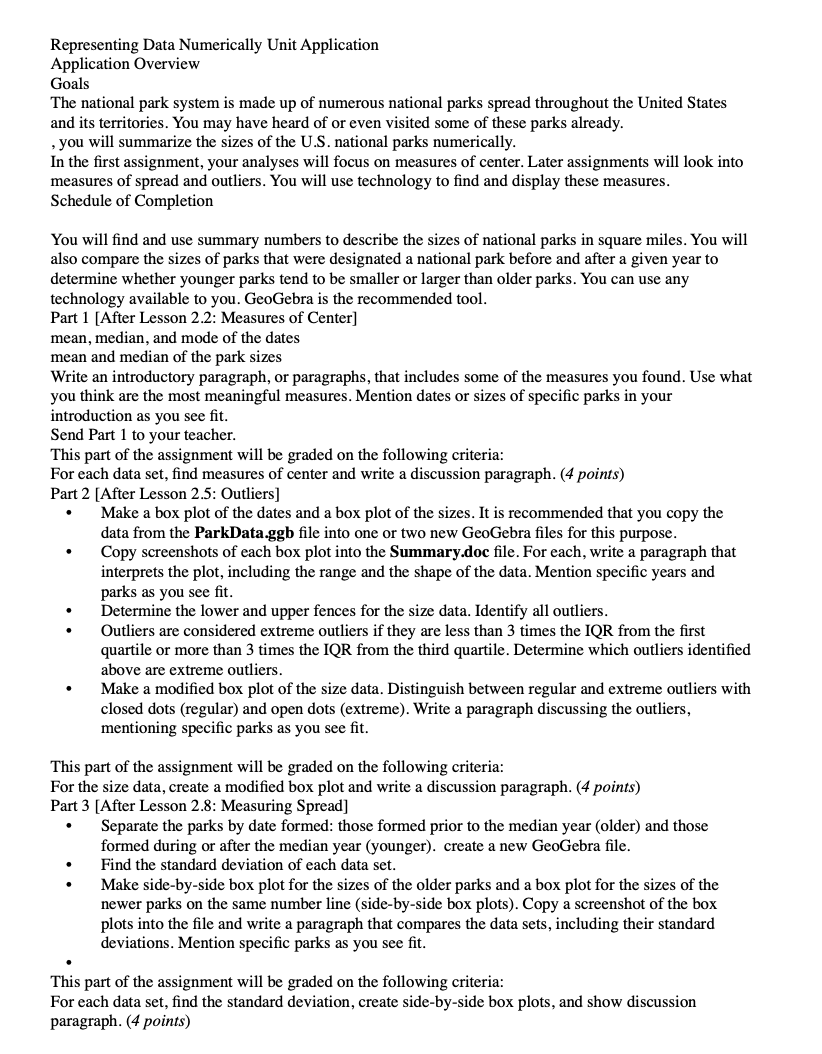
Representing Data Numerically Unit Application Application Overview Goals The national park system is made up of numerous national parks spread throughout the United States and its territories. You may have heard of or even visited some of these parks already. , you will summarize the sizes of the U.S. national parks numerically. In the first assignment, your analyses will focus on measures of center. Later assignments will look into measures of spread and outliers. You will use technology to find and display these measures. Schedule of Completion You will find and use summary numbers to describe the sizes of national parks in square miles. You will also compare the sizes of parks that were designated a national park before and after a given year to determine whether younger parks tend to be smaller or larger than older parks. You can use any technology available to you. GeoGebra is the recommended tool. Part 1 [After Lesson 2.2: Measures of Center] mean, median, and mode of the dates mean and median of the park sizes Write an introductory paragraph, or paragraphs, that includes some of the measures you found. Use what you think are the most meaningful measures. Mention dates or sizes of specific parks in your introduction as you see fit. Send Part 1 to your teacher. This part of the assignment will be graded on the following criteria: For each data set, find measures of center and write a discussion paragraph. (4 points) Part 2 [After Lesson 2.5: Outliers] Make a box plot of the dates and a box plot of the sizes. It is recommended that you copy the data from the ParkData.ggb file into one or two new GeoGebra files for this purpose. Copy screenshots of each box plot into the Summary.doc file. For each, write a paragraph that interprets the plot, including the range and the shape of the data. Mention specific years and parks as you see fit. Determine the lower and upper fences for the size data. Identify all outliers. Outliers are considered extreme outliers if they are less than 3 times the IQR from the first quartile or more than 3 times the IQR from the third quartile. Determine which outliers identified above are extreme outliers. Make a modified box plot of the size data. Distinguish between regular and extreme outliers with closed dots (regular) and open dots (extreme). Write a paragraph discussing the outliers, mentioning specific parks as you see fit. This part of the assignment will be graded on the following criteria: For the size data, create a modified box plot and write a discussion paragraph. (4 points) Part 3 [After Lesson 2.8: Measuring Spread] Separate the parks by date formed: those formed prior to the median year (older) and those formed during or after the median year (younger). create a new GeoGebra file. Find the standard deviation of each data set. Make side-by-side box plot for the sizes of the older parks and a box plot for the sizes of the newer parks on the same number line (side-by-side box plots). Copy a screenshot of the box plots into the file and write a paragraph that compares the data sets, including their standard deviations. Mention specific parks as you see fit. This part of the assignment will be graded on the following criteria: For each data set, find the standard deviation, create side-by-side box plots, and show discussion paragraph. (4 points)
Step by Step Solution
There are 3 Steps involved in it

Get step-by-step solutions from verified subject matter experts
 Study Help