







Question: Require a specific solution for 2 questions. Q: 2. (a) Le = 266.67, W. = 3.33. (b) Lm = 200, Wm = 2.5. (c) In
Require a specific solution for 2 questions.
Q:

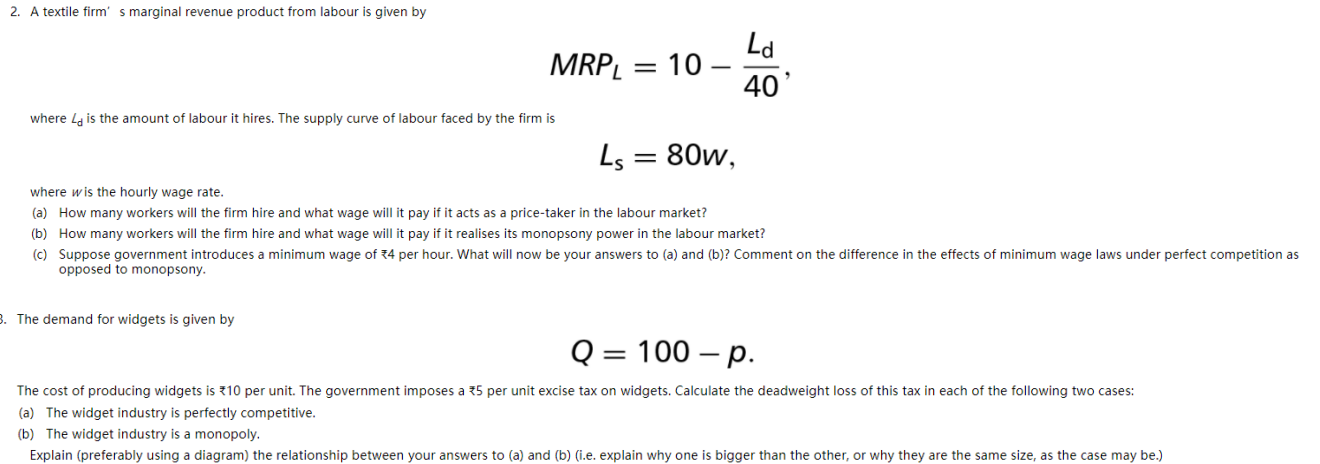
2. (a) Le = 266.67, W. = 3.33. (b) Lm = 200, Wm = 2.5. (c) In both cases, w= 4, L = 240. So employment will fall in the competitive case but rise in the monopsony case. 3. (a) DWL = 12.5. (b) DWLm = 115.625. (c) DWL is much higher under monopoly because output is already restricted and p > MC.2. A textile firm' s marginal revenue product from labour is given by MRPL = 10 - Ld 40 where Zo is the amount of labour it hires. The supply curve of labour faced by the firm is Ls = 80w, where wis the hourly wage rate. (a) How many workers will the firm hire and what wage will it pay if it acts as a price-taker in the labour market? (b) How many workers will the firm hire and what wage will it pay if it realises its monopsony power in the labour market? (c) Suppose government introduces a minimum wage of 14 per hour. What will now be your answers to (a) and (b)? Comment on the difference in the effects of minimum wage laws under perfect competition as opposed to monopsony. The demand for widgets is given by Q = 100 - p. The cost of producing widgets is $10 per unit. The government imposes a 75 per unit excise tax on widgets. Calculate the deadweight loss of this tax in each of the following two cases: (a) The widget industry is perfectly competitive. (b) The widget industry is a monopoly. Explain (preferably using a diagram) the relationship between your answers to (a) and (b) (i.e. explain why one is bigger than the other, or why they are the same size, as the case may be.)
Step by Step Solution
There are 3 Steps involved in it

Get step-by-step solutions from verified subject matter experts
 Study Help