Question: Requirea information Boeing Continuing Case-Part 4 This is the fourth part of a continuing case on Boeing. Each part considers issues confronting Boeing as it
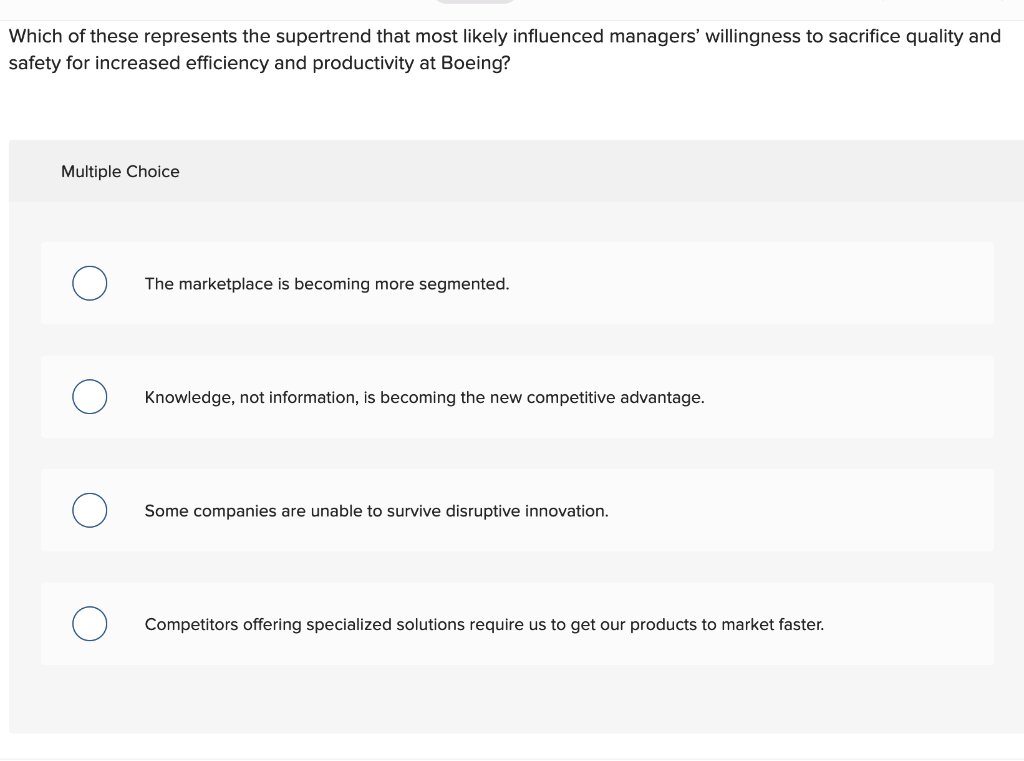
Requirea information Boeing Continuing Case-Part 4 This is the fourth part of a continuing case on Boeing. Each part considers issues confronting Boeing as it attempts to manage problems associated with the Boeing 737 MAX tragedy. Part 4 integrates concepts covered in Chapters 8, 9, and 10. Read the case and answer the questions that follow. CHAPTER 8: ORGANIZATIONAL CULTURE AND STRUCTURE: DRIVERS OF STRATEGIC IMPLEMENTATION An organization's culture and structure are two of the key drivers of strategic implementation, and leadership must align these drivers to execute strategy. In this section of the case, we look at how culture and structure at Boeing contributed to the 737 MAX disaster. Strategy Boeing operated more like an association of engineers than a business during its first 80 years, with the core engineering values of safety, integrity, and quality driving decisions at every level. The company kept both its manufacturing facilities and corporate headquarters in Seattle, and its executivesmany of whom were engineers themselves-focused far more energy on operations than on stock prices and investors. Boeing's culture changed after it merged with McDonnell Douglas, its exceedingly profit-focused rival, in the late 1990s. Executive decisions beginning shortly after the merger had the effect of drastically shifting Boeing's strategy from one centered on engineering the safest and highest-quality airplanes to one predominated by speed and cost-cutting concerns. 2 For example, by 2001, then-CEO Phil Condit had relocated Boeing's headquarters to Chicago in order to distance the executives from the design and assembly process. Condit said at the time that "When the headquarters is located in proximity to a principal business-as ours was in Seattle-the corporate center is inevitably drawn into day-to-day business operations.3 James McNerney stepped in as CEO in 2005 and made decisions that further removed Boeing from its foundational values. 4 The 3M and General Electric veteran-likely influenced by the lean and efficient six-sigma philosophy on which he'd cut his executive teeth-took drastic measures to improve the company's productivity. Instead of consulting Boeing's engineers and other employees to figure out how to best increase efficiency, McNerney slashed jobs, decreased wages, eliminated pensions, and outsourced some of the company's most complex design work. Further, he set and met goals related to sharp annual increases in sales operating earnings and ensured that short-term performance metrics such as cash flow and stock price performed well.5 Dennis Muilenburg took over as CEO in 2016 and took a similar stance by vowing to double Boeing's profit margins. Since that time, the company's stock price has increased by more than 200%.. Many have blamed Boeing's dramatic strategic swing for the 737 MAX disaster. Let's consider the role that the Boeing's organizational structure and culture played in supporting its strategy. Structure and Culture The 737 MAX disaster was likely influenced by structural decisions in addition to the physical separation of manufacturing facilities and corporate headquarters. According to insiders, the company had adopted a structure that prevented engineers' concerns from reaching necessary levels. Specifically, instead of reporting safety concerns to the company's chief engineer, Boeing's engineering employees had to go through division managers.? Each division manager oversaw the production of a specific airplane model, and their primary concern was to meet production deadlines. Safety issues had the potential to slow production, and it's possible that many engineers' calls for alarm never made it past division managers' desks. 8 Rooina's culture also influenced the events that led to the 737 MAX dicaster Former comnany engineer Boeing's culture also influenced the events that led to the 737 MAX disaster. Former company engineer Stan Sorcher described the current culture as the opposite of a culture built on productivity, innovation, safety or quality."9 Several pieces of evidence that surfaced after the crashes support his assertion. For example, an email from 2014 shows then-chief technical pilot Mark Forkner explaining to a concerned Boeing employee that there simply wasn't time to update the 737 MAX pilot manual with additional instruction on how to handle specific emergencies. Doing so would likely trigger questions from the F.A.A. along with additional pilot training requirements, which Forkner acknowledged was "a bad excuse, but what I'm being pressured into complying with.10 As another example, internal communications related to the process of obtaining F.A.A. approval for the 737 MAX revealed concerted attempts to avoid providing pilots with enhanced-and more importantly, costly-simulator training. Boeing employees convinced the agency that pilots certified to fly the plane's predecessor didn't need additional safety training in order to fly the MAX. One employee involved in the deception described the F.A.A. as "dogs watching TV, and another said There is no confidence that the F.A.A. is understanding what they are accepting (or rejecting). 11 The communications also showed a Boeing employee referring to one Indonesian airline as idiots after the airline questioned whether its pilots should receive additional simulator training in order to fly the 737 MAX. The employee went on to explain that the airlines' pilots only required more training because of their own stupidity." Alignment through Leadership Boeing's initial response to the crashes suggests that executive leadership was complicit in supporting the company's profit-driven structure and culture. 12 For example, then-CEO Muilenburg waited months before acknowledging that the crashes may have resulted from a design flaw or some other issue that could be traced back to Boeing. Even after the second 737 MAX crash in less than 6 months, Muilenburg refused to accept responsibility. Instead, the CEO called President Trump to convince him that the plane was safe did not need to be grounded in the U.S. 13 CHAPTER 9: HUMAN RESOURCE MANAGEMENT: GETTING THE RIGHT PEOPLE FOR MANAGERIAL Cirrece CHAPTER 9: HUMAN RESOURCE MANAGEMENT: GETTING THE RIGHT PEOPLE FOR MANAGERIAL SUCCESS In this section of the case we examine how HR practicesthe third key driver of strategic implementation contributed to the 737 MAX disaster. Performance Management One way to understand what went wrong at Boeing is to dissect its performance management practices. Insiders reveal that Boeing's managers consistently rewarded behaviors that resulted in faster production turnaround times and lower costs. Further, managers allegedly penalized employees whose safety concerns threatened to jeopardize existing contracts by slowing production. Employees who continued to raise flags were moved into positions that effectively silenced their voices, recounted one insider, who added that these employees often were "replaced by someone who is less capable of resisting pressure."14 According to a former Boeing engineer, "You play ball or else. The managers could tell you to keep your mouth shut or you lose your job." 15 Said another former employee, "It was pretty intense low morale because of all the layoffs-constant, grinding layoffs, year after year... So, you really watched your step and were careful about what you said." 16 The company has been accused on multiple occasions-of displaying a systematic pattern of age discrimination in its layoff decisions. Complaints filed with the EEOC describe managers strategically altering performance ranking criteria in order to justify laying off large numbers of their most qualified and experienced (and, therefore, most costly) engineers. Boeing's performance management practices speak to an incessant focus on cutting costs and increasing workers' speed and efficiency in order to meet production deadlines, satisfy customers' demands, and outperform competitors. As reported by The New York Times, Boeing employees "Once relentlessly focused on safety and engineering ... are shown obsessing over the bottom line."17 Boeing's HR strategy succeeded in driving its strategic implementation, resulting in the company distributing an all-time high $600 million in honnises in 2018 to reward its emnlovees for their nart in delivering a record HR strategy succeeded in driving its strategic implementation, resulting in the company distributing an all-time high $600 million in bonuses in 2018 to reward its employees for their part in delivering a record number of airplanes to the commercial market. 18 Safety Boeing's safety-related HR practices also contributed to the problem. According to one organizational scholar, Evidence is now trickling out that workers in the troubled Boeing 787 Dreamliner plant in South Carolina were pushed to maintain an overly ambitious production schedule and fearful of losing their jobs if they raised concerns."19 Managers incentivized employees to bypass or ignore regulators such as the F.A.A., whose job it was to ensure that planes were safe before being allowed to fly, and employees may have been subjected to grueling schedules that violated workplace safety laws. Former senior manager and retired Naval officer Ed Pierson recently testified before Congress that he began reporting grave safety concerns to Boeing's executives almost four months before the first crash. 20 His Renton, Washington factory had experienced a substantial 737 production backlog and responded by doubling its rate of overtime labor and allowing workers to complete production tasks out of sequencetwo things he knew could engender accidents and/or product quality deficiencies. Pierson's 30-year Naval career had ingrained in him how dangerous even the smallest of defects can be to the safety of an airplane." Further, the factory had begun holding large Town Hall meetings during each shift, during which Pierson witnessed upper management publicly interrogating low-level managers about schedule delays in front of 100 or more of their coworkers. He testified that despite continued attempts to convince executives to halt production, mitigate employee fatigue, and address worker and product-safety hazards, he was dismissed. CHAPTER 10: ORGANIZATIONAL CHANGE AND INNOVATION: LIFELONG CHALLENGES FOR THE EXCEPTIONAL MANAGER Let's consider the role that organizational change played in the 737 MAX disaster. CHAPTER 10: ORGANIZATIONAL CHANGE AND INNOVATION: LIFELONG CHALLENGES FOR THE EXCEPTIONAL MANAGER Let's consider the role that organizational change played in the 737 MAX disaster. Forces Against Change The internal communications that surfaced after the 737 MAX crashes revealed a company divided into two groups: those who wanted to reinforce the company's new profit-driven culture, and those who longed for the engineering-focused Boeing that existed prior to the McDonnell Douglas merger. What were the forces that prevented the latter group from successfully returning the company to its roots? First, companies in today's economy feel intense pressure to create products in record times in order to remain competitive. Current and former employees who worked on the 737 MAX project report that Boeing's engineers were pushed to submit technical drawings and designs at roughly double the normal pace ... facing tight deadlines and strict budgets."21 This kind of pressure is antithetical to core engineering principles like quality and safety. Boeing's leaders' actions indicate a second force inhibiting change. For example, former Boeing engineer-turned whistleblower Curtis Ewbank told authorities that his manager directly instructed him to hide incriminating data about the plane's autothrottle system from the European Union Aviation Safety Agency (EASA). 22 Ewbank said he quit his job in 2015 "in protest of management actions to rationalize the poor design of the 737 MAX," adding, I did not think I could do my duty as an engineer to protect the safety of the public in the environment created by management at Boeing. 23 Others have suggested that recent decisions aimed at increasing the efficiency of the F.A.A. certification process shifted far too much power to Boeing and removed layers of regulation that were necessary for ensuring public safety. One report described "grossly insufficient oversight" on the part of the F.A.A. and suggested that the agency had delegated an "excessive" amount of its certification work to the A company.24 For example, prior to 2005, the F.A.A. was responsible for designating engineers inside Boeing that would work on its behalf, but newer regulations gave Boeing the authority to select these engineers on its own. Further, investigations conducted after the crashes suggest that Boeing exerted undue influence even over those decisions that remained under F.A.A. authority. According to one New York Times article, During the Max certification, senior leaders at the F.A.A. sometimes overruled their own staff members' recommendations after Boeing pushed back."25 1. J. Useem, "The Long-Forgotten Flight That Sent Boeing Off Course." The Atlantic, November 20, 2019, https://www.theatlantic.com/ideas/archive/2019/11 /how-boeing-lost-its-bearings/602188/. 2. Welch, James. "Will Boeing Soar Again? Navigating A Corporate Recovery Process," Journal of Business Strategy, 2020. 3. J. Useem, "The Long-Forgotten Flight That Sent Boeing Off Course." The Atlantic, November 20, 2019, https://www.theatlantic.com/ideas/archive/2019/11 /how-boeing-lost-its-bearings/602188/. 4. Walker, S. (2018, Apr 27). One leader sent boeing into hurricane; landing it was the next guy's job; jim McNerney's tenure shows that the success of a disrupter often hinges on who comes next. Wall Street Journal (Online). 5. Lublin, J. S. (2011, Sep 05). GE also-rans got top jobs elsewhere, to mixed results. Wall Street Journal (Online), https://www.forbes.com/sites/richardaboulafia /2015/06/24/boeing-mcnerney-and-the-high-price-of-treating-aircraft-like-it-was-any-other-industry/#5dc69900579c. 6. D. Catchpole, The Forces Behind Boeing's Long Descent," Fortune, January 20, 2020, https://fortune.com/longform/boeing-737-max-crisis-shareholder- first-culturel ditorial Board, "One Thing that Boeing Just Got Right," Chicago Business, October 18, 2019, https://www.chicagobusiness.com/opinion/one-thing-boeing- just-got-right. 8. R. Marsh, "Boeing Committee Expected To Make Safety Recommendations This Week," CNN, September 15, 2019, https://www.cnn.com/2019/09 /15/business/boeing-safety-committee/index.html. 9. P. Boucher,"737 Max Crashes Raised Questions About Boeing's Culture. Soon Its CEO Will Have to Answer Them." Fortune, October 4, 2019, https://fortune.com/2019/10/04/boeing-737-max-culture-muilenburg/. 10. D. Gelles, "Crisis Reveals 'Sick' Culture Inside Boeing," New York Times, January 11, 2020, Retrieved from https://search.proquest.com/docview /2335382696?accountid=8361. 11. D. Gelles, "Crisis Reveals 'Sick' Culture Inside Boeing," New York Times, January 11, 2020, Retrieved from https://search.proquest.com/docview /2335382696?accountid=8361. 12. D. Catchpole, The Forces Behind Boeing's Long Descent," Fortune, January 20, 2020, https://fortune.com/longform/boeing-737-max-crisis-shareholder- first-culturel Which of these represents the supertrend that most likely influenced managers' willingness to sacrifice quality and safety for increased efficiency and productivity at Boeing? Multiple Choice The marketplace is becoming more segmented. Knowledge, not information, is becoming the new competitive advantage. Some companies are unable to survive disruptive innovation. Competitors offering specialized solutions require us to get our products to market faster




