







Question: Required : 1)Establish the respective required returns for: a: Expected Asset Return b: Expected Equity Return c: Expected Return on all Invested Capital 2)Establish the
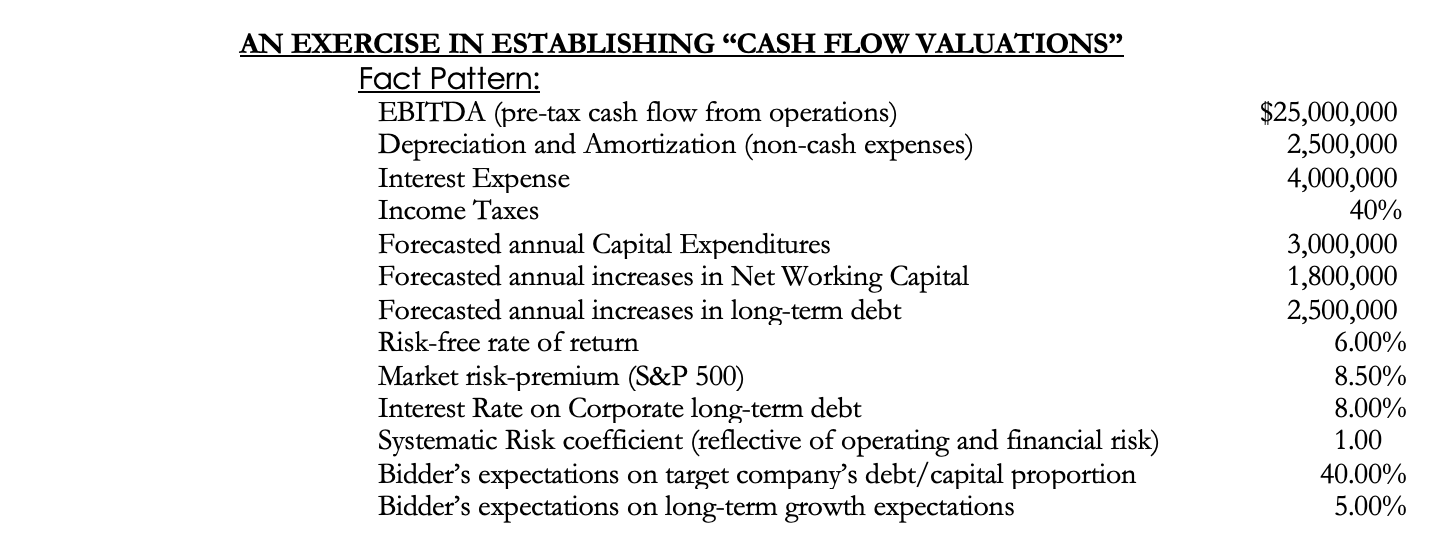
Required:
1)Establish the respective required returns for:
a: Expected Asset Return
b: Expected Equity Return
c: Expected Return on all Invested Capital
2)Establish the respective values for:
a: All Invested Capital (using CCF and WACC and APV)
b: The Firm's Equity Capital
Please note that the results may not be precisely the same, but close enough to support your argument that all valuation models will lead to a reasonably identical value.
It may be assumed that if Debt is not intended to be a constant dollar amount, then it may be assumed that the cash flows derived from the interest tax shield are as risky as the overall firm's cash flows.
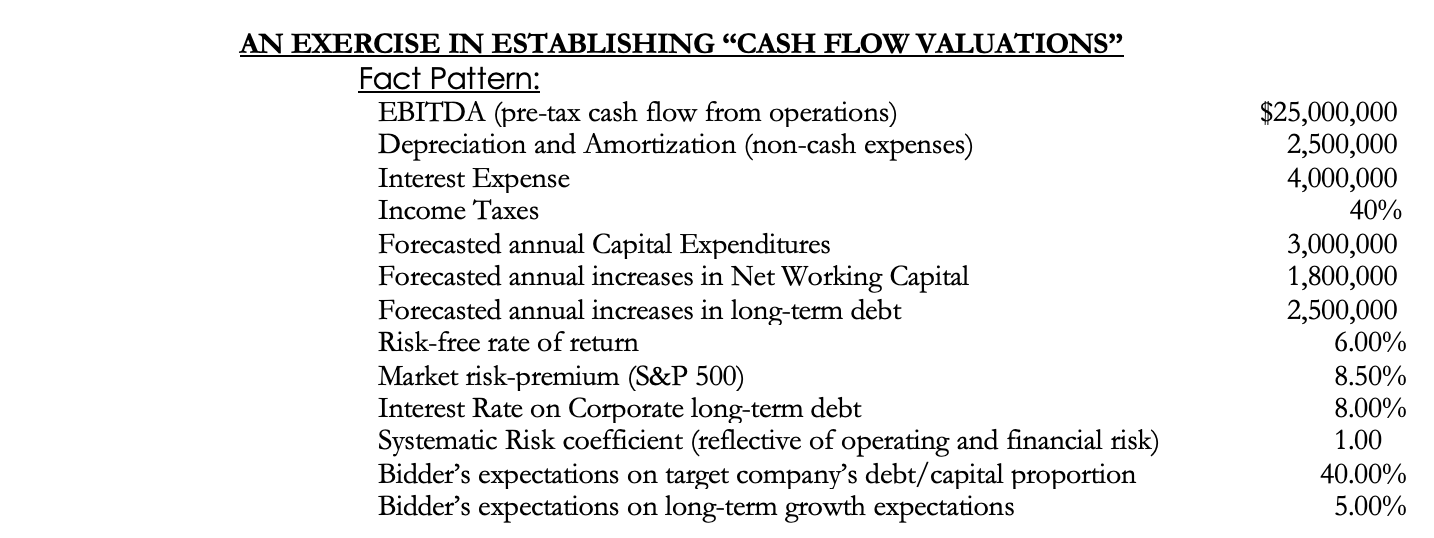
AN EXERCISE IN ESTABLISHING "CASH FLOW VALUATIONS" Fact Pattern: EBITDA (pre-tax cash flow from operations) $25,000,000 Depreciation and Amortization (non-cash expenses) 2,500,000 Interest Expense 4,000,000 Income Taxes 40% Forecasted annual Capital Expenditures 3,000,000 Forecasted annual increases in Net Working Capital 1,800,000 Forecasted annual increases in long-term debt 2,500,000 Risk-free rate of return 6.00% Market risk-premium (S&P 500) 8.50% Interest Rate on Corporate long-term debt 8.00% Systematic Risk coefficient (reflective of operating and financial risk) 1.00 Bidder's expectations on target company's debt/ capital proportion 40.00% Bidder's expectations on long-term growth expectations 5.00%
Step by Step Solution
There are 3 Steps involved in it

Get step-by-step solutions from verified subject matter experts
 Study Help