







Question: Required: a. Calculate expected excess returns, alpha values, and residual variances for these stocks. b. Compute the proportion in the active portfolio and the passive
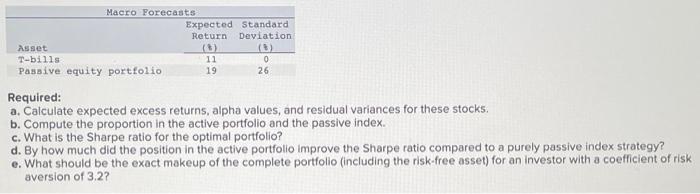
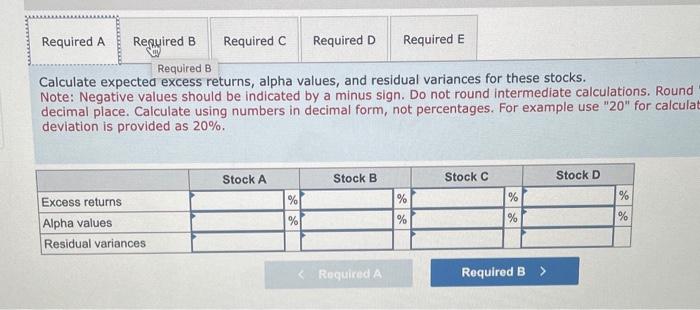
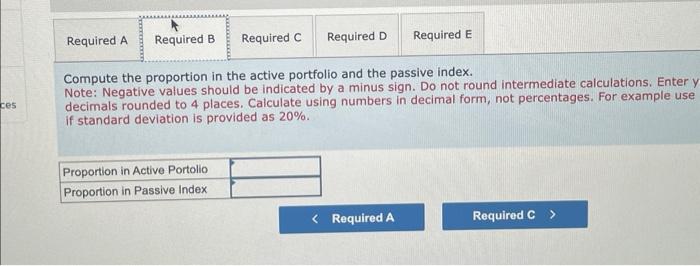
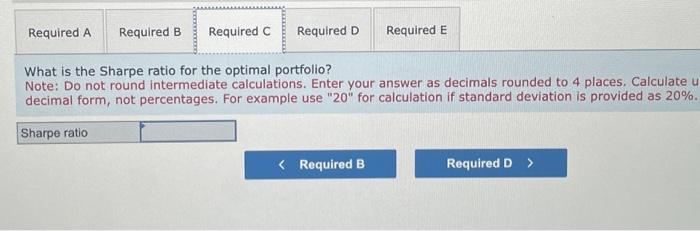

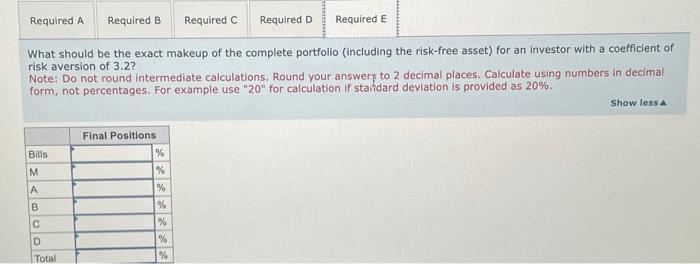
Required: a. Calculate expected excess returns, alpha values, and residual variances for these stocks. b. Compute the proportion in the active portfolio and the passive index. c. What is the Sharpe ratio for the optimal portfolio? d. By how much did the position in the active portfolio improve the Sharpe ratio compared to a purely passive index strategy? e. What should be the exact makeup of the complete portfolio (including the risk-free asset) for an investor with a coefficient of risk aversion of 3.2 ? Calculate expected excess returns, alpha values, and residual variances for these stocks. Note: Negative values should be indicated by a minus sign. Do not round intermediate calculations. Rounc decimal place. Calculate using numbers in decimal form, not percentages. For example use "20" for calcul deviation is provided as 20%. Compute the proportion in the active portfolio and the passive index. Note: Negative values should be indicated by a minus sign. Do not round intermediate calculations. Enter decimals rounded to 4 places. Calculate using numbers in decimal form, not percentages. For example use if standard deviation is provided as 20%. What is the Sharpe ratio for the optimal portfolio? Note: Do not round intermediate calculations. Enter your answer as decimals rounded to 4 places. Calculate decimal form, not percentages. For example use " 20 " for calculation if standard deviation is provided as 20% By how much did the position in the active portfolio improve the Sharpe ratio compared to a purely passive index strategy? Note: Do not round intermediate calculations. Enter your answer as decimals rounded to 4 places. Calculate using numbers in decimal form, not percentages. For example use " 20 " for calculation if standard deviation is provided as 20%. What should be the exact makeup of the complete portfolio (including the risk-free asset) for an investor with a coefficient of risk aversion of 3.2 ? Note: Do not round intermediate calculations. Round your answer to 2 decimal places. Calculate using numbers in decimal form, not percentages. For example use " 20 " for calculation if standard deviation is provided as 20%
Step by Step Solution
There are 3 Steps involved in it

Get step-by-step solutions from verified subject matter experts
 Study Help