



Question: Required: a) Subsidiary Z requested a provisional quotation for 30,000 units of Xaver from Subsidiary Y for the coming year. Calculate the transfer price per
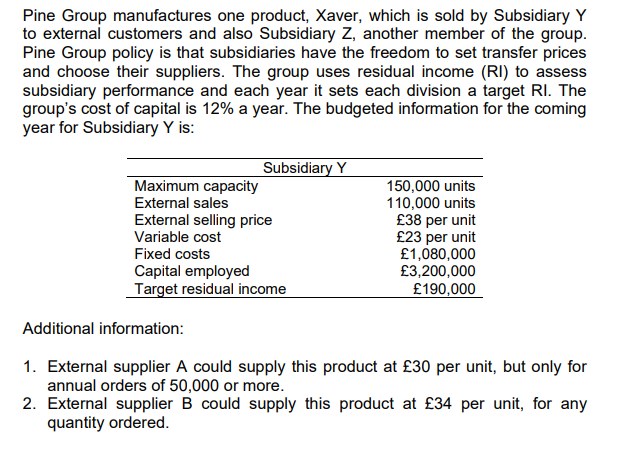
Required:
a) Subsidiary Z requested a provisional quotation for 30,000 units of Xaver from Subsidiary Y for the coming year. Calculate the transfer price per unit which Subsidiary Y should quote to Subsidiary Z in order that is budgeted residual income target will be met. Comment on the possible consequences of this transfer price from Pine Groups perspective. (15 marks)
b) Subsidiary Z now requires 50,000 units and requested a revised quotation from Subsidiary Y. Assuming that Subsidiary Y is willing to supply all units to Subsidiary Z, determine the transfer pricing should quote based on:
i. An average price for the quantity required, such that the target RI of subsidiary Y will still be met. (5 marks)
ii. An average price per component which reflects the opportunity cost of Xaver transferred from Y to Z. (5 marks)
Assuming that subsidiary Y is now willing to part supply the components to subsidiary Z at prices per Xaver which reflect the opportunity cost of each unit. iii. Determine the transfer price that subsidiary Y should quote. (5 marks)
iv. State the impact of each of the transfer prices above on subsidiary Z product sourcing decision. (5 marks)
Pine Group manufactures one product, Xaver, which is sold by Subsidiary Y to external customers and also Subsidiary Z, another member of the group. Pine Group policy is that subsidiaries have the freedom to set transfer prices and choose their suppliers. The group uses residual income (RI) to assess subsidiary performance and each year it sets each division a target RI. The group's cost of capital is 12% a year. The budgeted information for the coming year for Subsidiary Y is: Subsidiary Y Maximum capacity External sales External selling price Variable cost Fixed costs Capital employed Target residual income 150,000 units 110,000 units 38 per unit 23 per unit 1,080,000 3,200,000 190,000 Additional information: 1. External supplier A could supply this product at 30 per unit, but only for annual orders of 50,000 or more. 2. External supplier B could supply this product at 34 per unit, for any quantity ordered
Step by Step Solution
There are 3 Steps involved in it

Get step-by-step solutions from verified subject matter experts