







Question: Required answer for highlighted red box MORE THAN ONE SOLUTION WILL BE APPERCIATED. Please dont post image as solution. b,a 0,Er page 114 EXAMPLE 2.14
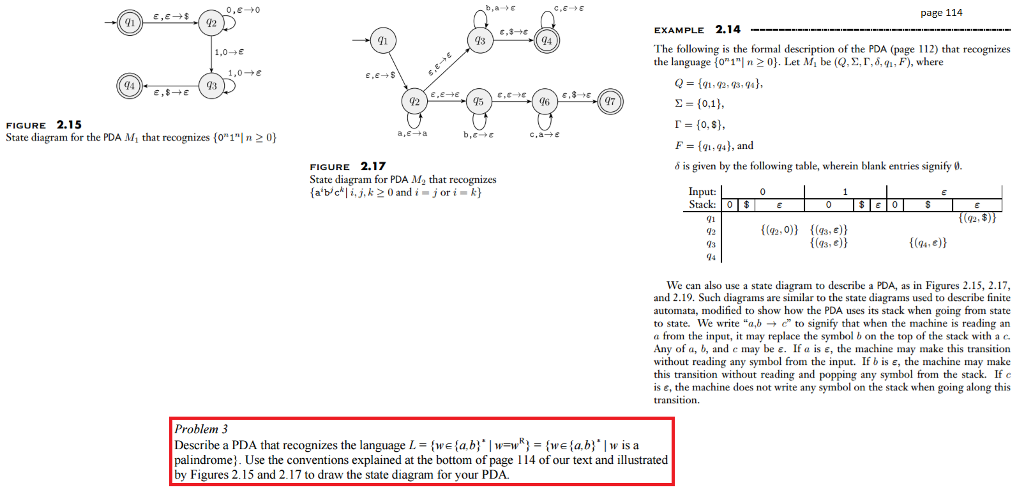
Required answer for highlighted red box
MORE THAN ONE SOLUTION WILL BE APPERCIATED. Please dont post image as solution.
b,a 0,Er page 114 EXAMPLE 2.14 31 The following is the formal description of the PDA (page 112) that recognizes 1.0 E he language to 1 n 20 Let Mi be (Q, T, gi, F), where 1,0 E 94 93 E, E ELE E 0,1) FIGURE 2.15 0, S State diagram for the PDA M1 that recognizes t0"1"In 0 C, E F g), and is given by the following table, wherein blank entries signify FIGURE 2.17 State diagram for PDA M2 that recognizes (a b cli, j, k 20 and i Jori kl Stack: 0 92, We can also use a state diagram to describe a PDA, as in Figures 2.15, 2.17, and 2.19. Such diagrams are similar to the state diagrams used to describe finite automata, modified to show how the PDA uses its stack when going from state to state. We write "ab c to signify that when the machine is reading an a from the input, it may replace the symbol b on the top of the stack with a c. Any of a, b, and c may be E. If a is e, the machine may make this transition without reading any symbol from the input. If bis E, the machine may make this transition without reading and popping any symbol from the stack. If c is e, the machine does not write any symbol on the stack when going along this rans on Problem 3 Describe a PDA that recognizes the language LE Eweeta, b Iw wK) weta, b W is a palindrome). Use the conventions explained at the bottom of page l 4 of our text and illustrated by Figures 2.15 and 2.17 to draw the state diagram for your PDA
Step by Step Solution
There are 3 Steps involved in it

Get step-by-step solutions from verified subject matter experts
 Study Help