







Question: Required 1. Compute Dennis' pre-retirement annual return requirement and advise Dennis on the feasibility of his plans. 2. Assess Dennis' risk tolerance 3. Discuss other
- Required 1. Compute Dennis' pre-retirement annual return requirement and advise Dennis on the feasibility of his plans.
2. Assess Dennis' risk tolerance
3. Discuss other important considerations when drafting an investment policy statement for Dennis.
4. Recommend a portfolio that satisfies both of Dennis' return and risk objectives and justify your recommendation.
5. You would like to rationalize your recommended portfolio by dropping one of the constituent ETFs. Without additional computations, suggest an ETF to drop from the portfolio and justify your choice.
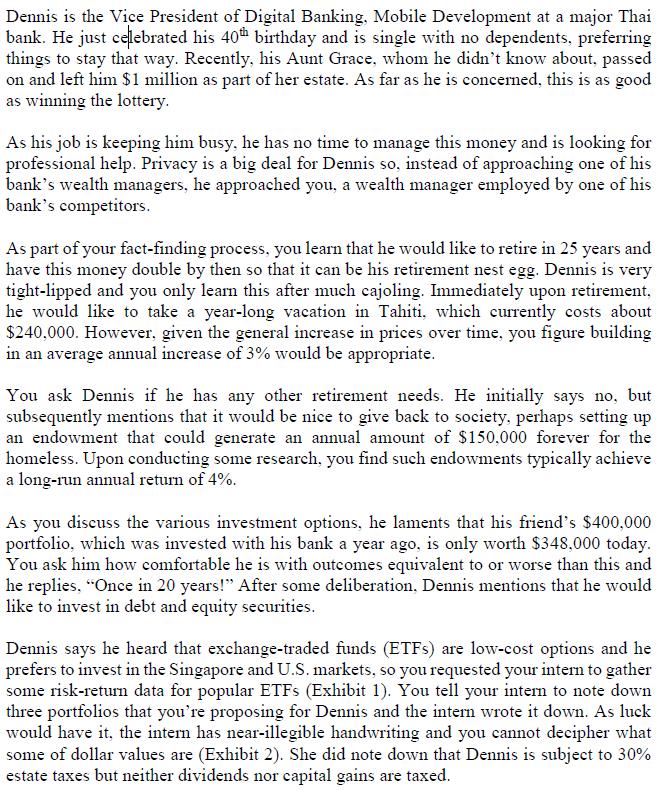
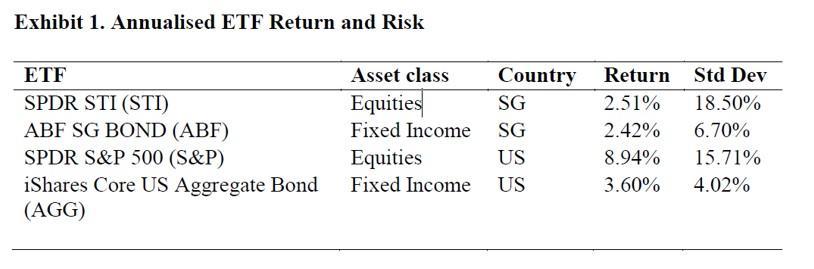
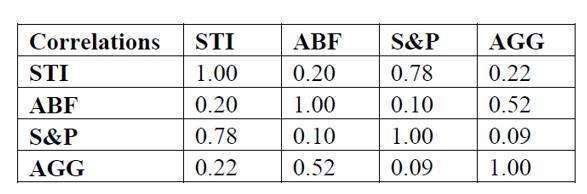
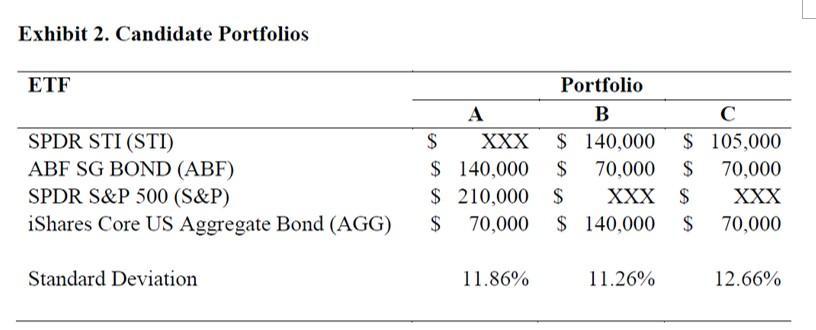
Dennis is the Vice President of Digital Banking, Mobile Development at a major Thai bank. He just celebrated his 40th birthday and is single with no dependents, preferring things to stay that way. Recently, his Aunt Grace, whom he didn't know about, passed on and left him $1 million as part of her estate. As far as he is concerned, this is as good as winning the lottery. As his job is keeping him busy, he has no time to manage this money and is looking for professional help. Privacy is a big deal for Dennis so, instead of approaching one of his bank's wealth managers, he approached you, a wealth manager employed by one of his bank's competitors. As part of your fact-finding process, you learn that he would like to retire in 25 years and have this money double by then so that it can be his retirement nest egg. Dennis is very tight-lipped and you only learn this after much cajoling. Immediately upon retirement, he would like to take a year-long vacation in Tahiti, which currently costs about $240,000. However, given the general increase in prices over time, you figure building in an average annual increase of 3% would be appropriate. You ask Dennis if he has any other retirement needs. He initially says no, but subsequently mentions that it would be nice to give back to society, perhaps setting up an endowment that could generate an annual amount of $150,000 forever for the homeless. Upon conducting some research, you find such endowments typically achieve a long-run annual return of 4%. As you discuss the various investment options, he laments that his friend's $400,000 portfolio, which was invested with his bank a year ago, is only worth $348,000 today. You ask him how comfortable he is with outcomes equivalent to or worse than this and he replies. "Once in 20 years!" After some deliberation, Dennis mentions that he would like to invest in debt and equity securities. Dennis says he heard that exchange-traded funds (ETFs) are low-cost options and he prefers to invest in the Singapore and U.S. markets, so you requested your intern to gather some risk-return data for popular ETFs (Exhibit 1). You tell your intern to note down three portfolios that you're proposing for Dennis and the intern wrote it down. As luck would have it, the intern has near-illegible handwriting and you cannot decipher what some of dollar values are (Exhibit 2). She did note down that Dennis is subject to 30% estate taxes but neither dividends nor capital gains are taxed.
Step by Step Solution
3.48 Rating (161 Votes )
There are 3 Steps involved in it
1 Present Value PV 1000000 Future Value at retirement FV 2000000 Time to retirement n 25 years Let i Required Real Return We know FV PV 1i n 2000000 10000001i 25 1i25 2 Taking log 25 log 1i log 2 Log ... View full answer

Get step-by-step solutions from verified subject matter experts
 Study Help