Question: REQUIRED Based on your notes (above) following your discussions with the warehouse manager: 1) Identify twelve (1 2 ) procedural weaknesses regarding the inventory count
REQUIRED
Based on your notes (above) following your discussions with the warehouse manager:
1) Identify twelve (12) procedural weaknesses regarding the inventory count planned by the new warehouse manager. (2 points each)
a. Supervision and Count Teams identify and list four(4) weaknesses
b. Inventory Count Tags - identify and list three (3)weaknesses
c. Updating Perpetual Inventory Records with Actual Count Results- identify and list one (1) weakness
d. Products missing identification identify and list two (2) weaknesses
e. Damaged Goods identify and list one (1) weakness
f. Warehouse and inter-store transfers identify and list one (1) weakness
2) For each identified weakness listed, explain why it is weak. (2 points each)
3) For each identified weakness provide a recommended improvement. Please use full sentences and not sentence fragments. (2 points each)
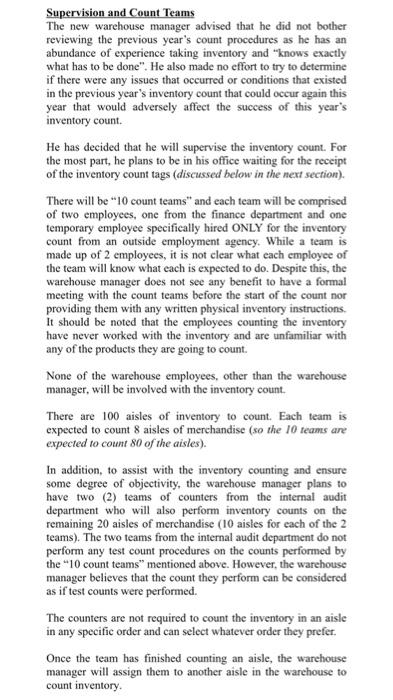
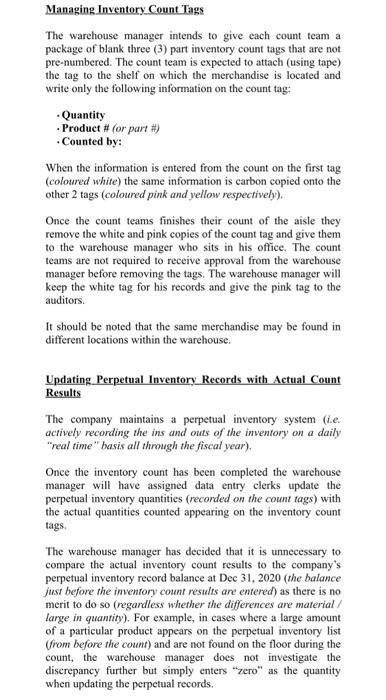
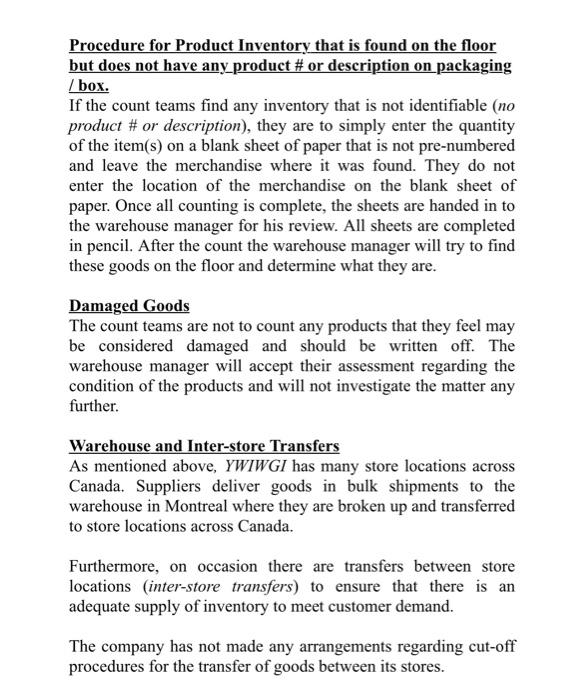
Supervision and Count Teams The new warehouse manager advised that he did not bother reviewing the previous year's count procedures as he has an abundance of experience taking inventory and "knows exactly what has to be done". He also made no effort to try to determine if there were any issues that occurred or conditions that existed in the previous year's inventory count that could occur again this year that would adversely affect the success of this year's inventory count. He has decided that he will supervise the inventory count. For the most part, he plans to be in his office waiting for the receipt of the inventory count tags (discussed below in the next section). There will be "10 count teams" and each team will be comprised of two employees, one from the finance department and one temporary employee specifically hired ONLY for the inventory count from an outside employment agency. While a team is made up of 2 employees, it is not clear what each employee of the team will know what each is expected to do. Despite this, the warehouse manager does not see any benefit to have a formal meeting with the count teams before the start of the count nor providing them with any written physical inventory instructions. It should be noted that the employees counting the inventory have never worked with the inventory and are unfamiliar with any of the products they are going to count. None of the warehouse employees, other than the warehouse manager, will be involved with the inventory count. There are 100 aisles of inventory to count. Each team is expected to count 8 aisles of merchandise (so the 10 teams are expected to count 80 of the aisles). In addition, to assist with the inventory counting and ensure some degree of objectivity, the warehouse manager plans to have two (2) teams of counters from the internal audit department who will also perform inventory counts on the remaining 20 aisles of merchandise (10 aisles for each of the 2 teams). The two teams from the internal audit department do not perform any test count procedures on the counts performed by the "10 count teams mentioned above. However, the warehouse manager believes that the count they perform can be considered as if test counts were performed. The counters are not required to count the inventory in an aisle in any specific order and can select whatever order they prefer. Once the team has finished counting an aisle, the warehouse manager will assign them to another aisle in the warehouse to count inventory Managing Inventory Count Tags The warehouse manager intends to give each count team a package of blank three (3) part inventory count tags that are not pre-numbered. The count team is expected to attach (using tape) the tag to the shelf on which the merchandise is located and write only the following information on the count tag: Quantity Product # (or part #) Counted by: When the information is entered from the count on the first tag (coloured white) the same information is carbon copied onto the other 2 tags (coloured pink and yellow respectively), Once the count teams finishes their count of the aisle they remove the white and pink copies of the count tag and give them to the warehouse manager who sits in his office. The count teams are not required to receive approval from the warehouse manager before removing the tags. The warehouse manager will keep the white tag for his records and give the pink tag to the auditors. It should be noted that the same merchandise may be found in different locations within the warehouse. Updating Perpetual Inventory Records with Actual Count Results The company maintains a perpetual inventory system (ie. actively recording the ins and outs of the inventory on a daily "real time" basis all through the fiscal year), Once the inventory count has been completed the warehouse manager will have assigned data entry clerks update the perpetual inventory quantities (recorded on the count tags) with the actual quantities counted appearing on the inventory count tags The warehouse manager has decided that it is unnecessary to compare the actual inventory count results to the company's perpetual inventory record balance at Dec 31, 2020 (the balance just before the inventory count results are entered) as there is no merit to do so (regardless whether the differences are material/ large in quantity). For example, in cases where a large amount of a particular product appears on the perpetual inventory list from before the count) and are not found on the floor during the count, the warehouse manager does not investigate the discrepancy further but simply enters "zero" as the quantity when updating the perpetual records. Procedure for Product Inventory that is found on the floor but does not have any product # or description on packaging /box, If the count teams find any inventory that is not identifiable (no product # or description), they are to simply enter the quantity of the item(s) on a blank sheet of paper that is not pre-numbered and leave the merchandise where it was found. They do not enter the location of the merchandise on the blank sheet of paper. Once all counting is complete, the sheets are handed in to the warehouse manager for his review. All sheets are completed in pencil. After the count the warehouse manager will try to find these goods on the floor and determine what they are. Damaged Goods The count teams are not to count any products that they feel may be considered damaged and should be written off. The warehouse manager will accept their assessment regarding the condition of the products and will not investigate the matter any further. Warehouse and Inter-store Transfers As mentioned above, YWIWGI has many store locations across Canada. Suppliers deliver goods in bulk shipments to the warehouse in Montreal where they are broken up and transferred to store locations across Canada. Furthermore, on occasion there are transfers between store locations (inter-store transfers) to ensure that there is an adequate supply of inventory to meet customer demand. The company has not made any arrangements regarding cut-off procedures for the transfer of goods between its stores