







Question: REQUIRED Comment on the insights provided by the ABM study to date. Where's the law.hanging in other words, what activities appear to be good candidates
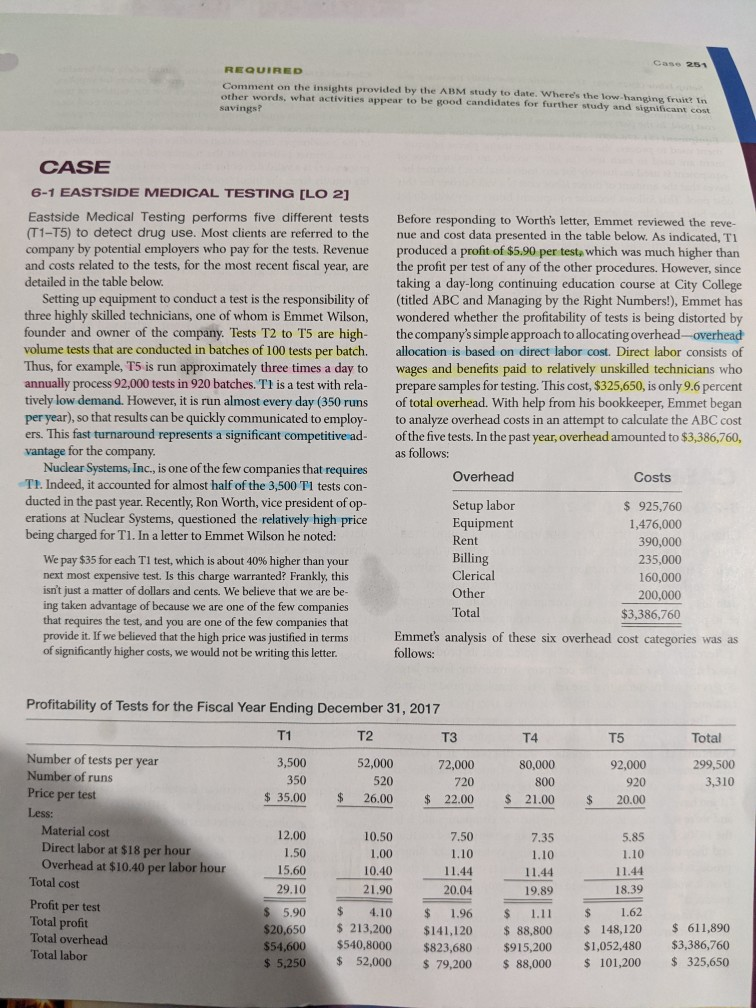
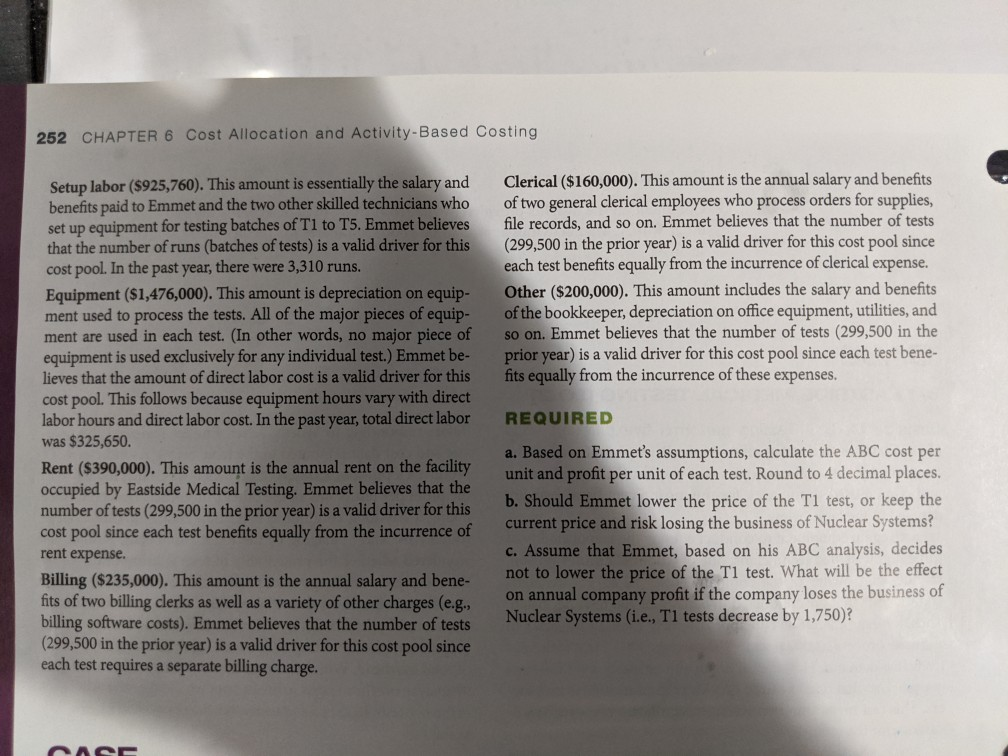
REQUIRED Comment on the insights provided by the ABM study to date. Where's the law.hanging in other words, what activities appear to be good candidates for further study and significant cost savings? CASE 6-1 EASTSIDE MEDICAL TESTING (LO 2] Eastside Medical Testing performs five different tests (T1-T5) to detect drug use. Most clients are referred to the company by potential employers who pay for the tests. Revenue and costs related to the tests, for the most recent fiscal year, are detailed in the table below. Setting up equipment to conduct a test is the responsibility of three highly skilled technicians, one of whom is Emmet Wilson, founder and owner of the company. Tests T2 to T5 are high- volume tests that are conducted in batches of 100 tests per batch. Thus, for example, T5 is run approximately three times a day to annually process 92,000 tests in 920 batches. Ti is a test with rela- tively low demand. However, it is run almost every day (350 runs per year), so that results can be quickly communicated to employ- ers. This fast turnaround represents a significant competitive ad vantage for the company. Nuclear Systems, Inc., is one of the few companies that requires Th. Indeed, it accounted for almost half of the 3,500 T1 tests con- ducted in the past year. Recently, Ron Worth, vice president of op- erations at Nuclear Systems, questioned the relatively high price being charged for Ti. In a letter to Emmet Wilson he noted: Before responding to Worthis letter, Emmet reviewed the reve- nue and cost data presented in the table below. As indicated, TI produced a profit of $5.90 per test, which was much higher than the profit per test of any of the other procedures. However, since taking a day-long continuing education course at City College (titled ABC and Managing by the Right Numbers!), Emmet has wondered whether the profitability of tests is being distorted by the company's simple approach to allocating overhead-overhead allocation is based on direct labor cost. Direct labor consists of wages and benefits paid to relatively unskilled technicians who prepare samples for testing. This cost, $325,650, is only 9.6 percent of total overhead. With help from his bookkeeper, Emmet began to analyze overhead costs in an attempt to calculate the ABC cost of the five tests. In the past year, overhead amounted to $3,386,760, as follows: Overhead Costs Billing We pay $35 for each Ti test, which is about 40% higher than your next most expensive test. Is this charge warranted? Frankly, this isn't just a matter of dollars and cents. We believe that we are be- ing taken advantage of because we are one of the few companies that requires the test, and you are one of the few companies that provide it. If we believed that the high price was justified in terms of significantly higher costs, we would not be writing this letter. Setup labor $ 925,760 Equipment 1,476,000 Rent 390,000 235,000 Clerical 160,000 Other 200,000 Total $3,386,760 Emmet's analysis of these six overhead cost categories was as follows: Profitability of Tests for the Fiscal Year Ending December 31, 2017 T1 T2 T3 T4 T5 Total 3,500 350 $ 35.00 52,000 520 26.00 72,000 720 22.00 80,000 800 21.00 92,000 920 20.00 299,500 3,310 $ $ $ $ Number of tests per year Number of runs Price per test Less: Material cost Direct labor at $18 per hour Overhead at $10.40 per labor hour Total cost Profit per test Total profit Total overhead Total labor 10.50 1.00 10.40 21.90 7.35 1.10 11.44 19.89 5.85 1.10 11.44 18.39 12.00 1.50 15.60 29.10 $ 5.90 $20,650 $54,600 $ 5,250 7.50 1.10 11.44 20.04 $ 1.96 $141,120 $823,680 $ 79,200 4.10 $ 213,200 $540,8000 $ 52,000 $ 1.11 $ 88,800 $915,200 $ 88,000 $ 1.62 $ 148,120 $1,052,480 $ 101,200 $ 611,890 $3,386,760 $ 325,650 252 CHAPTER 6 Cost Allocation and Activity-Based Costing Clerical ($160,000). This amount is the annual salary and benefits of two general clerical employees who process orders for supplies, file records, and so on. Emmet believes that the number of tests (299,500 in the prior year) is a valid driver for this cost pool since each test benefits equally from the incurrence of clerical expense. Other ($200,000). This amount includes the salary and benefits of the bookkeeper, depreciation on office equipment, utilities, and so on. Emmet believes that the number of tests (299,500 in the prior year) is a valid driver for this cost pool since each test bene. fits equally from the incurrence of these expenses. Setup labor ($925,760). This amount is essentially the salary and benefits paid to Emmet and the two other skilled technicians who set up equipment for testing batches of Ti to T5. Emmet believes that the number of runs (batches of tests) is a valid driver for this cost pool. In the past year, there were 3,310 runs. Equipment ($1,476,000). This amount is depreciation on equip- ment used to process the tests. All of the major pieces of equip- ment are used in each test. In other words, no major piece of equipment is used exclusively for any individual test.) Emmet be- lieves that the amount of direct labor cost is a valid driver for this cost pool. This follows because equipment hours vary with direct labor hours and direct labor cost. In the past year, total direct labor was $325,650. Rent ($390,000). This amount is the annual rent on the facility occupied by Eastside Medical Testing. Emmet believes that the number of tests (299,500 in the prior year) is a valid driver for this cost pool since each test benefits equally from the incurrence of rent expense. Billing ($235,000). This amount is the annual salary and bene fits of two billing clerks as well as a variety of other charges (e.g. billing software costs). Emmet believes that the number of tests (299,500 in the prior year) is a valid driver for this cost pool since each test requires a separate billing charge. REQUIRED a. Based on Emmet's assumptions, calculate the ABC cost per unit and profit per unit of each test. Round to 4 decimal places, b. Should Emmet lower the price of the T1 test, or keep the current price and risk losing the business of Nuclear Systems? c. Assume that Emmet, based on his ABC analysis, decides not to lower the price of the T1 test. What will be the effect on annual company profit if the company loses the business of Nuclear Systems (i.e., T1 tests decrease by 1,750)? ONE
Step by Step Solution
There are 3 Steps involved in it

Get step-by-step solutions from verified subject matter experts
 Study Help