Question: Required Elements for All Lab Reports (4 pts) A clear comparison of this follow-up investigation to the original. (Follow up investigation its uploaded) Interpret your

Required Elements for All Lab Reports
(4 pts) A clear comparison of this follow-up investigation to the original. (Follow up investigation its uploaded)
Interpret your value of t or Chi-squared for your audience.
Explain the difference between this value of t or Chi-squared compared to the previous value from the original investigation.
(5 pts) Data analysis & treatment of uncertainties
Calculate either t or Chi-squared, depending on which type of investigation your group chose.
See Holmes's Statistics Summary and the assignment description for the previous lab investigation your group is extending.
(5 pts) Visualization of raw and/or processed data
Include one or more tables, graphs, or charts your group thinks will help communicate your experiment to your audience.
See Holmes's Statistics Summary and the assignment description for the previous lab investigation your group is extending.
(2 pts) Connection to physics principles and/or concepts
(2 pts) Recommendations for a follow-up investigation
Interpret the value of t or Chi-squared and suggest what might be changed or improved upon if another group were to extend this investigation.
(2 pts) References in APA format
Purdue OWL is a good resource for APA formatting.
You must include a citation for the Statistics Summary:
Holmes, N. G. (Aug 2020) Statistics Summary. Physport. physport.org/curricula
Also include any other references you used (maybe a textbook or website?)
If Jupyter was used, include any software imported (e.g., Matplotlib).
(optional) Work Breakdown Structure
Include a WBS only if your group used one. Place it on a separate page at the end of your submission document.
Required Elements for All Lab Reports (4 pts) A
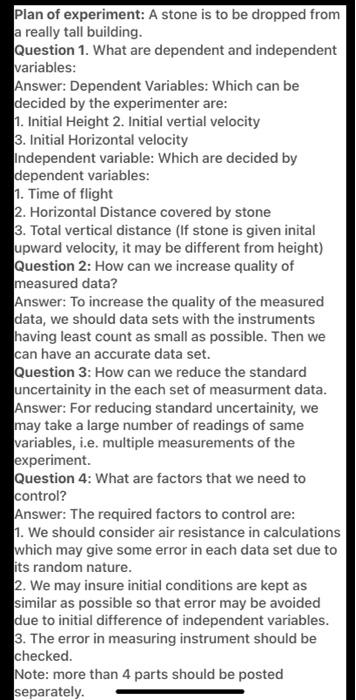
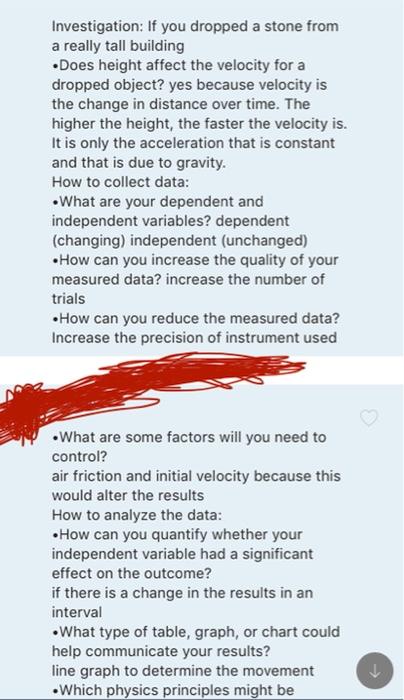
Investigation: If you dropped a stone from a really tall building Does height affect the velocity for a dropped object? yes because velocity is the change in distance over time. The higher the height, the faster the velocity is. It is only the acceleration that is constant and that is due to gravity. How to collect data: What are your dependent and independent variables? dependent (changing) independent (unchanged) How can you increase the quality of your measured data? increase the number of trials How can you reduce the measured data? Increase the precision of instrument used What are some factors will you need control? air friction and initial velocity because this would alter the results How to analyze the data: How can you quantify whether your independent variable had a significant effect on the outcome? if there is a change in the results in an interval What type of table, graph, or chart could help communicate your results? line graph to determine the movement Which physics principles might be Plan of experiment: A stone is to be dropped from a really tall building. Question 1. What are dependent and independent variables: Answer: Dependent Variables: Which can be decided by the experimenter are: 1. Initial Height 2. Initial vertial velocity 3. Initial Horizontal velocity Independent variable: Which are decided by dependent variables: 1. Time of flight 2. Horizontal Distance covered by stone 3. Total vertical distance (If stone is given inital upward velocity, it may be different from height) Question 2: How can we increase quality of measured data? Answer: To increase the quality of the measured data, we should data sets with the instruments having least count as small as possible. Then we can have an accurate data set. Question 3: How can we reduce the standard uncertainty in the each set of measurment data. Answer: For reducing standard uncertainity, we may take a large number of readings of same variables, i.e. multiple measurements of the experiment. Question 4: What are factors that we need to control? Answer: The required factors to control are: 1. We should consider air resistance in calculations which may give some error in each data set due to its random nature. 2. We may insure initial conditions are kept as similar as possible so that error may be avoided due to initial difference of independent variables. 3. The error in measuring instrument should be checked. Note: more than 4 parts should be posted separately. Investigation: If you dropped a stone from a really tall building Does height affect the velocity for a dropped object? yes because velocity is the change in distance over time. The higher the height, the faster the velocity is. It is only the acceleration that is constant and that is due to gravity. How to collect data: What are your dependent and independent variables? dependent (changing) independent (unchanged) How can you increase the quality of your measured data? increase the number of trials How can you reduce the measured data? Increase the precision of instrument used What are some factors will you need control? air friction and initial velocity because this would alter the results How to analyze the data: How can you quantify whether your independent variable had a significant effect on the outcome? if there is a change in the results in an interval What type of table, graph, or chart could help communicate your results? line graph to determine the movement Which physics principles might be Plan of experiment: A stone is to be dropped from a really tall building. Question 1. What are dependent and independent variables: Answer: Dependent Variables: Which can be decided by the experimenter are: 1. Initial Height 2. Initial vertial velocity 3. Initial Horizontal velocity Independent variable: Which are decided by dependent variables: 1. Time of flight 2. Horizontal Distance covered by stone 3. Total vertical distance (If stone is given inital upward velocity, it may be different from height) Question 2: How can we increase quality of measured data? Answer: To increase the quality of the measured data, we should data sets with the instruments having least count as small as possible. Then we can have an accurate data set. Question 3: How can we reduce the standard uncertainty in the each set of measurment data. Answer: For reducing standard uncertainity, we may take a large number of readings of same variables, i.e. multiple measurements of the experiment. Question 4: What are factors that we need to control? Answer: The required factors to control are: 1. We should consider air resistance in calculations which may give some error in each data set due to its random nature. 2. We may insure initial conditions are kept as similar as possible so that error may be avoided due to initial difference of independent variables. 3. The error in measuring instrument should be checked. Note: more than 4 parts should be posted separately

Step by Step Solution

There are 3 Steps involved in it

1 Expert Approved Answer
Step: 1 Unlock blur-text-image

Question Has Been Solved by an Expert!

Get step-by-step solutions from verified subject matter experts

Step: 2 Unlock
Step: 3 Unlock

Students Have Also Explored These Related General Management Questions!