Question: Required information Comprehensive Problem 8-84 (LO 8-1, LO 8-2, LO 8-3, LO 8-4, LO 8-5) (Static) [The following information applies to the questions displayed below.]
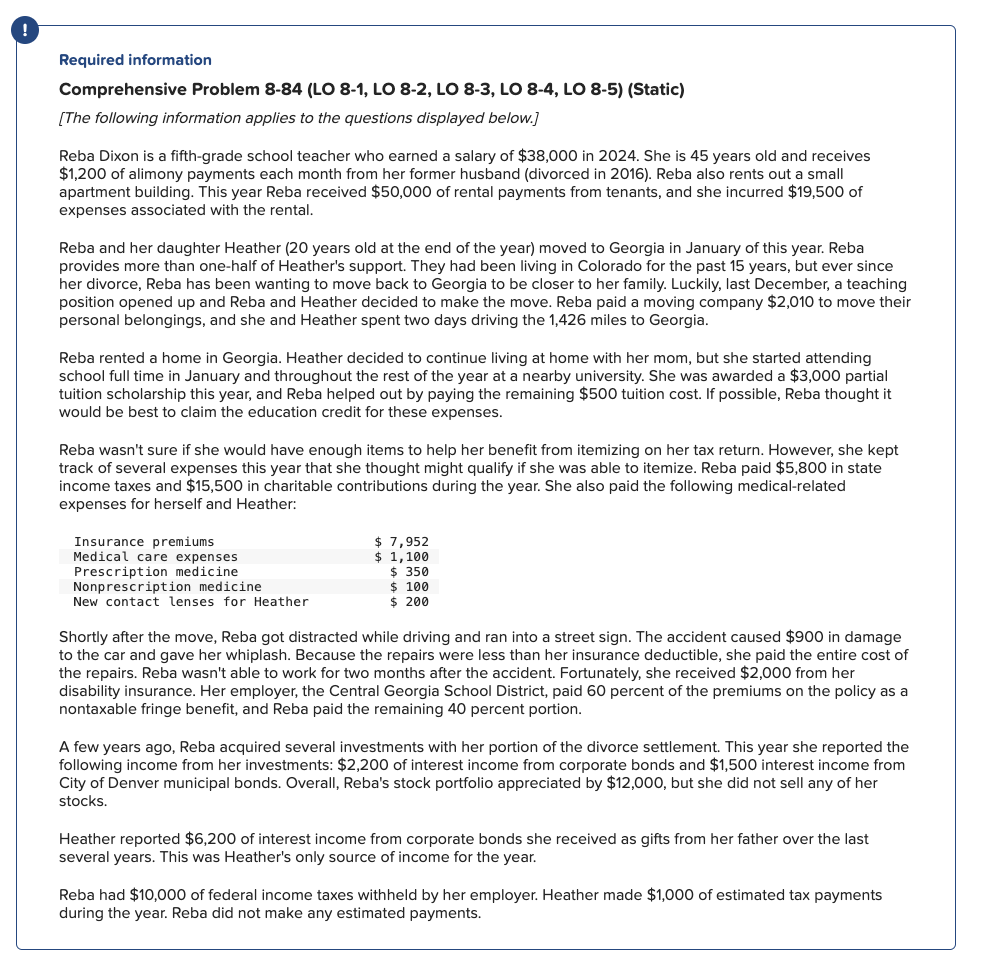
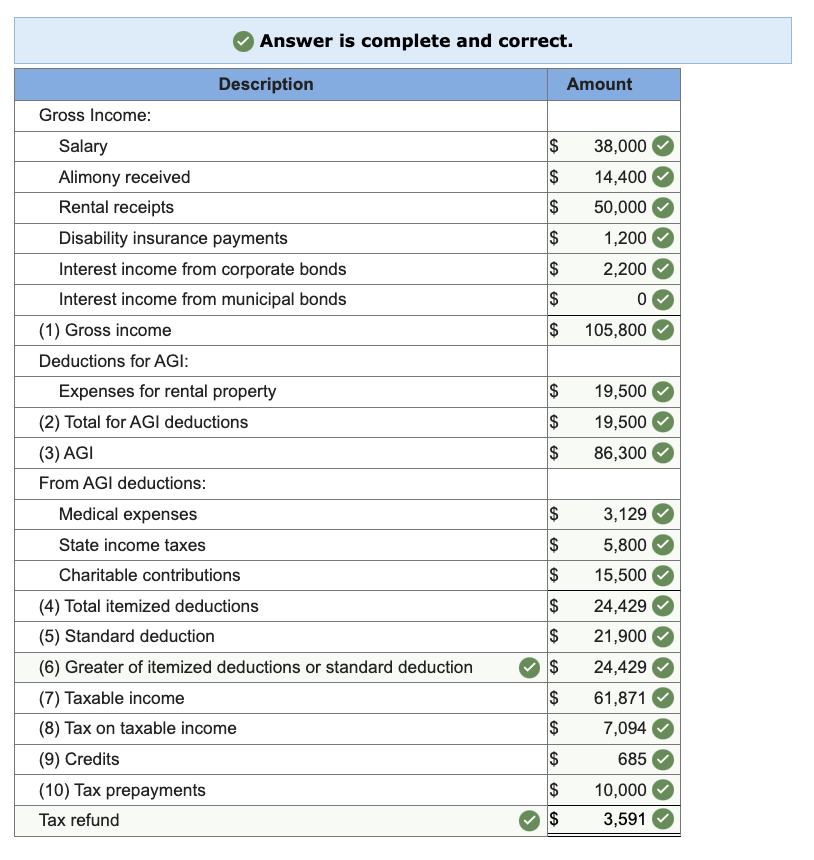
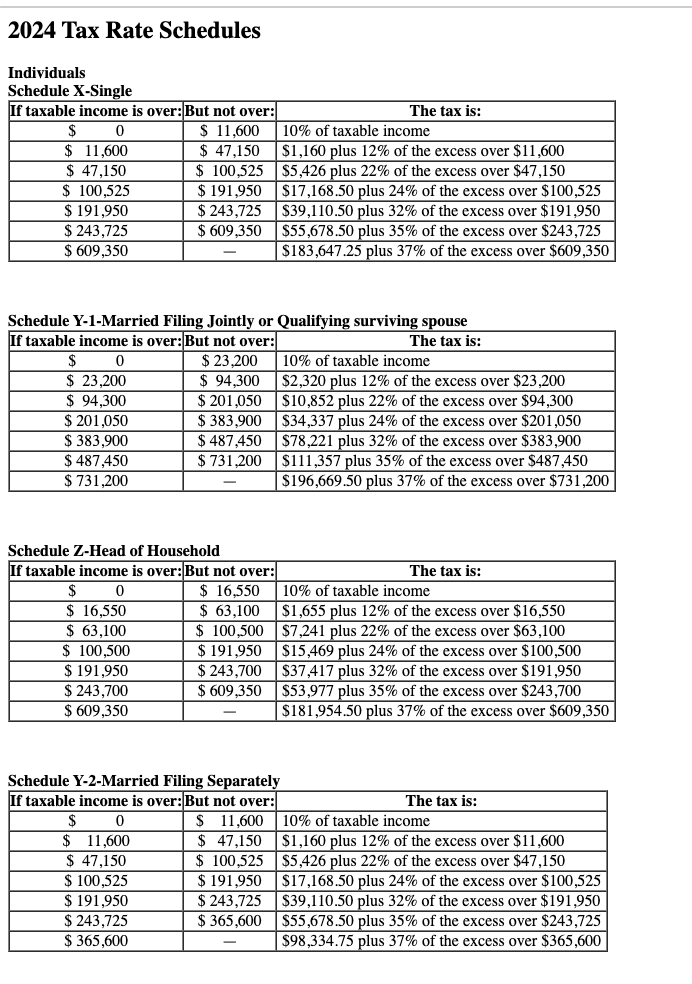
Required information Comprehensive Problem 8-84 (LO 8-1, LO 8-2, LO 8-3, LO 8-4, LO 8-5) (Static) [The following information applies to the questions displayed below.] Reba Dixon is a fifth-grade school teacher who earned a salary of $38,000 in 2024. She is 45 years old and receives $1,200 of alimony payments each month from her former husband (divorced in 2016). Reba also rents out a small apartment building. This year Reba received $50,000 of rental payments from tenants, and she incurred $19,500 of expenses associated with the rental. Reba and her daughter Heather (20 years old at the end of the year) moved to Georgia in January of this year. Reba provides more than one-half of Heather's support. They had been living in Colorado for the past 15 years, but ever since her divorce, Reba has been wanting to mowve back to Georgia to be closer to her family. Luckily, last December, a teaching position opened up and Reba and Heather decided to make the move. Reba paid a moving company $2,010 to move their personal belongings, and she and Heather spent two days driving the 1,426 miles to Georgia. Reba rented a home in Georgia. Heather decided to continue living at home with her mom, but she started attending school full time in January and throughout the rest of the year at a nearby university. She was awarded a $3,000 partial tuition scholarship this year, and Reba helped out by paying the remaining $500 tuition cost. If possible, Reba thought it would be best to claim the education credit for these expenses. Reba wasn't sure if she would have enough items to help her benefit from itemizing on her tax return. Howewver, she kept track of several expenses this year that she thought might qualify if she was able to itemize. Reba paid $5,800 in state income taxes and $15,500 in charitable contributions during the year. She also paid the following medical-related expenses for herself and Heather: Insurance premiums $ 7,952 Medical care expenses $ 1,100 Prescription medicine $ 350 Nonprescription medicine $ 100 New contact lenses for Heather $ 280 Shortly after the move, Reba got distracted while driving and ran into a street sign. The accident caused $900 in damage to the car and gave her whiplash. Because the repairs were less than her insurance deductible, she paid the entire cost of the repairs. Reba wasn't able to work for two months after the accident. Fortunately, she received $2,000 from her disability insurance. Her employer, the Central Georgia School District, paid 60 percent of the premiums on the policy as a nontaxable fringe benefit, and Reba paid the remaining 40 percent portion. A few years ago, Reba acquired several investments with her portion of the divorce settlement. This year she reported the following income from her investments: $2,200 of interest income from corporate bonds and $1,500 interest income from City of Denver municipal bonds. Overall, Reba's stock portfolio appreciated by $12,000, but she did not sell any of her stocks. Heather reported $6,200 of interest income from corporate bonds she received as gifts from her father over the last several years. This was Heather's only source of income for the year. Reba had $10,000 of federal income taxes withheld by her employer. Heather made $1,000 of estimated tax payments during the year. Reba did not make any estimated payments. @ Answer is complete and correct. . Deseripton | Amount Gross Income: Salary $ 380008 Alimony received $ 144000 Rental receipts $ 50,000 Disability insurance payments $ 1,200 @ Interest income from corporate bonds $ 2,200 @ Interest income from municipal bonds $ 0 (1) Gross income $ 105,800 @ Deductions for AGI: Expenses for rental property $ 19,500 @ (2) Total for AGI deductions $ 19,500 @ (3) AGI $ 86,300 From AGI deductions: Medical expenses $ 3,129 @ State income taxes $ 5,800 @ Charitable contributions $ 15,500 (4) Total itemized deductions $ 244290 (5) Standard deduction $ 21,900 @ (6) Greater of itemized deductions or standard deduction @5 244290 (7) Taxable income $ 618711@ (8) Tax on taxable income $ 7,004 @ (9) Credits $ 685 @ (10) Tax prepayments $ 10,000 @ Tax refund Q@35 3599 2024 Tax Rate Schedules Individuals Schedule X-Single If taxable income is over: But not over: The tax is: $ C $ 11,600 10% of taxable income $ 11,600 $ 47,150 $1,160 plus 12% of the excess over $11,600 $ 47,150 $ 100,525 $5,426 plus 22% of the excess over $47,150 $ 100,525 $ 191,950 $17,168.50 plus 24% of the excess over $100,525 $ 191,950 $ 243,725 $39,110.50 plus 32% of the excess over $191,950 $ 243,725 $ 609,350 $55,678.50 plus 35% of the excess over $243,725 $ 609,350 $183,647.25 plus 37% of the excess over $609,350 Schedule Y-1-Married Filing Jointly or Qualifying surviving spouse If taxable income is over: But not over: The tax is: $ 0 $ 23,200 10% of taxable income $ 23,200 $ 94,300 $2,320 plus 12% of the excess over $23,200 $ 94,300 $ 201,050 $10,852 plus 22% of the excess over $94,300 $ 201,050 $ 383,900 $34,337 plus 24% of the excess over $201,050 $ 383,900 $ 487,450 $78,221 plus 32% of the excess over $383,900 $ 487,450 $ 731,200 $111,357 plus 35% of the excess over $487,450 $ 731,200 $196,669.50 plus 37% of the excess over $731,200 Schedule Z-Head of Household If taxable income is over: But not over: The tax is: $ 0 $ 16,550 10% of taxable income $ 16,550 $ 63,100 $1,655 plus 12% of the excess over $16,550 $ 63,100 $ 100,500 $7,241 plus 22% of the excess over $63,100 $ 100,500 $ 191,950 $15,469 plus 24% of the excess over $100,500 $ 191,950 $ 243,700 $37,417 plus 32% of the excess over $191,950 $ 243,700 $ 609,350 $53,977 plus 35% of the excess over $243,700 $ 609,350 $181,954.50 plus 37% of the excess over $609,350 Schedule Y-2-Married Filing Separately If taxable income is over: But not over: The tax is: $ 0 $ 11,600 10% of taxable income $ 11,600 $ 47,150 $1,160 plus 12% of the excess over $11,600 $ 47,150 $ 100,525 $5,426 plus 22% of the excess over $47,150 $ 100,525 $ 191,950 $17,168.50 plus 24% of the excess over $100,525 $ 191,950 $ 243,725 $39,110.50 plus 32% of the excess over $191,950 $ 243,725 $ 365,600 $55,678.50 plus 35% of the excess over $243,725 $ 365,600 $98,334.75 plus 37% of the excess over $365,600
Step by Step Solution
There are 3 Steps involved in it
1 Expert Approved Answer
Step: 1 Unlock
Question Has Been Solved by an Expert!
Get step-by-step solutions from verified subject matter experts
Step: 2 Unlock
Step: 3 Unlock
Students Have Also Explored These Related Accounting Questions!









 Study Help