



Question: Required information Exercise 17-8 Liquidity analysis and interpretation LO P3 [The following information applies to the questions displayed below.] Simon Company's year-end balance sheets follow.
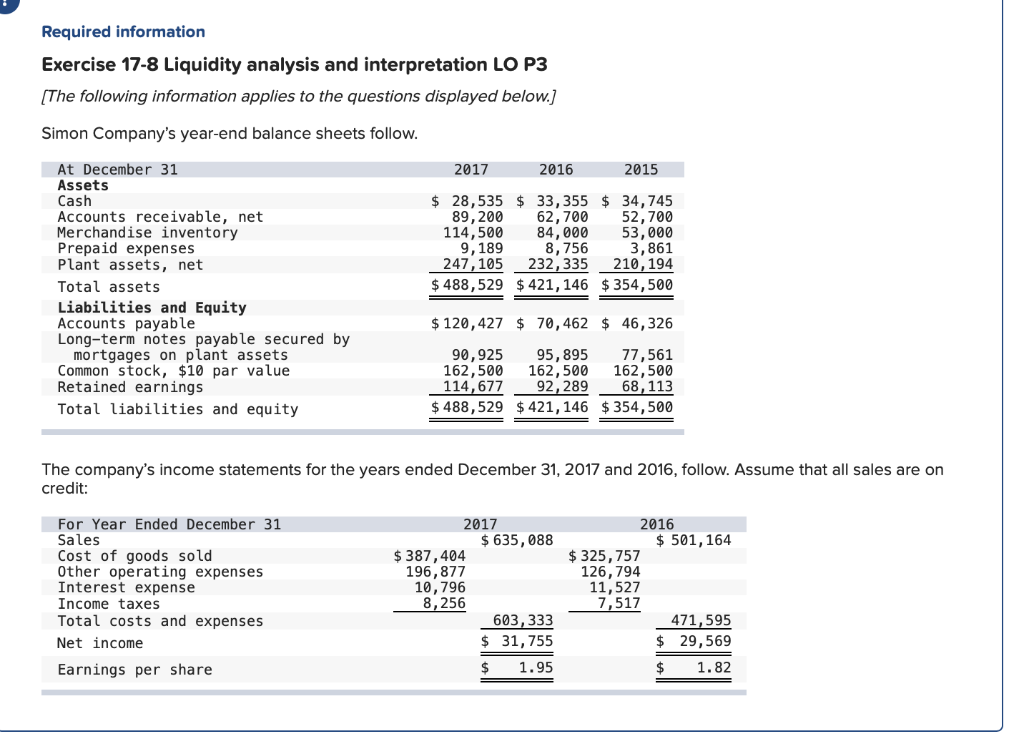
![following information applies to the questions displayed below.] Simon Company's year-end balance](https://s3.amazonaws.com/si.experts.images/answers/2024/07/66a4f347a4401_21566a4f34741fe7.jpg)
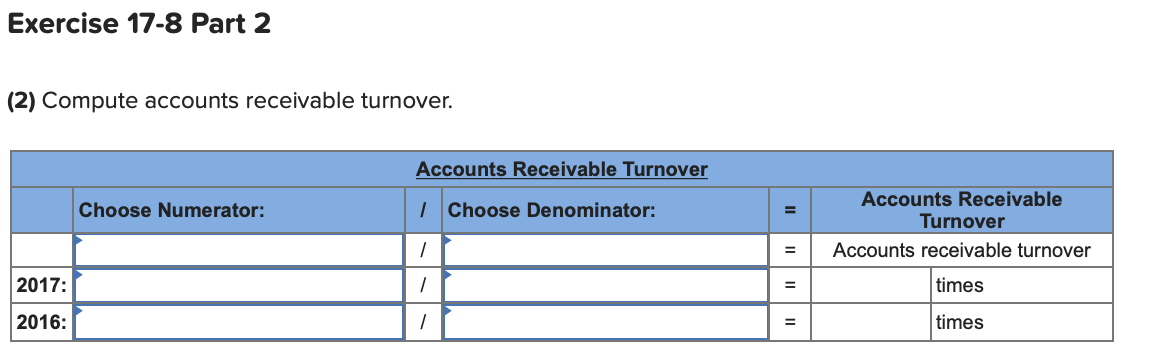
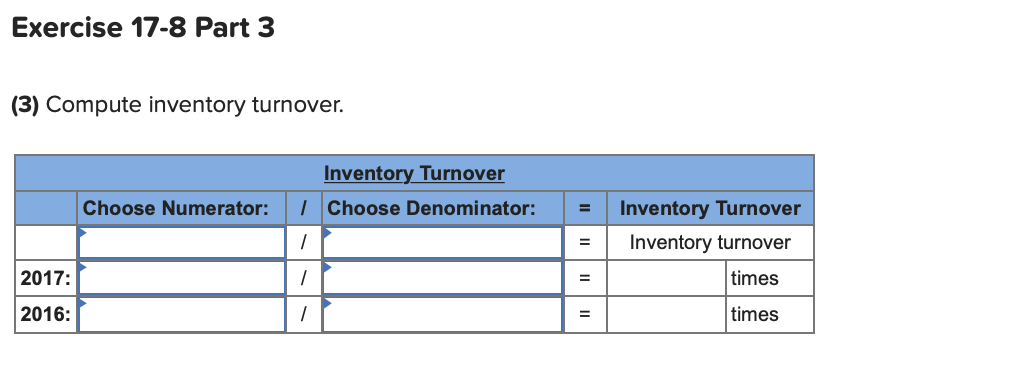
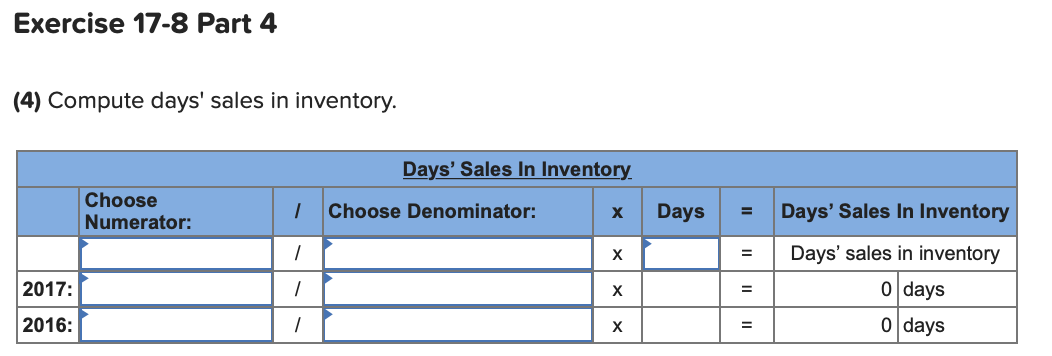
Required information Exercise 17-8 Liquidity analysis and interpretation LO P3 [The following information applies to the questions displayed below.] Simon Company's year-end balance sheets follow. At December 31 2017 2016 2015 Assets $ 28,535 $ 33, 355 $ 34,745 89,200 62,700 52,700 114,500 84,000 53,000 9, 189 8,756 3,861 247,105 232, 335 210,194 $ 488,529 $ 421, 146 $ 354,500 Cash Accounts receivable, net Merchandise inventory Prepaid expenses Plant assets, net Total assets Liabilities and Equity Accounts payable Long-term notes payable secured by mortgages on plant assets Common stock, $10 par value Retained earnings Total liabilities and equity $ 120,427 $ 70,462 $ 46,326 90,925 95,895 77,561 162,500 162,500 162,500 114,677 92,289 68,113 $ 488,529 $ 421, 146 $ 354,500 The company's income statements for the years ended December 31, 2017 and 2016, follow. Assume that all sales are on credit: For Year Ended December 31 Sales Cost of goods sold Other operating expenses Interest expense Income taxes Total costs and expenses Net income Earnings per share 2017 $ 635,088 $ 387,404 196,877 10,796 8,256 603, 333 $ 31,755 1.95 2016 $ 501,164 $ 325,757 126,794 11,527 7,517 471,595 $ 29,569 $ 1.82 Exercise 17-8 Part 1 (1) Compute days' sales uncollected. Days' Sales Uncollected Choose Numerator: 1 Choose Denominator: Days Days' Sales Uncollected / Days' Sales Uncollected 2017: / X 0 days 2016: 1 o days Exercise 17-8 Part 2 (2) Compute accounts receivable turnover. Accounts Receivable Turnover Choose Numerator: | Choose Denominator: Accounts Receivable Turnover Accounts receivable turnover / 2017: / = times 2016: / times Exercise 17-8 Part 3 (3) Compute inventory turnover. Choose Numerator: Inventory Turnover | Choose Denominator: 1 Inventory Turnover Inventory turnover = 2017: 1 times 2016: 1 times Exercise 17-8 Part 4 (4) Compute days' sales in inventory. Days' Sales In Inventory Choose Numerator: 1 Choose Denominator: X Days Days' Sales In Inventory / Days' sales in inventory 2017: 1 0 days 2016: / 0 days
Step by Step Solution
There are 3 Steps involved in it

Get step-by-step solutions from verified subject matter experts