







Question: ! Required information Problem 6-1A (Algo) Perpetual: Alternative cost flows LO P1 (The following information applies to the questions displayed below.) Warnerwoods Company uses a
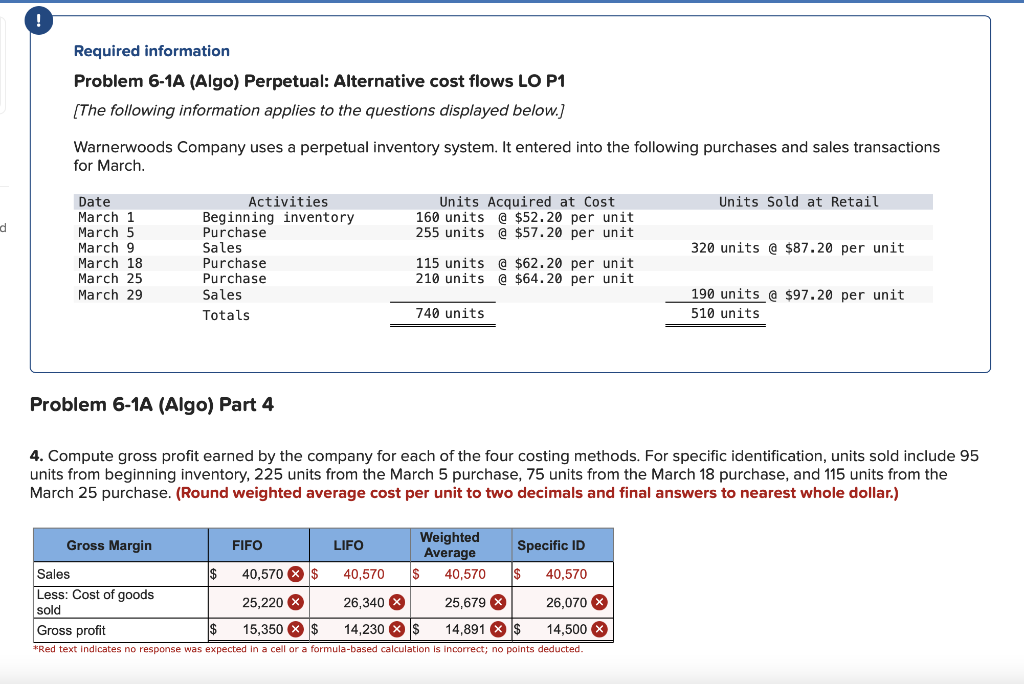
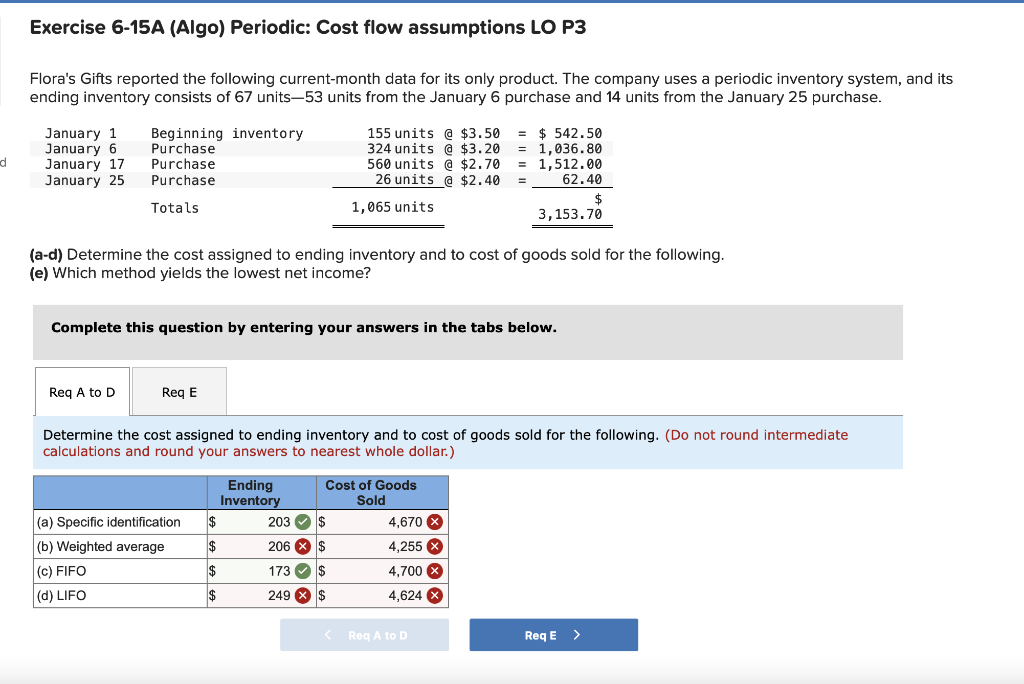
! Required information Problem 6-1A (Algo) Perpetual: Alternative cost flows LO P1 (The following information applies to the questions displayed below.) Warnerwoods Company uses a perpetual inventory system. It entered into the following purchases and sales transactions for March. Units Sold at Retail Units Acquired at Cost 160 units @ $52.20 per unit 255 units @ $57.20 per unit d Date March 1 March 5 March 9 March 18 March 25 March 29 320 units @ $87.20 per unit Activities Beginning inventory Purchase Sales Purchase Purchase Sales Totals 115 units @ $62.20 per unit 210 units @ $64.20 per unit 190 units @ $97.20 per unit 510 units 740 units Problem 6-1A (Algo) Part 4 4. Compute gross profit earned by the company for each of the four costing methods. For specific identification, units sold include 95 units from beginning inventory, 225 units from the March 5 purchase, 75 units from the March 18 purchase, and 115 units from the March 25 purchase. (Round weighted average cost per unit to two decimals and final answers to nearest whole dollar.) Gross Margin Weighted FIFO LIFO Specific ID Average Sales $ 40,570 X $ 40,570 $ 40,570 40,570 Less: Cost of goods sold 25,220 X 26,340 X 25,679 X 26,070 X Gross profit $ 15,350 X $ 14,230 X $ 14,891 X $ 14,500 X *Red text indicates no response was expected in a cell or a formula-based calculation is incorrect; no points deducted Exercise 6-15A (Algo) Periodic: Cost flow assumptions LO P3 Flora's Gifts reported the following current-month data for its only product. The company uses a periodic inventory system, and its ending inventory consists of 67 units-53 units from the January 6 purchase and 14 units from the January 25 purchase. January 1 January 6 January 17 January 25 Beginning inventory Purchase Purchase Purchase 155 units $3.50 324 units @ $3.20 560 units @ $2.70 26 units @ $2.40 d $ 542.50 = 1,036.80 = 1,512.00 62.40 Totals 1,065 units 3,153.70 (a-d) Determine the cost assigned to ending inventory and to cost of goods sold for the following. (e) Which method yields the lowest net income? Complete this question by entering your answers in the tabs below. Req A to D ReqE Determine the cost assigned to ending inventory and to cost of goods sold for the following. (Do not round intermediate calculations and round your answers to nearest whole dollar.) (a) Specific identification (b) Weighted average (c) FIFO (d) LIFO Ending Cost of Goods Inventory Sold 203 $ 4,670 X $ 206 X $ 4,255 X $ 173 $ 4,700 X $ 249 X $ 4,624 X
Step by Step Solution
There are 3 Steps involved in it

Get step-by-step solutions from verified subject matter experts
 Study Help