







Question: Required information Problem 6-2AA Periodic: Alternative cost flows LO P3 The following information applies to the questions displayed below.) Warnerwoods Company uses a periodic inventory
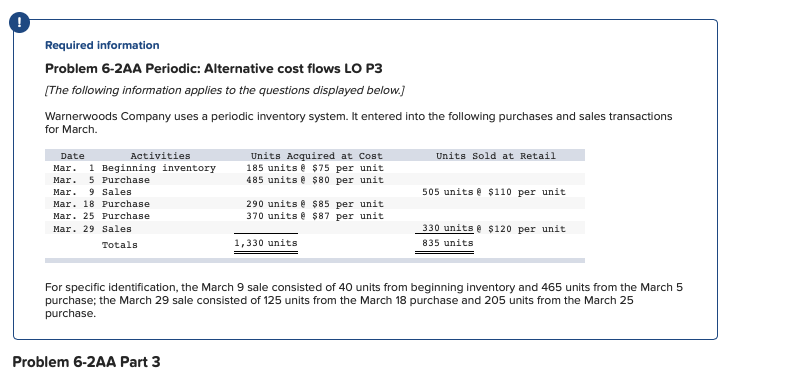
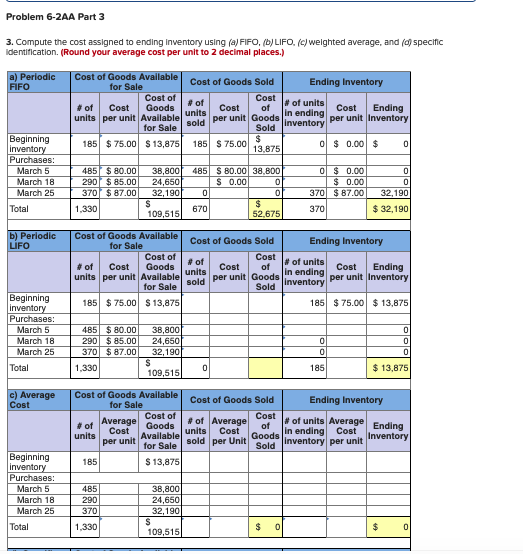
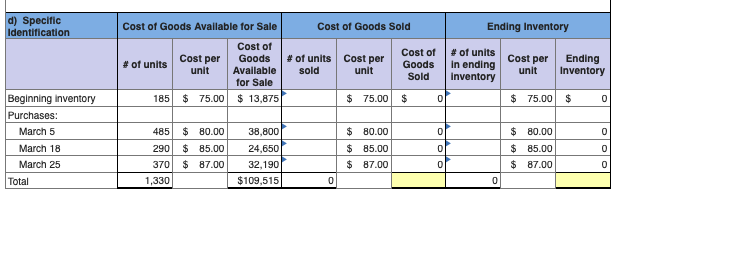
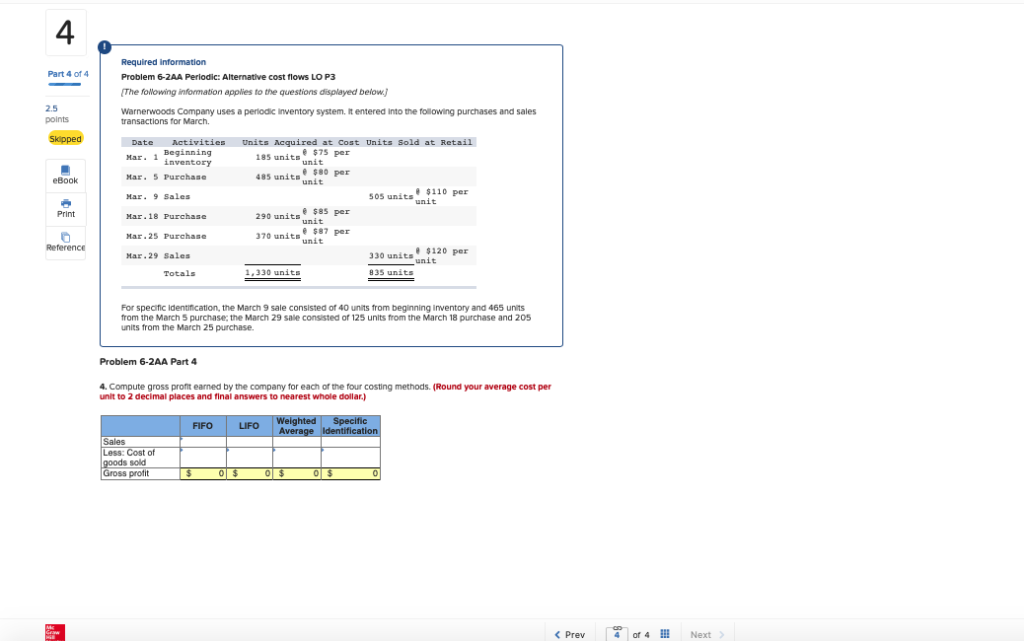
Required information Problem 6-2AA Periodic: Alternative cost flows LO P3 The following information applies to the questions displayed below.) Warnerwoods Company uses a periodic inventory system. It entered into the following purchases and sales transactions for March. Units Sold at Retail Units Acquired at Cost 185 units @ $75 per unit 485 units @ $80 per unit 505 units @ $110 per unit Date Activities Mar. 1 Beginning inventory Mar. 5 Purchase Mar. 9 Sales Mar. 18 Purchase Mar. 25 Purchase Mar. 29 Sales Totals 290 units @ $85 per unit 370 units @ $87 per unit 330 units@ $120 per unit 835 units 1,330 units For specific identification, the March 9 sale consisted of 40 units from beginning inventory and 465 units from the March 5 purchase; the March 29 sale consisted of 125 units from the March 18 purchase and 205 units from the March 25 purchase. Problem 6-2AA Part 3 Problem 6-2AA Part 3 3. Compute the cost assigned to ending inventory using (a) FIFO. (LIFO. [weighted average, and (of specific Identification (Round your average cost per unit to 2 decimal places.) a) Periodic FIFO Cost of Goods Available for Sale Cost of Goods Sold Ending Inventory Cost of of Cost Cost Cost End of Cost Goods units per unit Available units for Sale sold per unit Goodsin ending of units of in ending per unit Inventory Sold inventory 13.875 0 $0.00 $ 185 $ 75,00 $ 13,875 185 $ 75.00 Beginning inventory Purchases: March 5 March 18 March 25 0 S 80.00 38.800 s 0.00 of 485 $ 80.00 38,800 485 290 $ 85.00 24,6501 370 $ 87.0032.1900 1,330 100 5150 670 $ 0.00 $ 0.00 $ 87.00 370 32,190 $ 32,190 Total 370 52.675/ b) Periodic UFO Cost of Goods Available for Sale Cost of Goods Sold Ending Inventory Cost of of Cost of units units Cost per unit Goods in ending -ost of Cost Ending per unit Inventory # of Cost Goods units per unit Available for Sale 185 $ 75.00 $ 13,875 Sold inventory 185 $75.00 $ 13,875 Beginning inventory Purchases: March 5 March 18 March 25 Total 1485 $ 80.00 T290 $ 85,00 3 70 $ 87,00 1,330 38,800 24.650 32, 1901 185 109.5151 $ 13,875 c) Average Cost Cost of Goods Sold Ending Inventory Cost of Goods Available ble for Sale Average cost of rage Goods of Average Cost units per unit Available sold per Unit of Average cost of units Average of rage Ending units Cost din ending Cost sold per Unit inventory per unit Inventory Sold for Sale $ 13,875 185 Beginning inventory Purchases March 5 March 18 March 25 1485 290 38.800 24,6501 32,1901 370 Total 1,330 109,5151 d) Specific Identification Cost of Goods Sold Ending Inventory Cost of Goods Available for Sale Cost of Cost per Goods # of units unit Available for Sale 185 $ 75.00 $ 13,875 # of units sold Cost per unit Cost of Goods Sold # of units in ending Inventory Cost per unit Ending Inventory $ 75.00 $ $ 75.00 $ Beginning inventory Purchases: March 5 March 18 March 25 Total 485 290 370 1,330 $ 80.00 $ 85.00 $ 87.00 38,800 24,650 32,190 $ 109,515 $ $ $ 80.00 85.00 87.00 $ $ $ 80.00 85.00 87.00 Part 4 of 4 Required information Problem 6-2AA Periodic: Alternative cost flows LO P3 The following information applies to the questions displayed below.] Warnerwoods Company uses a periodic Inventory system. It entered into the following purchases and sales transactions for March. points Skipped Date Activities Units Acquired at Cost Units Sold at Retail Mar, Beginning 185 unite $75 per unit inventory Mar. 5 Purchase eBook 485 units unit 485 unit. $0 per Mar. 9 Sales 505 units $110 per unit Print Mar. 18 Purchase 290 units unit @ $85 per Mar.25 Purchase 370 units unit $87 per Reference Mar.29 Sales $120 per 330 units unit Totals 1,330 units 835 units For specific identification, the March 9 sale consisted of 40 units from beginning inventory and 465 units from the March 5 purchase, the March 29 sale consisted of 125 units from the March 18 purchase and 205 units from the March 25 purchase Problem 6-2AA Part 4 4. Compute gross profit earned by the company for each of the four costing methods. (Round your average cost per unit to 2 decimal places and final answers to nearest whole dollar) FIFO Weighted Specific Average Identification Sales Less: Cost of goods sold Gross profit $ 0 $ 0 $ 0 $ 0 22
Step by Step Solution
There are 3 Steps involved in it

Get step-by-step solutions from verified subject matter experts
 Study Help