







Question: Required information This case is important because the supply function is frequently given responsibility for logistics and transportation. As a leader in the supply organization,
Required information
This case is important because the supply function is
frequently given responsibility for logistics and
transportation. As a leader in the supply organization, you
need to understand the potential costs and benefits of
maintaining a central distribution center.
Read the following case on Huntington School District and
then answer the questions that follow.
Huntington School District
On Tuesday May Derek Chan, supply manager for
Huntington School District HSD in Arizona, met with
Jocelyn Harrison, finance supervisor. The district's
forecasted operating budget for the following year would be
in a deficit and Jocelyn had been asked to make
recommendations that would address the problem. During
their meeting, Jocelyn proposed eliminating the central
distribution center and giving the schools responsibility for
managing their own supplies. Derek had to respond to
Jocelyn's proposal by the end of the week.
THE SCHOOL DISTRICT
The HSD was created four years earlier with the
amalgamation of four repional school districts into one
centralized administrative body. Despite a growing
population in the area, the amalgamation was deemed
necessary to cut costs through operating synergies. The
amalgamated HSD operated approximately schools
employing more than full and parttime staff, in a
geographic area covering about square miles. Prior to
amalgamation, the Huntington City School District had been
the largest of the four, with approximately schools, while
the three others were smaller rural school districts. The
current operating budget for the HSD was $ million.
SUPPLY MANAGEMENT
The supply departments for the three rural districts were
eliminated at the time of amalgamation, and the purchasing
department at the Huntington City School District was given
responsibility for the new HSD Staffing levels were
maintained at the preamalgamation levels of people.
For a number of years, the supply department had been
utilizing its SupplyNet eprocurement system to make it
easier for staff to order supplies and to help manage its
inventory at the distribution center. At the time of the
amalgamation, the three other districts also adopted the
same system, which had been upgraded recently.
Purchases for the HSD excluding major construction
projects, specialized consulting services, legal and financial
charges, were approximately $ million per year. When a
staff member at a school needed to make a purchase, they
placed an order on HSDs eprocurement system. Orders
were crosschecked by finance for approvals and to ensure
adequate budget resources were available to acquire the
requested goods or services. The system consolidated
orders and issued purchase orders to suppliers daily. The
district also used purchasing cards for some small value
purchases.
THE DISTRIBUTION CENTER
The supply management department maintained a
squarefoot distribution center in the City of Huntington,
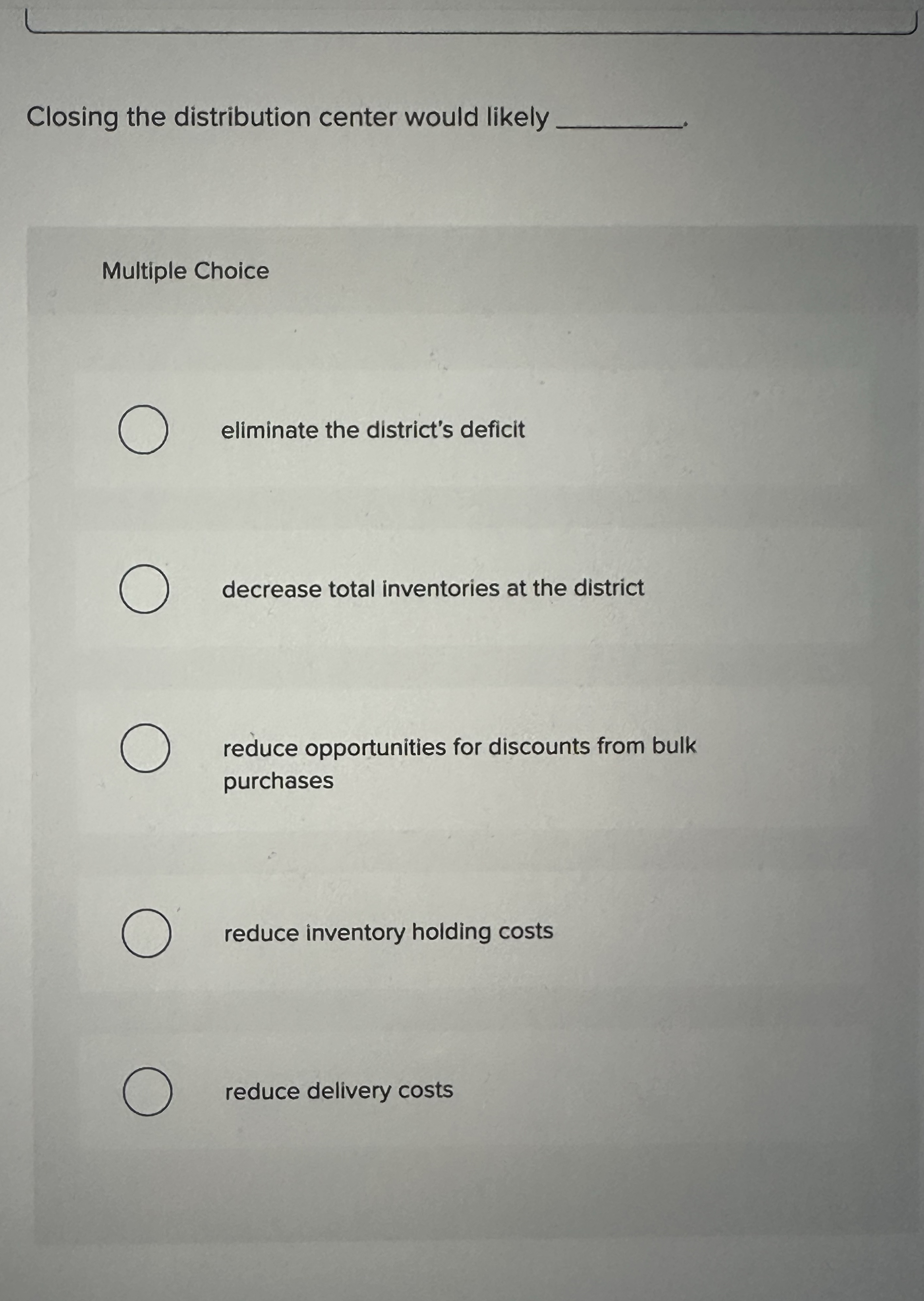
which served two primary purposes. Inventories were
maintained at the warehouse for general supplies, such as
paper, office supplies, and janitorial products. These
inventories were maintained either bscause quantity
discounts justified bulk purchases, minimum order quantities
set by suppliers, or substantial delivery lead times warranted
holding safety stock. Inventory levels at the distribution
center averaged $ million, although it fluctuated
considerably during the year. Also housed at the distribution
center was the district's inventory of educational resource
center was the district's inventory of educational resource
suppliesequipment such as audiovisual material and
special teaching suppliesthat schools used occasionally
and could loan on a short or mediumterm basis.
The distribution center also operated the district's delivery
system, including interdepartment mail, supplies,
educational resources, computer equipment, and
audiovisual equipment for repair or loan. In addition, the
delivery service handled the removal of surplus equipment
and furniture for disposal. Deliveries were made to schools
and district offices twice per week, and sometimes more
frequently if required. The district owned four delivery vans
and one large moving truck.
The distribution center had one supervisor, one clerk, five
warehouse staff, and five delivery drivers. Overall, school
and administrative staff were satisfied with the current
arrangement and the services provided by the distribution
center.
JOCELYN HARRISON'S PLAN
When Jocelyn Harrison met with Derek, she explained that
the HSD was forecasting a deficit of $ million for the
coming year and that adjustments to the budget would have
to be made in order to address this problem. While early
retirement of a number of staff and cuts to various programs
would eliminate some of the shortfall, additional reductions
were
Step by Step Solution
There are 3 Steps involved in it
1 Expert Approved Answer
Step: 1 Unlock

Question Has Been Solved by an Expert!
Get step-by-step solutions from verified subject matter experts
Step: 2 Unlock
Step: 3 Unlock
 Study Help