







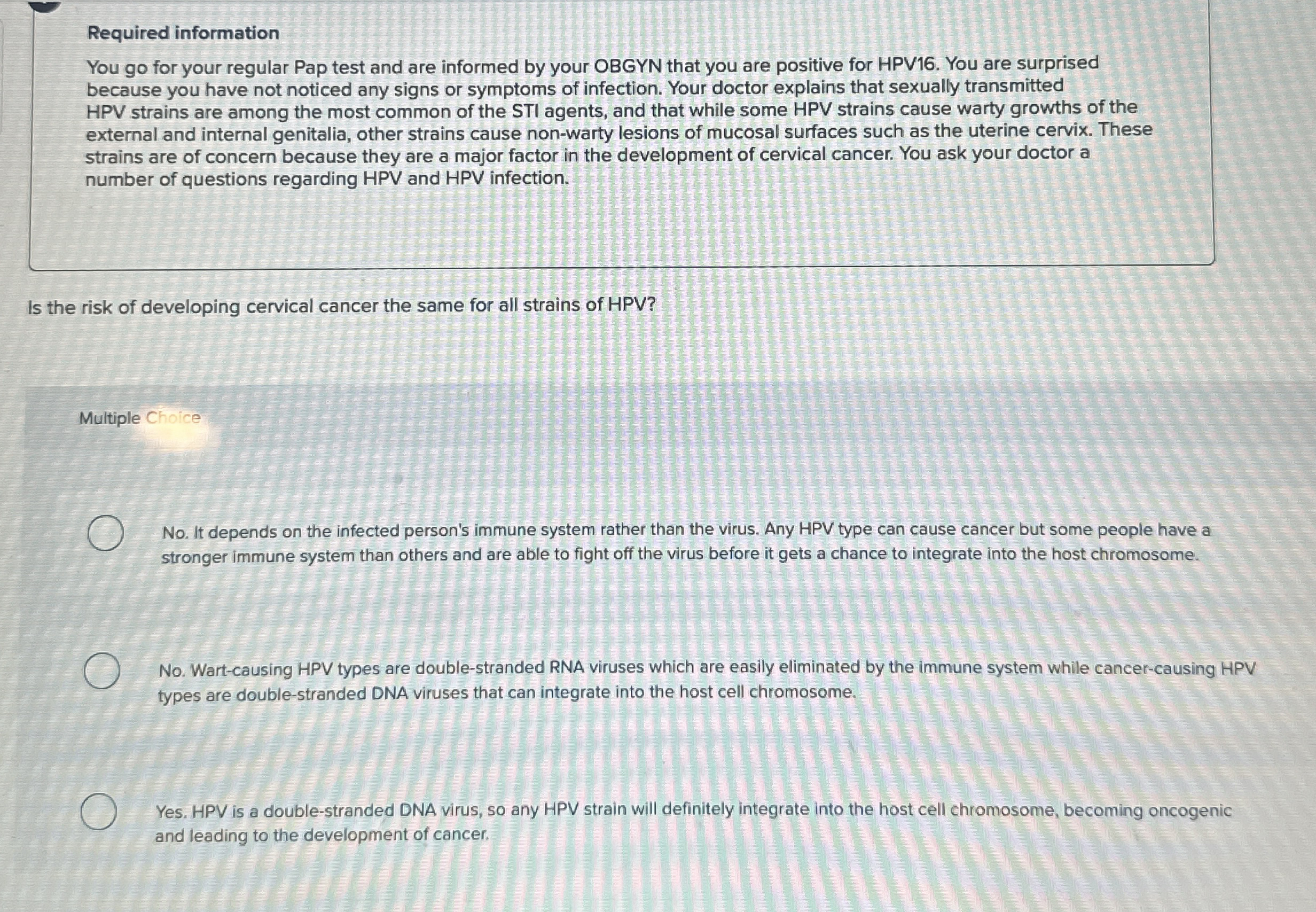
Question: Required information You go for your regular Pap test and are informed by your OBGYN that you are positive for HPV 1 6 . You
Required information
You go for your regular Pap test and are informed by your OBGYN that you are positive for HPV You are surprised because you have not noticed any signs or symptoms of infection. Your doctor explains that sexually transmitted HPV strains are among the most common of the STI agents, and that while some HPV strains cause warty growths of the external and internal genitalia, other strains cause nonwarty lesions of mucosal surfaces such as the uterine cervix. These strains are of concern because they are a major factor in the development of cervical cancer. You ask your doctor a number of questions regarding HPV and HPV infection.
Is the risk of developing cervical cancer the same for all strains of HPV
Multiple Choice
No It depends on the infected person's immune system rather than the virus. Any HPV type can cause cancer but some people have a stronger immune system than others and are able to fight off the virus before it gets a chance to integrate into the host chromosome.
No Wartcausing HPV types are doublestranded RNA viruses which are easily eliminated by the immune system while cancercausing HPV types are doublestranded DNA viruses that can integrate into the host cell chromosome.
Yes. HPV is a doublestranded DNA virus, so any HPV strain will definitely integrate into the host cell chromosome, becoming oncogenic and leading to the development of cancer.
Step by Step Solution
There are 3 Steps involved in it
1 Expert Approved Answer
Step: 1 Unlock

Question Has Been Solved by an Expert!
Get step-by-step solutions from verified subject matter experts
Step: 2 Unlock
Step: 3 Unlock
 Study Help