







Question: . Required: Question 01: identify the problem in the case: Question 02: information Question 03: Analyze the information Question 04: Give Solution (HRD Strategy) please
.
Required:
Question 01: identify the problem in the case:
Question 02: information
Question 03: Analyze the information
Question 04: Give Solution (HRD Strategy)
please do it
it is full case
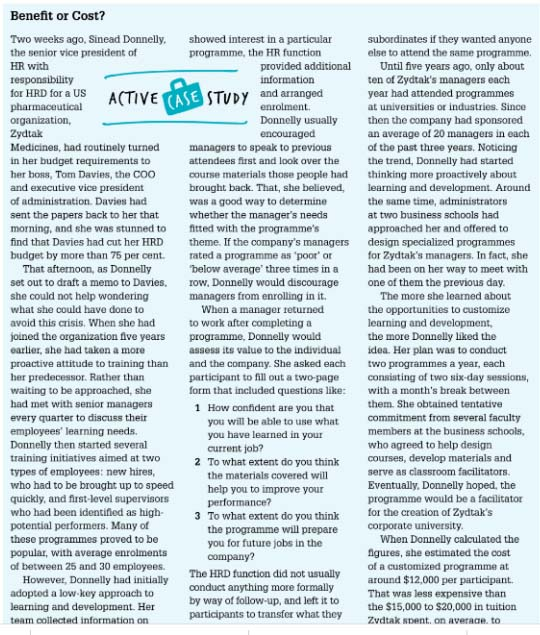
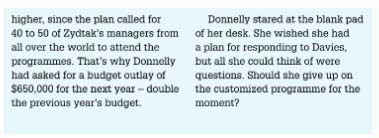
Benefit or Cost? ACTIVE CASE STUDY Two weeks ago, Sinead Donnelly, the senior vice president of HR with responsibility for HRD for a US pharmaceutical organization, Zydtak Medicines, had routinely turned in her budget requirements to her boss, Tom Davies, the COO and executive vice president of administration. Davies had sent the papers back to her that morning, and she was stunned to find that Davies had cut her HRD budget by more than 75 per cent. That afternoon, as Donnelly set out to draft a memo to Davies, she could not help wondering what she could have done to avoid this crisis. When she had joined the organization five years earlier, she had taken a more proactive attitude to training than her predecessor. Rather than waiting to be approached, she had met with senior managers every quarter to discuss their employees' learning needs. Donnelly then started several training initiatives aimed at two types of employees: new hires, who had to be brought up to speed quickly, and first-level supervisors who had been identified as high- potential performers. Many of these programmes proved to be popular, with average enrolments of between 25 and 30 employees However, Donnelly had initially adoptod a low-key approach to learning and development. Her team collected information on showed interest in a particular programme, the HR function provided additional information and arranged enrolment Donnelly usually encouraged managers to speak to previous attendees first and look over the course materials those people had brought back. That, she believed, was a good way to determine whether the manager's needs fitted with the programme's theme. If the company's managers rated a programme aspoor or below average' three times in a row, Donnelly would discourage managers from enrolling in it. When a manager returned to work after completing a programme, Donnelly would assess its value to the individual and the company. She asked each participant to fill out a two-page form that included questions like: 1 How confident are you that you will be able to use what you have learned in your current job? 2 To what extent do you think the materials covered will help you to improve your performance? 3 To what extent do you think the programme will prepare you for future jobs in the company? The HRD function did not usually conduct anything more formally by way of follow-up, and left it to participants to transfer what they subordinates if they wanted anyone else to attend the same programme Until five years ago, only about ten of Zydtak's managers each year had attended programmes at universities or industries. Since then the company had sponsored an average of 20 managers in each of the past three years, Noticing the trend, Donnelly had started thinking more proactively about learning and development. Around the same time, administrators at two business schools had approached her and offered to design specialized programmes for Zydtak's managers. In fact, she had been on her way to meet with one of them the previous day The more she learned about the opportunities to customize learning and development, the more Donnelly liked the idea. Her plan was to conduct two programmes a year, each consisting of two six-day sessions, with a month's break between them. She obtained tentative commitment from several faculty members at the business schools, who agreed to help design courses, develop materials and serve as classroom facilitators Eventually. Donnelly hoped, the programme would be a facilitator for the creation of Zydtak's corporate university When Donnelly calculated the figures, she estimated the cost of a customized programme at around $12,000 per participant That was less expensive than the $15,000 to $20,000 in tuition Zudtak Denton average to higher, since the plan called for 40 to 50 of Zydtak's managers from all over the world to attend the programmes. That's why Donnelly had asked for a budget outlay of $650,000 for the next year - double the previous year's budget. Donnelly stared at the blank pad of her desk. She wished she had a plan for responding to Davies, but all she could think of wore questions. Should she give up on the customized programme for the momentStep by Step Solution
There are 3 Steps involved in it
1 Expert Approved Answer
Step: 1 Unlock

Question Has Been Solved by an Expert!
Get step-by-step solutions from verified subject matter experts
Step: 2 Unlock
Step: 3 Unlock
 Study Help