







Question: . . Required Question: Question 01: Do you think the decisions made by Ms Assa Al Qubaissi were right or wrong? Justfy your answer (4
.
.
Required Question:
Question 01: Do you think the decisions made by Ms Assa Al Qubaissi were right or wrong? Justfy your answer (4 marks)
Question 02: If you were in her position what other decisions would you have made? (4 marks)
Question 03: What leadership Skills do you think she lacked? Justify you answer from instances mentioned on the case (8 marks)
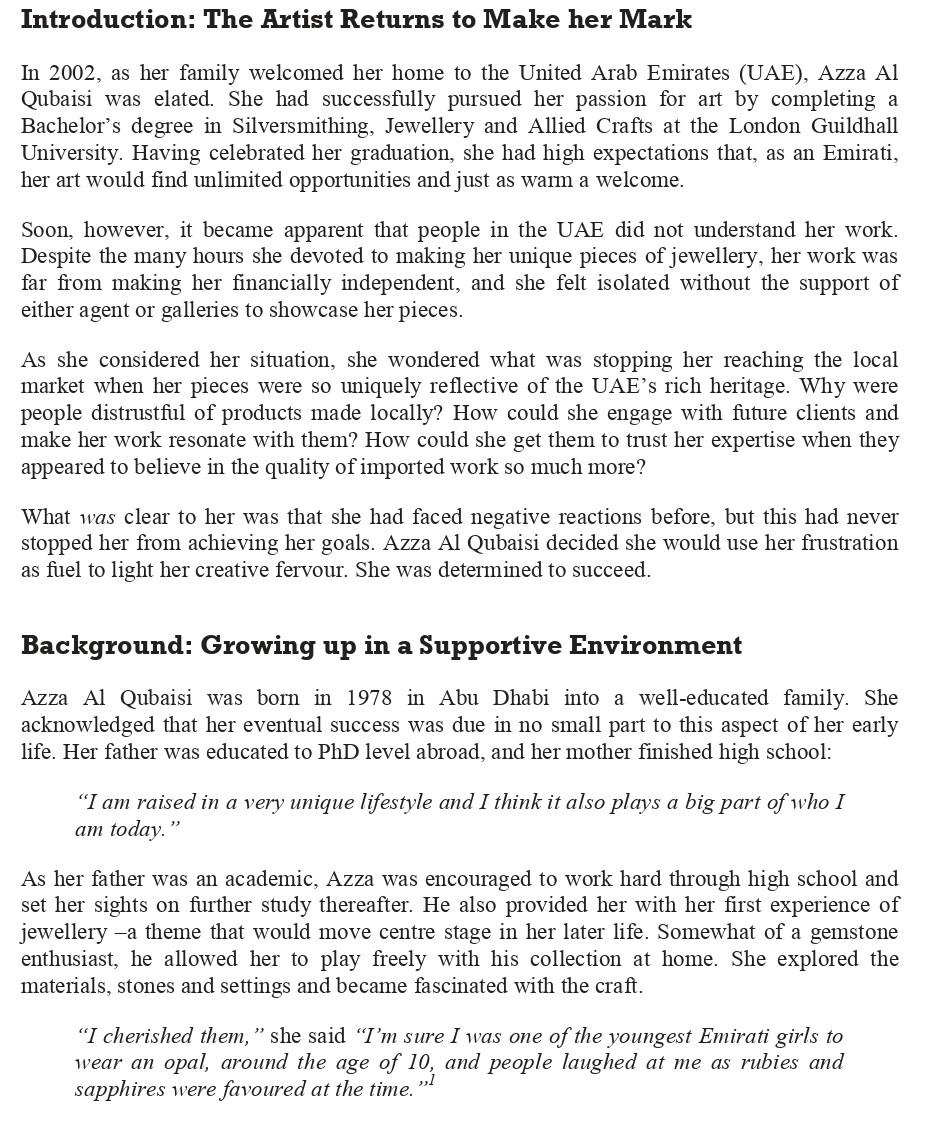
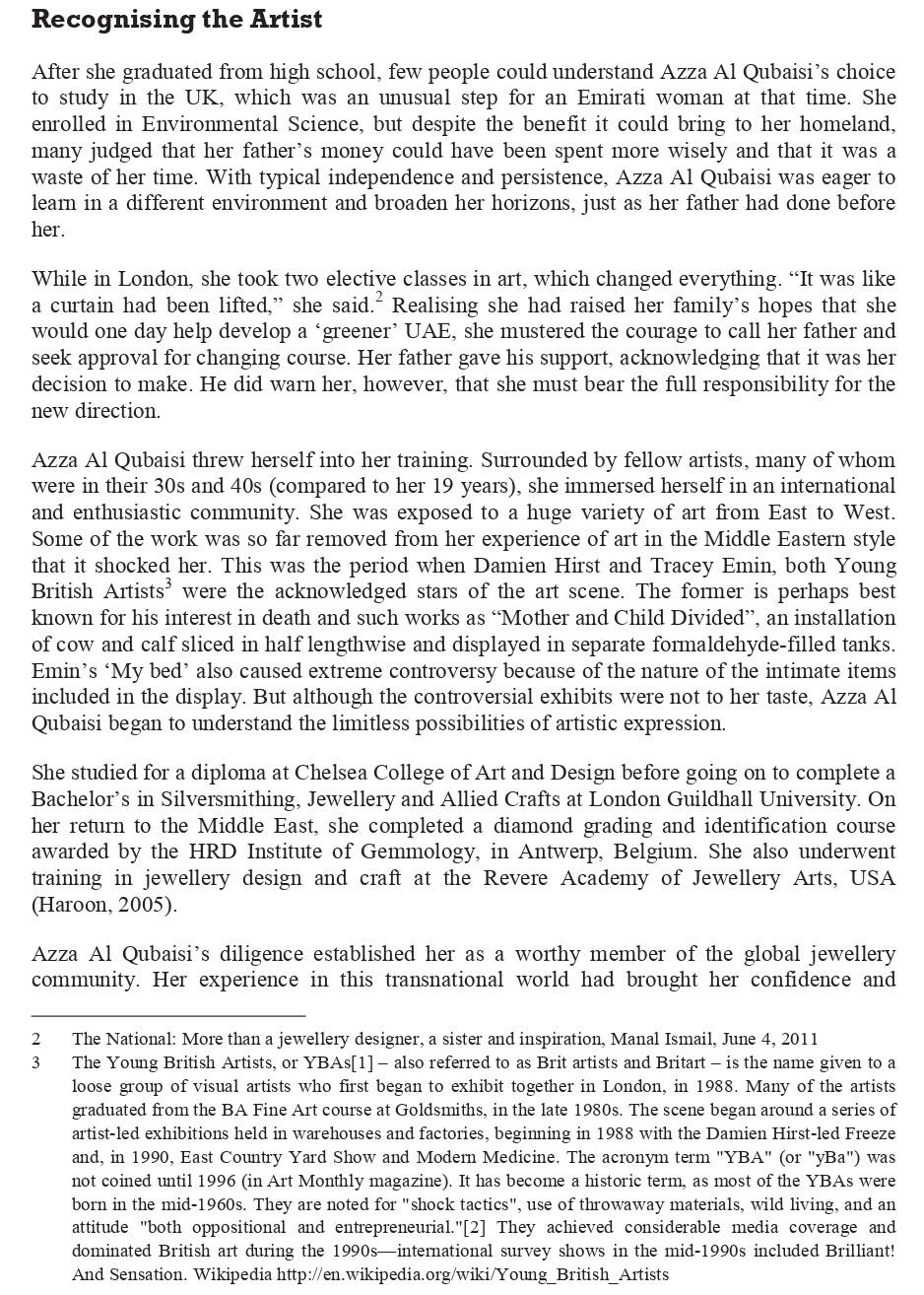
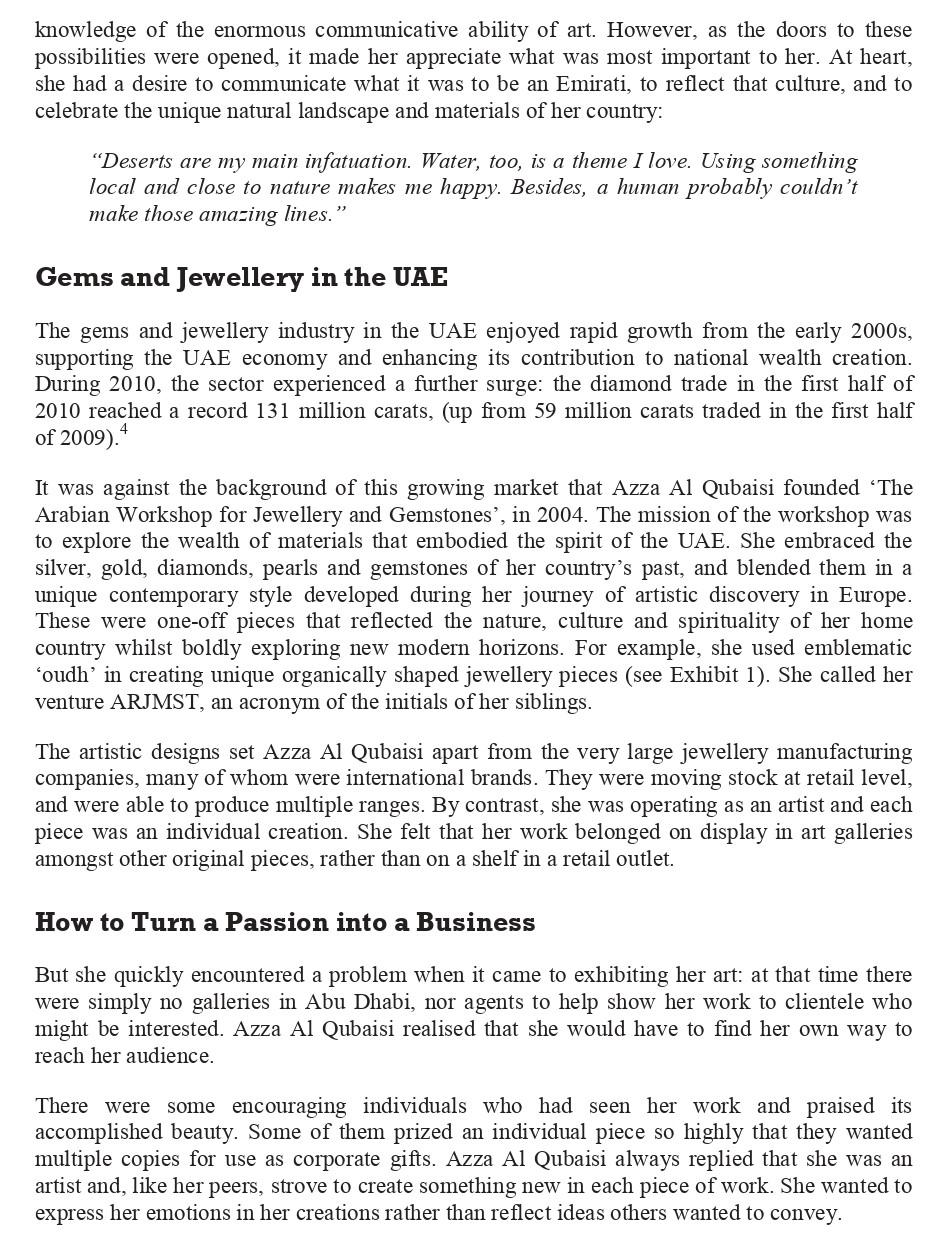
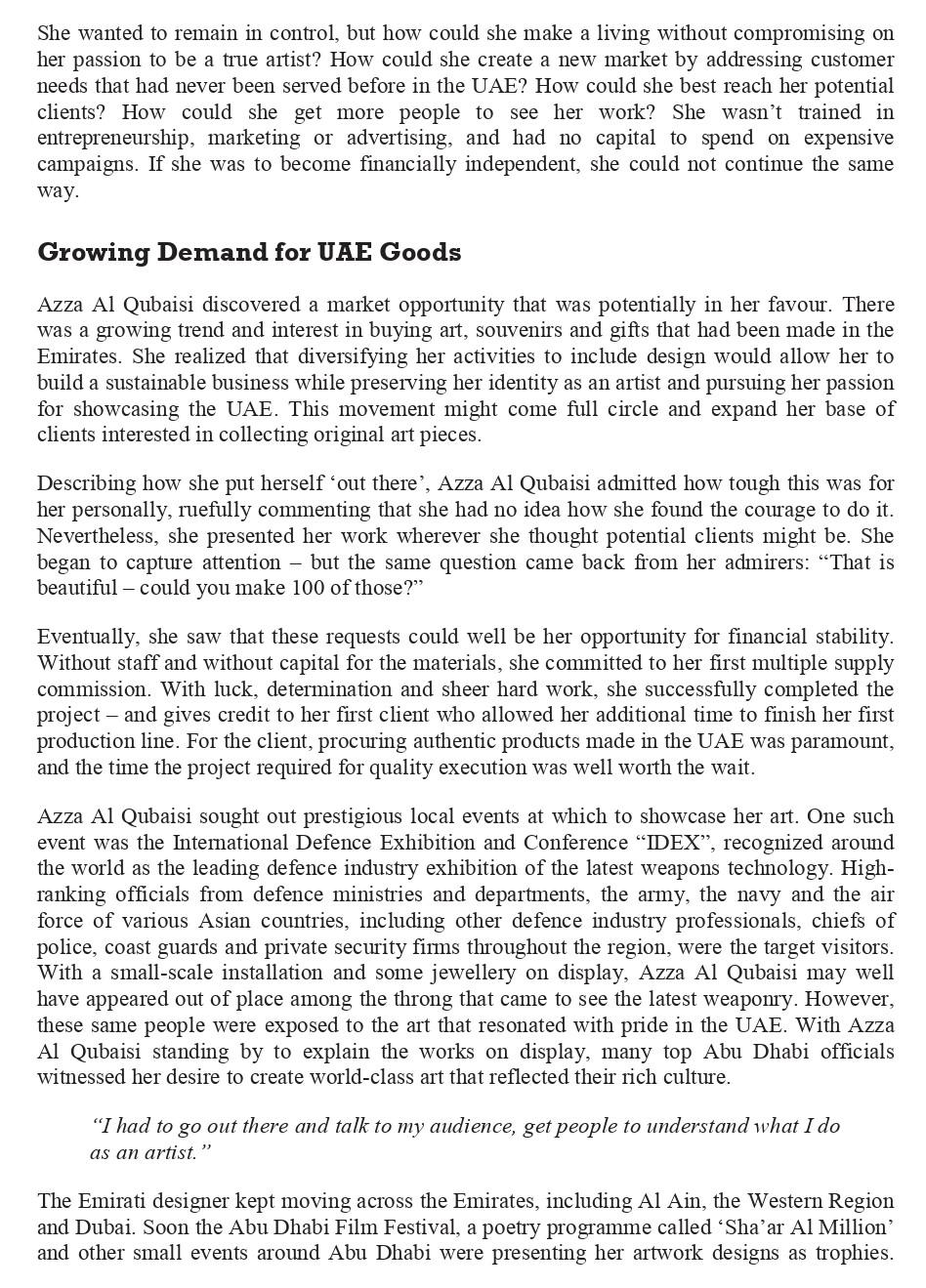
Introduction: The Artist Returns to Make her Mark In 2002, as her family welcomed her home to the United Arab Emirates (UAE), Azza Al Qubaisi was elated. She had successfully pursued her passion for art by completing a Bachelor's degree in Silversmithing, Jewellery and Allied Crafts at the London Guildhall University. Having celebrated her graduation, she had high expectations that, as an Emirati, her art would find unlimited opportunities and just as warm a welcome. Soon, however, it became apparent that people in the UAE did not understand her work. Despite the many hours she devoted to making her unique pieces of jewellery, her work was far from making her financially independent, and she felt isolated without the support of either agent or galleries to showcase her pieces. As she considered her situation, she wondered what was stopping her reaching the local market when her pieces were so uniquely reflective of the UAE's rich heritage. Why were people distrustful of products made locally? How could she engage with future clients and make her work resonate with them? How could she get them to trust her expertise when they appeared to believe in the quality of imported work so much more? What was clear to her was that she had faced negative reactions before, but this had never stopped her from achieving her goals. Azza Al Qubaisi decided she would use her frustration as fuel to light her creative fervour. She was determined to succeed. Background: Growing up in a Supportive Environment Azza Al Qubaisi was born in 1978 in Abu Dhabi into a well-educated family. She acknowledged that her eventual success was due in no small part to this aspect of her early life. Her father was educated to PhD level abroad, and her mother finished high school: "I am raised in a very unique lifestyle and I think it also plays a big part of who I am today. "" As her father was an academic, Azza was encouraged to work hard through high school and set her sights on further study thereafter. He also provided her with her first experience of jewellery -a theme that would move centre stage in her later life. Somewhat of a gemstone enthusiast, he allowed her to play freely with his collection at home. She explored the materials, stones and settings and became fascinated with the craft. "I cherished them," she said "I'm sure I was one of the youngest Emirati girls to wear an opal, around the age of 10, and people laughed at me as rubies and sapphires were favoured at the time. Recognising the Artist After she graduated from high school, few people could understand Azza Al Qubaisi's choice to study in the UK, which was an unusual step for an Emirati woman at that time. She enrolled in Environmental Science, but despite the benefit it could bring to her homeland, many judged that her father's money could have been spent more wisely and that it was a waste of her time. With typical independence and persistence, Azza Al Qubaisi was eager to learn in a different environment and broaden her horizons, just as her father had done before her. While in London, she took two elective classes in art, which changed everything. "It was like a curtain had been lifted," she said. Realising she had raised her family's hopes that she would one day help develop a 'greener' UAE, she mustered the courage to call her father and seek approval for changing course. Her father gave his support, acknowledging that it was her decision to make. He did warn her, however, that she must bear the full responsibility for the new direction. Azza Al Qubaisi threw herself into her training. Surrounded by fellow artists, many of whom were in their 30s and 40s (compared to her 19 years), she immersed herself in an international and enthusiastic community. She was exposed to a huge variety of art from East to West. Some of the work was so far removed from her experience of art in the Middle Eastern style that it shocked her. This was the period when Damien Hirst and Tracey Emin, both Young British Artists were the acknowledged stars of the art scene. The former is perhaps best known for his interest in death and such works as "Mother and Child Divided", an installation of cow and calf sliced in half lengthwise and displayed in separate formaldehyde-filled tanks. Emin's 'My bed' also caused extreme controversy because of the nature of the intimate items included in the display. But although the controversial exhibits were not to her taste, Azza Al Qubaisi began to understand the limitless possibilities of artistic expression. She studied for a diploma at Chelsea College of Art and Design before going on to complete a Bachelor's in Silversmithing, Jewellery and Allied Crafts at London Guildhall University. On her return to the Middle East, she completed a diamond grading and identification course awarded by the HRD Institute of Gemmology, in Antwerp, Belgium. She also underwent training in jewellery design and craft at the Revere Academy of Jewellery Arts, USA (Haroon, 2005). Azza Al Qubaisi's diligence established her as a worthy member of the global jewellery community. Her experience in this transnational world had brought her confidence and 2 3 The National: More than a jewellery designer, a sister and inspiration, Manal Ismail, June 4, 2011 The Young British Artists, or YBAS[1] - also referred to as Brit artists and Britart - is the name given to a loose group of visual artists who first began to exhibit together in London, in 1988. Many of the artists graduated from the BA Fine Art course at Goldsmiths, in the late 1980s. The scene began around a series of artist-led exhibitions held in warehouses and factories, beginning in 1988 with the Damien Hirst-led Freeze and, in 1990, East Country Yard Show and Modern Medicine. The acronym term "YBA" (or "yBa") was not coined until 1996 (in Art Monthly magazine). It has become a historic term, as most of the YBAs were born in the mid-1960s. They are noted for "shock tactics", use of throwaway materials, wild living, and an attitude "both oppositional and entrepreneurial."[2] They achieved considerable media coverage and dominated British art during the 1990s-international survey shows in the mid-1990s included Brilliant! And Sensation. Wikipedia http://en.wikipedia.org/wiki/Young_British_Artists knowledge of the enormous communicative ability of art. However, as the doors to these possibilities were opened, it made her appreciate what was most important to her. At heart, she had a desire to communicate what it was to be an Emirati, to reflect that culture, and to celebrate the unique natural landscape and materials of her country: "Deserts are my main infatuation. Water, too, is a theme I love. Using something local and close to nature makes me happy. Besides, a human probably couldn't make those amazing lines." Gems and Jewellery in the UAE The gems and jewellery industry in the UAE enjoyed rapid growth from the early 2000s, supporting the UAE economy and enhancing its contribution to national wealth creation. During 2010, the sector experienced a further surge: the diamond trade in the first half of 2010 reached a record 131 million carats, (up from 59 million carats traded in the first half of 2009).4 It was against the background of this growing market that Azza Al Qubaisi founded 'The Arabian Workshop for Jewellery and Gemstones', in 2004. The mission of the workshop was to explore the wealth of materials that embodied the spirit of the UAE. She embraced the silver, gold, diamonds, pearls and gemstones of her country's past, and blended them in a unique contemporary style developed during her journey of artistic discovery in Europe. These were one-off pieces that reflected the nature, culture and spirituality of her home country whilst boldly exploring new modern horizons. For example, she used emblematic 'oudh' in creating unique organically shaped jewellery pieces (see Exhibit 1). She called her venture ARJMST, an acronym of the initials of her siblings. The artistic designs set Azza Al Qubaisi apart from the very large jewellery manufacturing companies, many of whom were international brands. They were moving stock at retail level, and were able to produce multiple ranges. By contrast, she was operating as an artist and each piece was an individual creation. She felt that her work belonged on display in art galleries amongst other original pieces, rather than on a shelf in a retail outlet. How to Turn a Passion into a Business But she quickly encountered a problem when it came to exhibiting her art: at that time there were simply no galleries in Abu Dhabi, nor agents to help show her work to clientele who might be interested. Azza Al Qubaisi realised that she would have to find her own way to reach her audience. There were some encouraging individuals who had seen her work and praised its accomplished beauty. Some of them prized an individual piece so highly that they wanted multiple copies for use as corporate gifts. Azza Al Qubaisi always replied that she was an artist and, like her peers, strove to create something new in each piece of work. She wanted to express her emotions in her creations rather than reflect ideas others wanted to convey. She wanted to remain in control, but how could she make a living without compromising on her passion to be a true artist? How could she create a new market by addressing customer needs that had never been served before in the UAE? How could she best reach her potential clients? How could she get more people to see her work? She wasn't trained in entrepreneurship, marketing or advertising, and had no capital to spend on expensive campaigns. If she was to become financially independent, she could not continue the same way. Growing Demand for UAE Goods Azza Al Qubaisi discovered a market opportunity that was potentially in her favour. There was a growing trend and interest in buying art, souvenirs and gifts that had been made in the Emirates. She realized that diversifying her activities to include design would allow her to build a sustainable business while preserving her identity as an artist and pursuing her passion for showcasing the UAE. This movement might come full circle and expand her base of clients interested in collecting original art pieces. Describing how she put herself 'out there', Azza Al Qubaisi admitted how tough this was for her personally, ruefully commenting that she had no idea how she found the courage to do it. Nevertheless, she presented her work wherever she thought potential clients might be. She began to capture attention - but the same question came back from her admirers: "That is beautiful - could you make 100 of those?" Eventually, she saw that these requests could well be her opportunity for financial stability. Without staff and without capital for the materials, she committed to her first multiple supply commission. With luck, determination and sheer hard work, she successfully completed the project and gives credit to her first client who allowed her additional time to finish her first production line. For the client, procuring authentic products made in the UAE was paramount, and the time the project required for quality execution was well worth the wait. Azza Al Qubaisi sought out prestigious local events at which to showcase her art. One such event was the International Defence Exhibition and Conference "IDEX", recognized around the world as the leading defence industry exhibition of the latest weapons technology. High- ranking officials from defence ministries and departments, the army, the navy and the air force of various Asian countries, including other defence industry professionals, chiefs of police, coast guards and private security firms throughout the region, were the target visitors. With a small-scale installation and some jewellery on display, Azza Al Qubaisi may well have appeared out of place among the throng that came to see the latest weaponry. However, these same people were exposed to the art that resonated with pride in the UAE. With Azza Al Qubaisi standing by to explain the works on display, many top Abu Dhabi officials witnessed her desire to create world-class art that reflected their rich culture. "I had to go out there and talk to my audience, get people to understand what I do as an artist. "3 The Emirati designer kept moving across the Emirates, including Al Ain, the Western Region and Dubai. Soon the Abu Dhabi Film Festival, a poetry programme called 'Sha'ar Al Million' and other small events around Abu Dhabi were presenting her artwork designs as trophies. Other government entities and private companies began proudly handing out corporate gifts made by Azza Al Qubaisi's workshop too. Internationally, Azza Al Qubaisi travelled to showcase her collections. The Emirati sense of tradition in her work drew attention to her creations in Finland, London and Malaysia - she effectively became the "artistic ambassador" of the UAE. As a designer rather than an artist she had found a way to make her business financially viable. By bringing her artistic talent and London experience to the table, and combining that with her passion for her country, she had found a way to create a new market for herself and pass on her heritage. Consult, Communicate, Keep Learning As to the fears she had of being told what to create by her clients, Azza Al Qubaisi began to frame the issue differently. In her thinking she kept "Azza the artist" separate from "Azza the designer." After all, clients were approaching 'Azza the designer' because they admired her work as 'Azza the artist'. In her role as a reputable designer she had to create something for her customers that had her imprint, but met their needs. Finding out about these needs was often tricky. Many of her clients had no artistic ability themselves and did not know much about art. As a result, they lacked the language to express exactly what it was they wanted. Often, Azza Al Qubaisi found that simply interpreting her first impression of what they were looking for did not produce the desired result, and she became ever more adept at listening. She would research her clients thoroughly beforehand, and then ask very specific questions until she understood exactly what they envisioned. The care she took with each customer contributed to the excellent reputation that she was gathering by word of mouth. Azza Al Qubaisi had made her dreams come true: she had followed her passion as a uniquely Emirati artist. While promoting her culture and heritage, she had grown a successful business around that passion. Musing on her success, she felt keenly aware that as an artist, designer and entrepreneur she was indebted to the support from her local community. Deep in her heart she felt the desire to reciprocate to others in her home country and asked herself: How could her fellow Emiratis best benefit from her experience and how could she support the art and artists that shared her love of their communal culture? Social Entrepreneur - Cultural Legitimacy With her own funds, she started a number of outlets called 'Made in the UAE', where gifted local artists could display their own work. She also wanted people to have experience that mirrored her own exposure to international art. The not-for-profit venture therefore also acted as home to a cultural exchange programme by showcasing handicrafts from different parts of the world. In 2007, she opened the jewellery exhibition space "Voice Gallery" in Dubai, the first of its kind in the region. So motivated was she to grow and show local talent, Azza Al Qubaisi also established a project in the Western Region called 'Lamset Ibdaa" or "A Touch of Creativity". Here she brought together women from many backgrounds, from fresh graduates in jewellery design to amazingly talented housewives', and provided them with the resources they needed to develop their design and business skills. The vision was to found a community that could expand the expression of the UAE culture and heritage and build a bridge between all Emirati designers locally and internationally. Azza Al Qubaisi explained her motivation: "If I continue without really supporting the establishment of upcoming designers I would always be left alone, no matter how many workshops I do out there and how many people I train. If I don't really take the hands of those designers and put t them on board with me, they will not be able to make it. "I want them to work together, to support each other, and to get to establish a new Emirati designer network. I see them as supporters not competitors. This generosity of spirit did not go unnoticed. She won two Emirates Woman awards - one for her community contribution and also as the overall winner for business achievements in 2011. She was also named most successful 'UAE Young Design Entrepreneur in Fashion and Design' in August of the same year. Azza Al Qubaisi was aware that there was an international audience for her work and that by communicating its message she could better reflect her country to the world. She established a website that displayed her collections. Beside each one she mentioned how parts of the Emirates history gave her inspiration for the collections (see Exhibit1). Azza's Advice for Aspiring Entrepreneurs in the UAE Part of the impulse that lead to the setup of "Lamst Ibdaa" was that Azza Al Qubaisi wanted to assist her fellow entrepreneurs in honing their skills. Every entrepreneur needs support of many kinds to launch their ideas. Azza Al Qubaisi had the unswerving support of her parents, who gave her the capital to obtain her precious tools and set up her workshop. Her father also supported her for the first two years. She elaborated: "My closest friends are my parents and I am lucky. Without Dad, I wouldn't have been able to buy the different tools that I loved, and the things I needed and to finance my workshop." Later, in the development phase of her business, she also acknowledged the very real aid and encouragement her husband brought to both her and her company. "My husband is working with me in my business so he has certain responsibilities and I do too. So it's sharing, learning how to share and give certain responsibilities to different people, and making time for both my 'small' family and 'bigger' family". As an artist starting out, Azza Al Qubaisi's early entrepreneurial phase required her to rapidly acquire business skills. She had to administer, manage and deal with financial and budgetary matters. Her father as an academic did not have business skills himself. There were so many simple, basic questions that she wanted to ask, but felt she could not for fear of being underestimated by others in the business field. Back in 2002, when she started on her own, there was very little help available for local entrepreneurs. For example, the Khalifa Fund was not established until 2007. Azza Al Qubaisi hopes that more young nationals will follow in her footsteps and make use of their creative talents in future. "I am very happy to inspire as many people as possible, especially UAE nationals and Arabs from the region. " In addition, she was enthusiastic to share what she had learnt in setting up her business so that the next generation of entrepreneurs could bypass some of the struggles she had experienced. "Try to develop your business to be simpler rather than more complicated, and that is something we can do on paper before we do the physical." Generally, entrepreneurs need to make strategic plans and business plans in order to avoid risk and to ensure success. Therefore start-ups should - "question what they have in mind over and over, write it down, write a business plan, ask friends, nobody steals ideas today because the deep soul of an idea is always with the creator. Try to find trusted enough friends to share your questions." It is important for an entrepreneur to test their concept. In the 21st century, it is easy to establish a website to elucidate the mission and strategy of the company and gauge what price potential customers might be prepared to pay for the product. She emphasized how useful a web-based network can be in supporting company growth. "I think most of the businesses today, they are product oriented and start from a website. They can be checked out and tested in the market before they are in full production. She strongly recommended that all entrepreneurs think out of the box and strive to create a meaningful part in society with innovative business ideas. Travelling, too, can be extremely valuable in observing innovation elsewhere. These ideas can then be tailored and enhanced to suit the culture and identity within the local context. Azza encouraged those that follow in her footsteps: "There is always an answer to each issue and problem to reach where you want to be. Yes, today you can satisfy your parent's wishes on your education - but you can do more and further your education in ways that is more about what you want as well. Those things should be taken into consideration. Don't go out there and say I want to be the next Azza - I will break rules to become like her.' That's not the way I did it. I did it with the full support of my parentsStep by Step Solution
There are 3 Steps involved in it
1 Expert Approved Answer
Step: 1 Unlock

Question Has Been Solved by an Expert!
Get step-by-step solutions from verified subject matter experts
Step: 2 Unlock
Step: 3 Unlock
 Study Help