







Question: . Required Question: Question: Which strategies do you recommend for Carls restaurant in order to achieve sustainable competitive advantage in local and international markets? Justify
.
Required Question:
Question: Which strategies do you recommend for Carls restaurant in order to achieve sustainable competitive advantage in local and international markets? Justify and
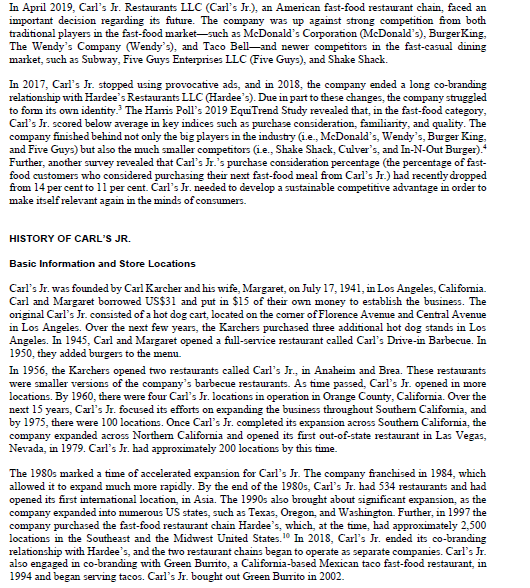
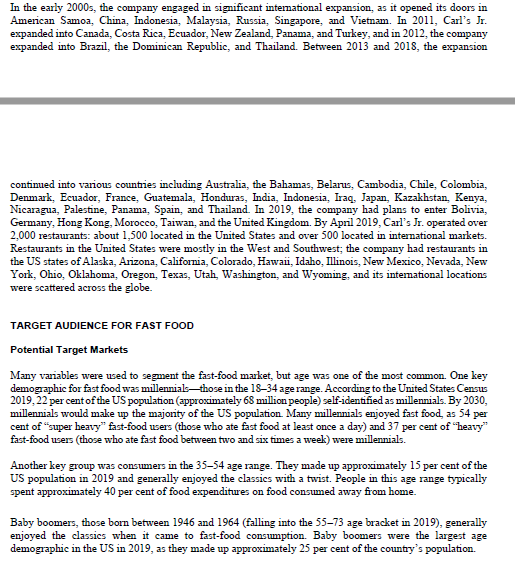
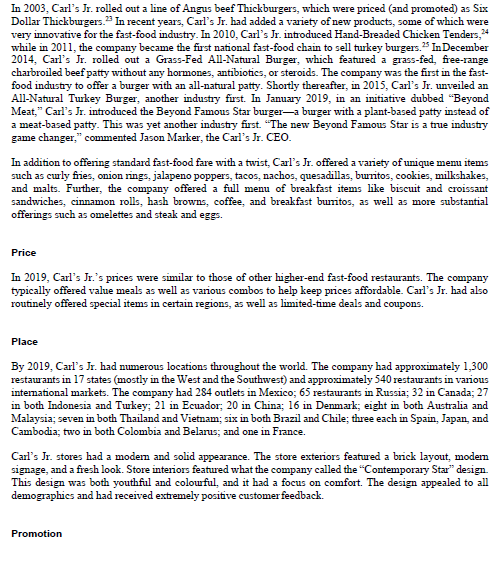
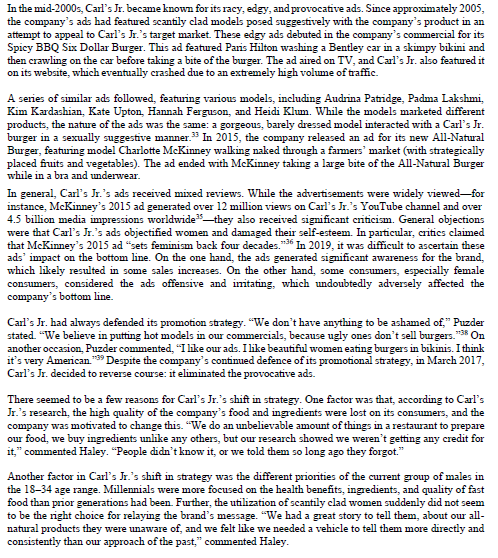
In April 2019, Carl's Jr. Restaurants LLC (Carl's Jr.), an American fast-food restaurant chain, faced an important decision regarding its future. The company was up against strong competition from both traditional players in the fast-food marketsuch as McDonald's Corporation (McDonald's), Burger King, The Wendy's Company (Wendy's), and Taco Belland newer competitors in the fast-casual dining market, such as Subway, Five Guys Enterprises LLC (Five Guys), and Shake Shack. In 2017, Carl's Jr. stopped using provocative ads, and in 2018, the company ended a long co-branding relationship with Hardee's Restaurants LLC (Hardee's). Due in part to these changes, the company struggled to form its own identity. The Hanis Poll's 2019 EqwTrend Study revealed that in the fast-food category, Carl's Jr. scored below average in key indices such as purchase consideration, familiarity, and quality. The company finished behind not only the big players in the industry (i.e., McDonald's, Wendy's, Burger King, and Five Guys) but also the much smaller competitors (ie., Shake Shack, Culver's, and In-N-Out Burger). Futher, another survey revealed that Carl's Jr.'s purchase consideration percentage (the percentage of fast- food customers who considered purchasing their next fast-food meal from Carl's Jr.) had recently dropped from 14 per cent to ll per cent. Carl's Jr. needed to develop a sustainable competitive advantage in order to make itself relevant again in the minds of consumers. HISTORY OF CARL'S JR. Basic Information and Store Locations Carl's Jr. was founded by Carl Karcher and his wife, Margaret, on July 17, 1941, in Los Angeles, California. Carl and Margaret borrowed US$31 and put in $15 of their own money to establish the business. The original Carl's Ir. consisted of a hot dog cart , located on the comer of Florence Avenue and Central Avenue in Los Angeles. Over the next few years, the Karchers purchased three additional hot dog stands in Los Angeles. In 1945, Carl and Margaret opened a full-service restaurant called Carl's Drive-in Barbecue. In 1950, they added burgers to the menu. In 1956, the Karchers opened two restaurants called Carl's Jr., in Anaheim and Brea. These restaurants were smaller versions of the company's barbecue restaurants. As time passed, Carl's Jr. opened in more locations. By 1960, there were four Carl's Jr. locations in operation in Orange County, California. Over the next 15 years, Carl's Jr. focused its efforts on expanding the business throughout Southem California, and by 1975, there were 100 locations. Once Carl's Jr. completed its expansion across Southern California, the company expanded across Northem California and opened its first out-of-state restaurant in Las Vegas, Nevada, in 1979. Carl's Jr. had approximately 200 locations by this time. The 1980s marked a time of accelerated expansion for Carl's Jr. The company franchised in 1984, which allowed it to expand much more rapidly. By the end of the 1980s, Carl's Jr. had 534 restaurants and had opened its first international location in Asia. The 1990s also brought about simificant expansion, as the company expanded into numerous US states, such as Texas, Oregon and Washington. Further, in 1997 the company purchased the fast-food restaurant chain Hardee's, which at the time, had approximately 2,500 locations in the Southeast and the Midwest United States. In 2018, Carl's Jr. ended its co-branding relationship with Hardee's, and the two restaurant chains began to operate as separate companies. Carl's Jr. also engaged in co-branding with Green Burrito, a California-based Mexican taco fast-food restaurant, in 1994 and began serving tacos. Carl's Jr. bought out Green Burrito in 2002. In the early 2000s, the company engaged in significant interational expansion, as it opened its doors in American Samoa, China, Indonesia, Malaysia, Russia, Singapore, and Vietnam. In 2011, Carl's Jr. expanded into Canada, Costa Rica, Ecuador, New Zealand, Panama, and Turkey, and in 2012, the company expanded into Brazil, the Dominican Republic, and Thailand. Between 2013 and 2018, the expansion continued into various countries including Australia, the Bahamas, Belarus, Cambodia, Chile, Colombia, Denmark, Ecuador, France, Guatemala, Honduras, India, Indonesia, Iraq, Japan, Kazakhstan Kenya, Nicaragua, Palestine Panama, Spain, and Thailand. In 2019, the company had plans to enter Bolivia, Germany, Hong Kong, Morocco, Taiwan, and the United Kingdom. By April 2019, Carl's Jr. operated over 2.000 restaurants: about 1,500 located in the United States and over 500 located in international markets. Restaurants in the United States were mostly in the West and Southwest: the company had restaurants in the US states of Alaska, Arizona, California, Colorado, Hawai, Idaho, Illinois, New Mexico, Nevada, New York, Ohio Oklahoma Oregon, Texas, Utah, Washington, and Wyoming, and its international locations were scattered across the globe. TARGET AUDIENCE FOR FAST FOOD Potential Target Markets Many variables were used to segment the fast-food market, but age was one of the most common. One key demographic for fast food was millennialthose in the 18-34 age range. According to the United States Census 2019,22 per cent of the US population (approximately 68 million people) self-identified as millennials. By 2030, millennials would make up the majority of the US population. Many millennials enjoyed fast food, as 54 per cent of "super heavy" fast-food users (those who ate fast food at least once a day) and 37 per cent of "heavy" fast-food users (those who ate fast food between two and six times a week) were millennials. Another key group was consumers in the 35-54 age range. They made up approximately 15 per cent of the US population in 2019 and generally enjoyed the classics with a twist. People in this age range typically spent approximately 40 per cent of food expenditures on food consumed away from home. Baby boomers, those born between 1946 and 1964 (falling into the 55-73 age bracket in 2019), generally enjoyed the classics when it came to fast-food consumption. Baby boomers were the largest age demographic in the US in 2019, as they made up approximately 25 per cent of the country's population. In 2003, Carl's Jr. rolled out a line of Angus beef Thickburgers, which were priced and promoted) as Six Dollar Thickburgers. In recent years, Carl's Jr. had added a variety of new products, some of which were very innovative for the fast-food industry. In 2010, Carl's Jr. introduced Hand-Breaded Chicken Tenders, 24 while in 2011, the company became the first national fast-food chain to sell turkey burgers. In December 2014. Carl's Jr. rolled out a Grass-Fed All-Natural Burger, which featured a grass-fed, free-range charbroiled beef patty without any hormones, antibiotics, or steroids. The company was the first in the fast- food industry to offer a burger with an all-natural patty. Shortly thereafter, in 2015, Carl's Jr. unveiled an All-Natural Turkey Burger, another industry first. In January 2019, in an initiative dubbed "Beyond Meat," Carl's Jr. introduced the Beyond Famous Star burgera burger with a plant-based patty instead of a meat-based patty. This was yet another industry first. The new Beyond Famous Star is a true industry game changer," commented Jason Marker, the Carl's Jr. CEO. In addition to offering standard fast-food fare with a twist, Carl's Jr. offered a variety of unique menu items such as cwly firies, onion rings, jalapeno poppers, tacos, nachos, quesadillas, burritos, cookies, milkshakes, and malts. Further, the company offered a full menu of breakfast items like biscuit and croissant sandwiches, cinnamon rolls, hash browns, coffee, and breakfast burritos, as well as more substantial offerings such as omelettes and steak and eggs. Price In 2019, Carl's Jr.'s prices were similar to those of other higher-end fast-food restaurants. The company typically offered value meals as well as various combos to help keep prices affordable. Carl's Jr. had also routinely offered special items in certain regions, as well as limited-time deals and coupons. Place By 2019. Carl's Jr. had numerous locations throughout the world. The company had approximately 1,300 restaurants in 17 states (mostly in the West and the Southwest) and approximately 540 restaurants in various international markets. The company had 284 outlets in Mexico; 65 restaurants in Russia; 32 in Canada; 27 in both Indonesia and Twkey: 21 in Ecuador, 20 in China: 16 in Denmark, eight in both Australia and Malaysia; seven in both Thailand and Vietnam; six in both Brazil and Chile; three each in Spain, Japan, and Cambodia; two in both Colombia and Belarus; and one in France. Carl's Jr. stores had a modem and solid appearance. The store exteriors featured a brick layout, modern signage, and a fresh look. Store interiors featured what the company called the "Contemporary Star" design This design was both youthful and colowful, and it had a focus on comfort. The design appealed to all demographics and had received extremely positive customer feedback. Promotion In the mid-2000s, Carl's Jr. became known for its racy, edgy, and provocative ads. Since approximately 2005, the company's ads had featured scantily clad models posed suggestively with the company's product in an attempt to appeal to Carl's Jr.'s target market. These edgy ads debuted in the company's commercial for its Spicy BBQ Six Dollar Burger. This ad featured Paris Hilton washing a Bentley car in a skimpy bikini and then crawling on the car before taking a bite of the burger. The ad aired on TV, and Carl's Jr. also featured it on its website, which eventually crashed due to an extremely high volume of traffic. A series of similar ads followed, featuring various models, including Audrina Patridge, Padma Lakshmi, Kim Kardashian, Kate Upton, Hannah Ferguson, and Heidi Klum. While the models marketed different products, the nature of the ads was the same: a gorgeous, barely dressed model interacted with a Carl's Jr. burger in a sexually suggestive manner." In 2015, the company released an ad for its new All-Natural Burger, featuring model Charlotte McKinney walking naked through a farmers' market (with strategically placed fruits and vegetables). The ad ended with McKinney taking a large bite of the All-Natural Burger while in a bra and underwear. In general, Carl's Jr.'s ads received mixed reviews. While the advertisements were widely viewedfor instance, McKinney's 2015 ad generated over 12 million views on Carl's Jr.'s YouTube channel and over 4.5 billion media impressions worldwidesthey also received significant criticism. General objections were that Carl's Jr.'s ads objectified women and damaged their self-esteem. In particular, critics claimed that McKinney's 2015 ad "sets feminism back four decades. 136 In 2019, it was difficult to ascertain these ads' impact on the bottom line. On the one hand, the ads generated significant awareness for the brand, which likely resulted in some sales increases. On the other hand, some consumers, especially female consumers, considered the ads offensive and initating, which undoubtedly adversely affected the company's bottom line. Carl's Jr. had always defended its promotion strategy. "We don't have anything to be ashamed of," Puzder stated. We believe in putting hot models in our commercials, because ugly ones don't sell burgers. On another occasion, Puzder commented, "I like our ads. I like beautiful women eating burgers in bikinis. I think it's very American "Despite the company's continued defence of its promotional strategy, in March 2017, Carl's Jr. decided to reverse course: it eliminated the provocative ads. There seemed to be a few reasons for Carl's Jr.'s shift in strategy. One factor was that, according to Carl's Jr.'s research, the high quality of the company's food and ingredients were lost on its consumers, and the company was motivated to change this. "We do an unbelievable amount of things in a restaurant to prepare our food, we buy ingredients unlike any others, but our research showed we weren't getting any credit for it," commented Haley. "People didn't know it, or we told them so long ago they forgot." Another factor in Carl's Jr.'s shift in strategy was the different priorities of the curent group of males in the 18-34 age range. Millennials were more focused on the health benefits, ingredients, and quality of fast food than prior generations had been Fwther, the utilization of scantily clad women suddenly did not seem to be the night choice for relaying the brand's message. We had a great story to tell them about our all- natural products they were unaware of, and we felt like we needed a vehicle to tell them more directly and consistently than our approach of the past," commented Haley. 3R Although the company denied it, the social movement toward a more positive image of women could have also affected the company's shift in strategy. A number of big brands like Dove, Always, Microsoft Corporation, and GoDaddy Inc. had embraced female-empowering messages. Carl's Jr.'s approach in this curent climate would likely be subject to greater criticism than in the past, and the effect of such an approach would likely be weaker, as provocative images of women were easily found online. According to Puzder, "young, hungry guys aren't as affected by the racy ads with the swimsuit models because you can get a lot of that on the internet now. It's not like it was 10, 12 years ago when we stated this *** The company may have privately decided that the costs of this approach outweighed the benefits. To reverse course, the company ran an ad that featured a fictional character, Carl Hardee Sr. In the ad, Carl Sr. had retuned to the office to take the reins from his son, Carl Hardee Jr., who was responsible for the provocative ads of the past. Carl Sr. then announced that when [he] started this company, it was about one thing: pioneering a new way to food, caring food, cut-no-corners food for you to eat with your mouth." This seemingly suggested that the company was retuning to its roots, with a greater focus on the products In 2018, this ad was followed up with the "Call of Carl's" campaign, which featured close-up shots of its products with a voice-over from Academy Award winner Matthew McConaughey. These new campaigns were run under the company's new slogan: "Pioneers of the Great American Burger ** Along with traditional promotion, Carl's Jr. also engaged its audience through social media. The company was active on Facebook, Twitter, and YouTube. Carl's Jr. used social media to interact with its customers in a digital space, further communicate its message, and develop online promotional campaigns. RELATIONSHIP WITH HARDEE'S Carl's Jr. and Hardee's began as separate chains. Hardee's was founded by Wilbur Hardee in North Carolina in 1961 and eventually expanded throughout the Midwest and the South * Over the years, Hardee opened restawrants in smaller towns that major fast-food chains such as McDonald's and Burger King had ignored As a result, Hardee's was popular with older, hard-working, blue-collar customers. Overall, the company's location strategy was successful; by the mid-1990s. Hardee's was the country's number-four fast-food chain, with approximately 2,500 locations scattered throughout the Midwest and the South During the same time period, Carl's Jr. expanded its operations throughout California and in nearby states in the Southwest In 1997, Carl's Jr. bought out Hardee's for $327 million. The merger gave each company instant access to geographic areas that they had not previously expanded into. At the time of the merger, Hardee's had approximately 3,100 locations worldwide (2,500 in the United States), while Carl's Jr. had approximately 700 locations, most of which were in California. The merger was expected to help Carl's Jr. in the breakfast category and to help Hardee's with its lunch and dinner menus. 2 Carl's Jr. believed that the merger with Hardee's would help it compete with major fast-food chains like McDonald's, Burger King, and Wendy's. Throughout the merger, the two fast-food chains kept their distinct names and their distinct personalities. However, the same red-and-yellow colour scheme, the same mascotan anthropomorphic star called "Happy Star"the same store design, and the same signage were used in both chains. This created the impression that the two companies were the same, except for the name. In time, this became true. However, in the early days of the merger, there were some distinct differences in terms of both the products offered and the marketing strategies utilized. Initially, Carl's Jr. and Hardee's operated separate menus, but over time each chain adopted the other's memu items, until both chains offered almost identical memus. The same thing happened with respect to marketing strategies: initially, the two companies had separate marketing programs, but over time the two chains adopted Carl's Jr.'s edgy advertising approach. In early 2018, parent company CKE Restaurants announced that the two chains would be managed as separate entities. The decision was the result of extensive market research that revealed Carl's Jr. and Hardee's to be separate brands with distinct personalities and very different types of customers. Jeff Jenkins, chief marketing officer at CKE Restaurants, commented that Carl's Jr.'s customers listen to EDM (electronic dance music], they're into esports and gaming, they're into soccer. They are coming to Carl's Jr. in the aftemoon, and in the evenings they're going out to the movies or going to a club. Then you look at the Hardee's customer, and they're talking about college sports, fishing, country music, and NASCAR, and they come in the moming a lot. A lot of times that trip in the morning is a pre-outdoor activity, whether it be going to their favorite fishing spot or going on a hunting trip. Consistent with this description, CKE Restaurants reported that, while breakfast made up 47 per cent of Hardee's business, it made up only 17 per cent of Carl's Jr.'s business. Marker noted that the two chains had very different personalities and thus benefitted from being operated separately: "Carl's Jr. is West Coast cool, bold, aggressive, impossible to ignore, famous for very disruptive advertising strategies. Hardee's is far more authentic and proud. We refer to it as down-home food done night." Marker also commented that the chains "have distinct customers. They grew up very differently. Their customers love them for who they are." The separation of the two chains was expected to help each brand experience significantly greater growth. Marker noted that "these are two iconic, regional brands, and they have the opportunity to become more relevant and more contemporary There's this huge amount of brand loyalty and enlightened brand equity in regional brands." Jenkins stated that "We'll see completely different menus and completely different assets. We want to stand out [so] when you're driving down the road (we] capture your attention to tell you what we stand for. And I think by separating the brands that allows us to really tap into the culinary trends that are going on regionally." Early returns on the separation were positive. Research showed that, since the two companies became separate entities, brand lovewhich was romantic in nature and generally referred to the emotional and passionate relationship that a consumer had with a particular brandincreased by 10 per cent for Carl's Jr. and by more than 20 per cent for Hardee's. Brand love was captured through fan interaction on social media as well as through customer ratings of overall approval of the brand. "Those are truly amazing numbers. After a successful campaign, you are lucky if you see a 5% spike," commented Jenkins. EMERGING TRENDS IN THE FAST-FOOD INDUSTRY The fast-food industry had experienced many changes and trends throughout its history, and in 2019, a number of new trends emerged One was an expected increased reliance on foreign cuisines, such as Korean Filipino, and Iranian. You have flavors and ingredients from Africa, from the Middle East that have been progressively gaining importance, but we think that will really pop up this year [2019). Filipino food is another example of that," commented Daniel Boutarel, a managing associate at the New England Consulting Group. Another trend was the utilization of plant-based ingredients, such as cauliflower, broccoli, avocado, guacamole, and yucca. I've been seeing a ton of root vegetables, and that is on the heels of the hero ingredient of yucca]." noted Liz Moskow, the culinary director of Sterling-Rice Group. Fries were expected to be increasingly featured in the fast-food industry, perhaps with a different twist than before (eg. Taco Bell's nacho fiies). Companies were expected to start topping firies with a variety of new and interesting toppings, such as melted cheese, bacon, or pork. This was expected to drive Instagram photos. Growth of the drinks category was also expected. In paticular, cold drinks were expected to be increasingly featured. For instance, McDonald's had introduced the McCaf Cold Brew Coffee, while Dunkin' Donuts had introduced an Energy Cold Brew drink. Further, coffee cherry tea and various sweet, creamy drinks were also significantly more popular than before. Extras, in terms of sauces, sprinkles, or small add-ons, were expected to be on the rise in order to add intrigue to fast-food offerings. These could be anything from a balsamic honey glaze or an overly spicy 'I dare you to try this' addition," commented Moskow. Fast-food outlets and chains were expected to continue to close, as labour costs were high Futher, costs associated with making technological and/or operational improvements were also high. "Restaurants will be] closing underperforming stores and opening up better optimized stores for what consumers are looking for," noted RJ. Hottovy, senior restaurant analyst for Momningstar Research Inc." High labour costs were also expected to help drive increased use of self-serve kiosks in restaurants as well as tablet use at restaurant tables. This was expected to result in customers ordering food and drinks without interacting with employees, thus reducing labour costs. Further, kiosks and tablets were expected to yield other benefits: as Boutarel commented The other nice thing with the tablets and kiosks is that based on the time of day and day of the week, the restaurant would be able to hypothetically alter their prices or push specific messages or push specific menu items. That allows for a lot more messaging activity from the restaurant as well as a lot more information and customization opportunities from the guest perspective. Increased reliance on technology was expected to continue, with robots continuing their influx into the workforce. For instance, Spyce Kitchen, a restaurant in Boston, had more robots than human employees to prepare foods like salad and grain bowls. The labor market is tight and people in the fast foods are really suffering, so we're going to start to see them employing technology in the making of the food and the supply chain that's going to really make it a sustainable business going forward." commented Moskow. Delivery was also expected to continue to grow. Third-party delivery from companies such as Uber Eats and GrubHub Inc. was expected to become increasingly essential for fast-food companies. However, alternatives such as direct delivery through public hot spots were also expected to emerge. Distinctions among fast causal, fast food, and fine-dining restawants were expected to blur, as they had increasingly competed with each other. Chef-driven concepts and celebrity chefs were expected to enter the fast-casual industry, and coffee shops were expected to innovate around food services. This was likely to contribute to the continued blurring of the fast-casual, fast-food, and fine-dining industries. "It's going to be more like fine casual. I think that's where it's moving," noted Moskow. NEXT STEPS Carl's Jr. was an American fast-food restaurant that faced significant competition from both traditional fast- food companies like McDonald's, Wendy's, and Burger King and newer fast-casual restaurants like Subway, Five Guys, and Shake Shack. In the midst of its separation from Hardee's and its transition away from provocative advertisements, Carl's Jr. struggled to establish its own identity, and as a result, the company scored below average among fast-food chains on key indices such as quality and purchase consideration. Marker needed to develop a sustainable competitive advantage to help the company turn its fortunes around
Step by Step Solution
There are 3 Steps involved in it
1 Expert Approved Answer
Step: 1 Unlock

Question Has Been Solved by an Expert!
Get step-by-step solutions from verified subject matter experts
Step: 2 Unlock
Step: 3 Unlock
 Study Help