







Question: Requirement one I have completed. The answer is D. However, I need help with requirement 2. Gavin's Glassworks makes glass flanges for scientific use. Materials
Requirement one I have completed. The answer is D. However, I need help with requirement 2.
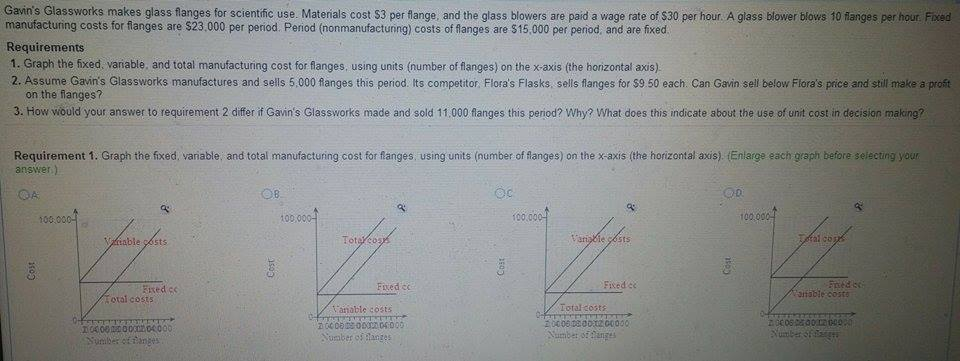

Gavin's Glassworks makes glass flanges for scientific use. Materials cost $3 per flange, and the glass blowers are paid a wage rate of $30 per hour. A glass blower blows 10 flanges per hour. Fixed manufacturing costs for flanges are $23,000 per period. Period (nonmanufacturing) costs of flanges are $15,000 per period, and are fixed. Requirements Graph the fixed, variable, and total manufacturing cost for flanges, using units (number of flanges) on the x-axis (the horizontal axis). Assume Gavin's Glassworks manufacturers and sells 5,000 flanges this period. Its competitor, Flora's Flasks, sells flanges for $9, 50 each. Can Gavin sell below Flora's price and still make a profit on the flanges? How would your answer to requirement 2 differ if Gavin's Glasswork made and sold 11,000 flanges this period? Why? What does this indicate about the use of unit cost in decision making? Requirement 1. Graph the fixed variable, and total manufacturing cost for flanges using units (number of flanges) on the x-axis (the horizontal axis). (Enlarge each graph selecting your answer.) Requirement 2. Assume Gavin's Glassworks manufacturers and sells 5,000 flanges this period. Its competitor, Flora's Flasks, sells flanges for $9.50 each. Can Gavin sell below Flora's price and still make a profit on the flanges? Begin by determining the formula used to calculate the total cost per unit. = Total cost per unit
Step by Step Solution
There are 3 Steps involved in it

Get step-by-step solutions from verified subject matter experts
 Study Help