







Question: Requirements mi i Prepare a direct material usage budget in both units and dollars. Calculate the budgeted overhead allocation rates for weaving and dyeing. Calculate
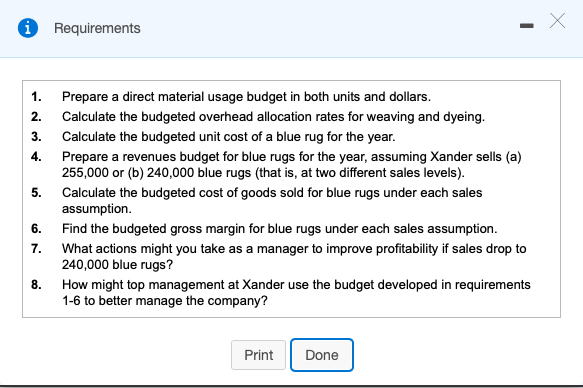
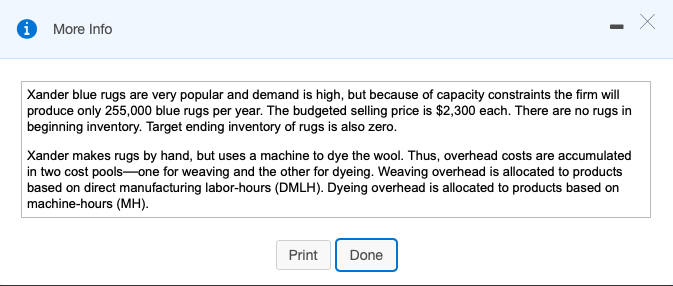
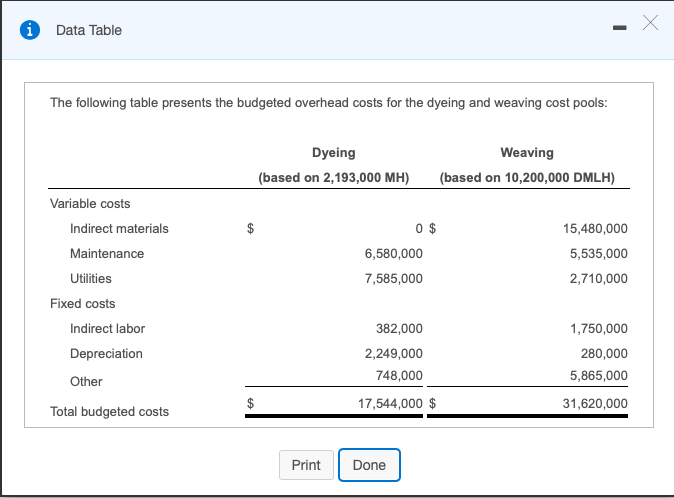
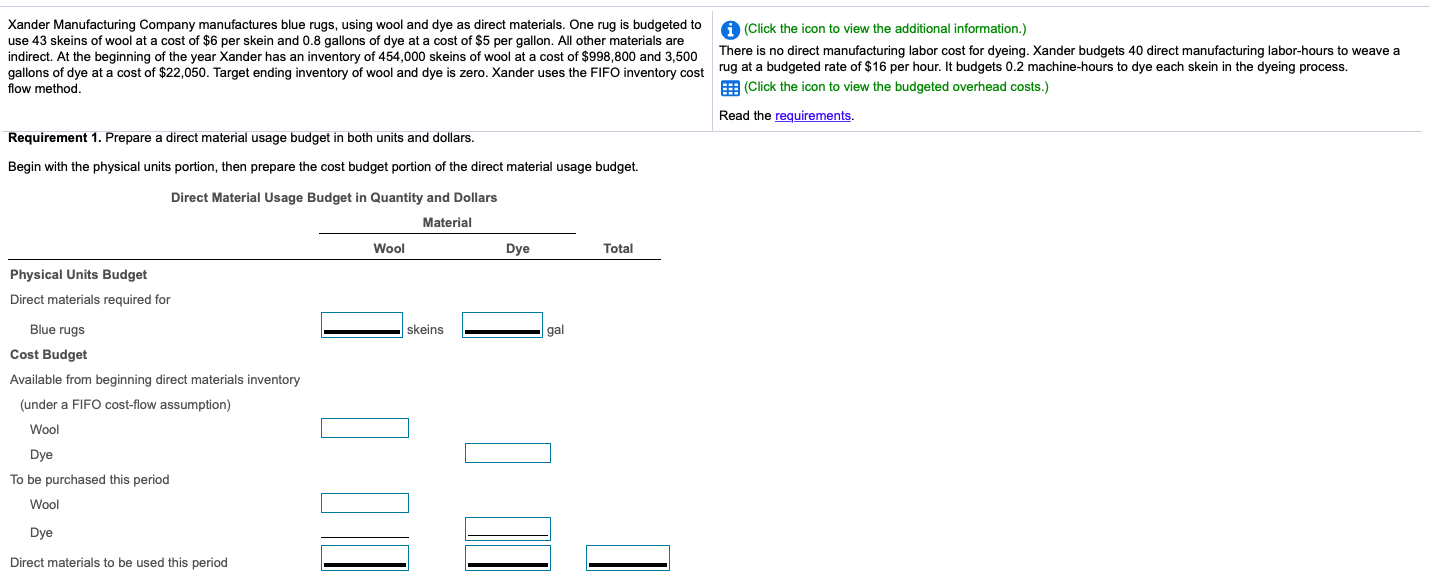
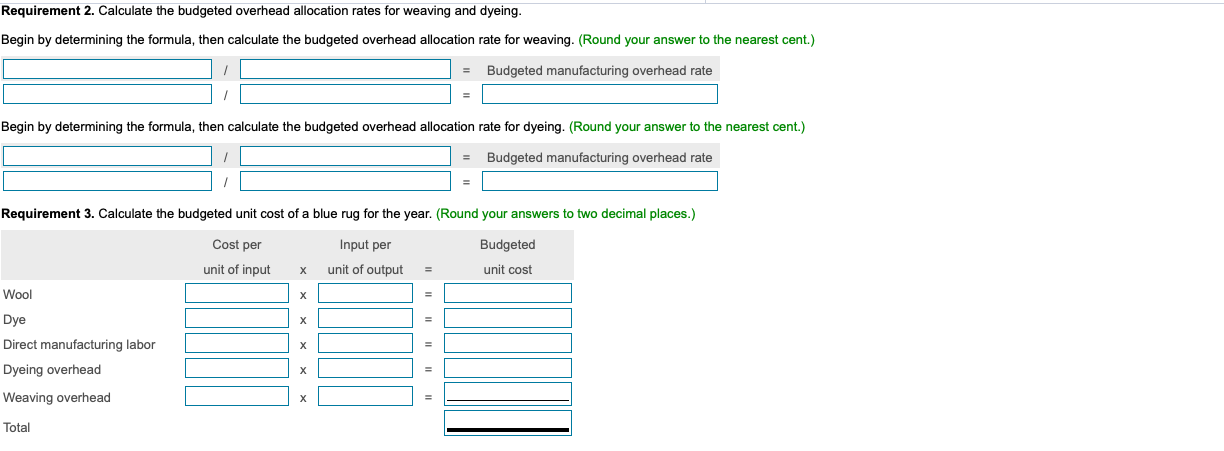
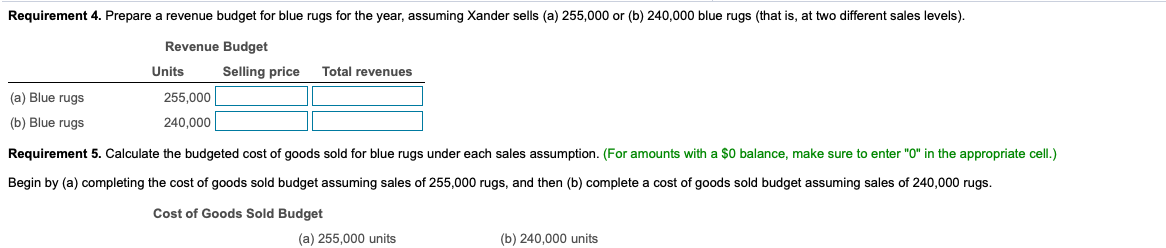
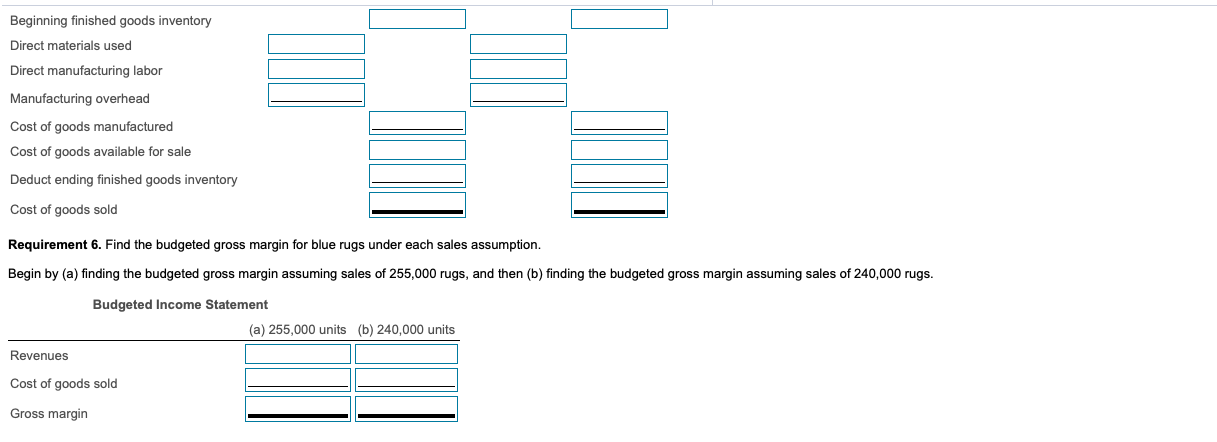

Requirements mi i Prepare a direct material usage budget in both units and dollars. Calculate the budgeted overhead allocation rates for weaving and dyeing. Calculate the budgeted unit cost of a blue rug for the year. Prepare a revenues budget for blue rugs for the year, assuming Xander sells (a) 255,000 or (b) 240,000 blue rugs (that is, at two different sales levels). Calculate the budgeted cost of goods sold for blue rugs under each sales assumption. Find the budgeted gross margin for blue rugs under each sales assumption. What actions might you take as a manager to improve profitability if sales drop to 240,000 blue rugs? How might top management at Xander use the budget developed in requirements 1-6 to better manage the company? Print Done A More Info Xander blue rugs are very popular and demand is high, but because of capacity constraints the firm will produce only 255,000 blue rugs per year. The budgeted selling price is $2,300 each. There are no rugs in beginning inventory. Target ending inventory of rugs is also zero. Xander makes rugs by hand, but uses a machine to dye the wool. Thus, overhead costs are accumulated in two cost pools-one for weaving and the other for dyeing. Weaving overhead is allocated to products based on direct manufacturing labor-hours (DMLH). Dyeing overhead is allocated to products based on machine-hours (MH). Print Done i Data Table The following table presents the budgeted overhead costs for the dyeing and weaving cost pools: Dyeing (based on 2,193,000 MH) Weaving (based on 10,200,000 DMLH) Variable costs Indirect materials Maintenance 0 $ 6,580,000 7,585,000 15,480,000 5,535,000 2,710,000 Utilities Fixed costs Indirect labor Depreciation 382,000 2,249,000 748,000 1,750,000 280,000 5,865,000 31,620,000 Other 17,544,000 $ Total budgeted costs Print Done Xander Manufacturing Company manufactures blue rugs, using wool and dye as direct materials. One rug is budgeted to use 43 skeins of wool at a cost of $6 per skein and 0.8 gallons of dye at a cost of $5 per gallon. All other materials are indirect. At the beginning of the year Xander has an inventory of 454,000 skeins of wool at a cost of $998,800 and 3,500 gallons of dye at a cost of $22,050. Target ending inventory of wool and dye is zero. Xander uses the FIFO inventory cost flow method. There is no direct manufacturing labor cost for dyeing. Xander budgets 40 direct manufacturing labor-hours to weave a rug at a budgeted rate of $16 per hour. It budgets 0.2 machine-hours to dye each skein in the dyeing process. (Click the icon to view the budgeted overhead costs.) Read the requirements. Requirement 1. Prepare a direct material usage budget in both units and dollars. Begin with the physical units portion, then prepare the cost budget portion of the direct material usage budget. Dye Total Direct Material Usage Budget in Quantity and Dollars Material Wool Physical Units Budget Direct materials required for Blue rugs skeins Cost Budget Available from beginning direct materials inventory (under a FIFO cost-flow assumption) Wool Dye To be purchased this period Wool Dye Direct materials to be used this period Requirement 2. Calculate the budgeted overhead allocation rates for weaving and dyeing. Begin by determining the formula, then calculate the budgeted overhead allocation rate for weaving. (Round your answer to the nearest cent.) = Budgeted manufacturing overhead rate Begin by determining the formula, then calculate the budgeted overhead allocation rate for dyeing. (Round your answer to the nearest cent.) = Budgeted manufacturing overhead rate Requirement 3. Calculate the budgeted unit cost of a blue rug for the year. (Round your answers to two decimal places.) Budgeted Cost per unit of input Input per unit of output X = unit cost Wool Dye Direct manufacturing labor Dyeing overhead Weaving overhead Total Requirement 4. Prepare a revenue budget for blue rugs for the year, assuming Xander sells (a) 255,000 or (b) 240,000 blue rugs (that is, at two different sales levels). Total revenues Revenue Budget Units Selling price 255,000 240,000 (a) Blue rugs (b) Blue rugs Requirement 5. Calculate the budgeted cost of goods sold for blue rugs under each sales assumption. (For amounts with a $0 balance, make sure to enter "0" in the appropriate cell.) Begin by (a) completing the cost of goods sold budget assuming sales of 255,000 rugs, and then (b) complete a cost of goods sold budget assuming sales of 240,000 rugs. Cost of Goods Sold Budget (a) 255,000 units (b) 240,000 units Beginning finished goods inventory Direct materials used Direct manufacturing labor Manufacturing overhead Cost of goods manufactured Cost of goods available for sale Deduct ending finished goods inventory Cost of goods sold Requirement 6. Find the budgeted gross margin for blue rugs under each sales assumption. Begin by (a) finding the budgeted gross margin assuming sales of 255,000 rugs, and then (b) finding the budgeted gross margin assuming sales of 240,000 rugs. Budgeted Income Statement (a) 255,000 units (b) 240,000 units Revenues Cost of goods sold Gross margin Requirement 7. What actions might you take as a manager to improve profitability if sales drop to 240,000 blue rugs? If sales drop to 240,000 blue rugs, Xander should look to V fixed costs and produce to reduce variable costs and inventory costs. Requirement 8. How might top management at Xander use the budget developed in requirements 1-6 to better manage the company? (Select all that apply.)
Step by Step Solution
There are 3 Steps involved in it

Get step-by-step solutions from verified subject matter experts
 Study Help